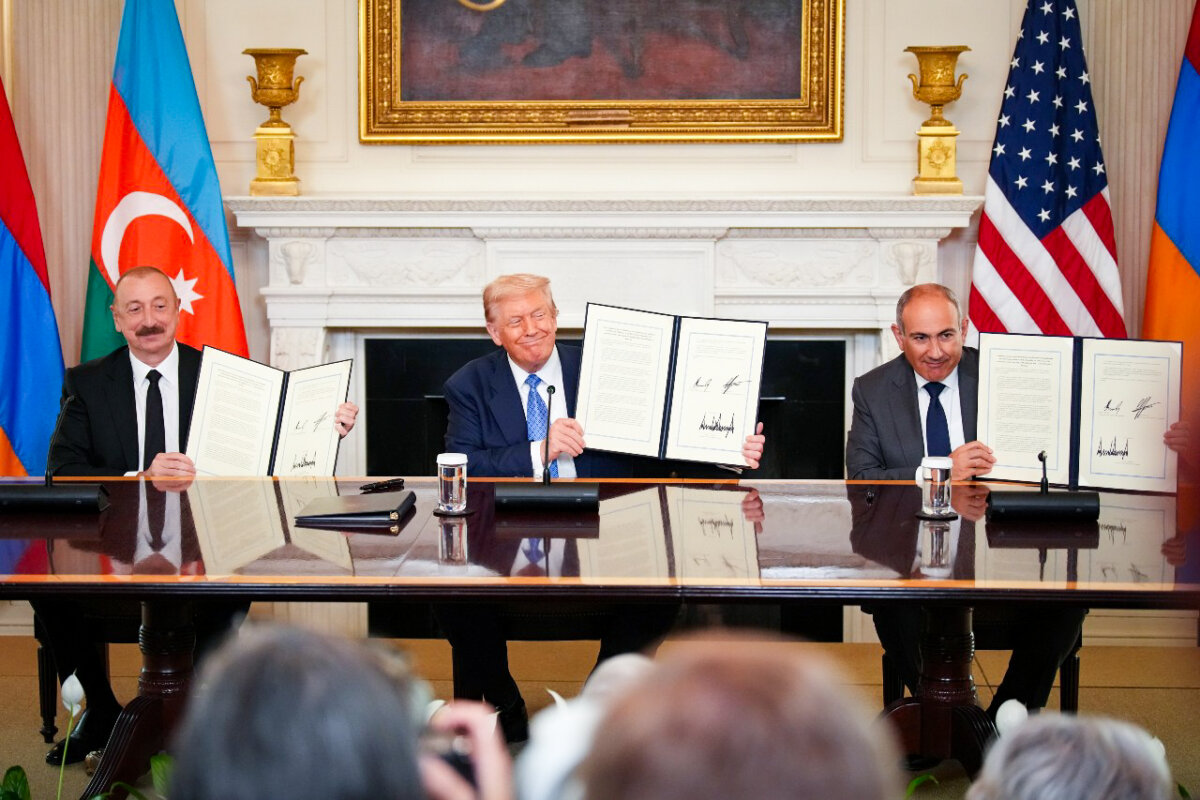

Armenia and Azerbaijan on Aug. 8 signed a U.S.-backed joint declaration aimed at ending decades of conflict between the two South Caucasus nations.
Hosted by U.S. President Donald Trump at the White House, Armenian Prime Minister Nikol Pashinyan and Azerbaijani President Ilham Aliyev also signed a second agreement paving the way for a U.S.-developed regional transit corridor.
To be called the “Trump Route for International Peace and Prosperity” (TRIPP), the land corridor will link Azerbaijan to its Nakhchivan exclave, which is separated from the mainland by Armenia and shares a border with Turkey.
According to geopolitical analyst Ana Maria Evans, the planned route “has the potential to induce significant geopolitical, economic, and security changes in the region and beyond.”
“An efficient trade route between Azerbaijan and Armenia has the potential to give both countries a front-seat role in global supply chains,” Evans, professor at the Catholic University of Portugal, told The Epoch Times.
Mamuka Tsereteli, senior fellow at the Central Asia-Caucasus Institute at the American Foreign Policy Council, said the TRIPP would likely create long-term opportunities “for free and open connectivity between Greater Central Asia and Europe and the Mediterranean through the South Caucasus.”
Addressing reporters at the signing ceremony, Trump described the planned corridor as “a special transit area that will allow Azerbaijan to get full access to its territory of Nakhchivan while fully respecting Armenia’s sovereignty.”
“[Armenia is] also creating an exclusive partnership with the United States to develop this corridor, which could extend for up to 99 years,” he said.
“We anticipate significant infrastructure development by American companies. They’re very anxious to go into these two countries.”
Shortly before the agreements were signed, a senior White House official told reporters that a consortium would likely be tasked with handling the TRIPP’s infrastructure and management.
Tsereteli told The Epoch Times that the corridor deal was a framework, so “many details still need to be worked out.”
Nevertheless, he described the U.S. role in the transit plan as a “geopolitical breakthrough” that would establish a “long-term U.S. presence in the region.”
“U.S. participation in the project still needs to be clarified,” he said.
Stimulating Trade
The idea of a land corridor linking Azerbaijan to its Nakhchivan exclave via Armenia has been raised intermittently over the past five years.
It was first proposed by Azerbaijan and Turkey, which calls it the “Zangezur Corridor,” after a 2020 war between Armenia and Azerbaijan in which the latter, with Turkish support, recaptured the flashpoint region of Nagorno-Karabakh.
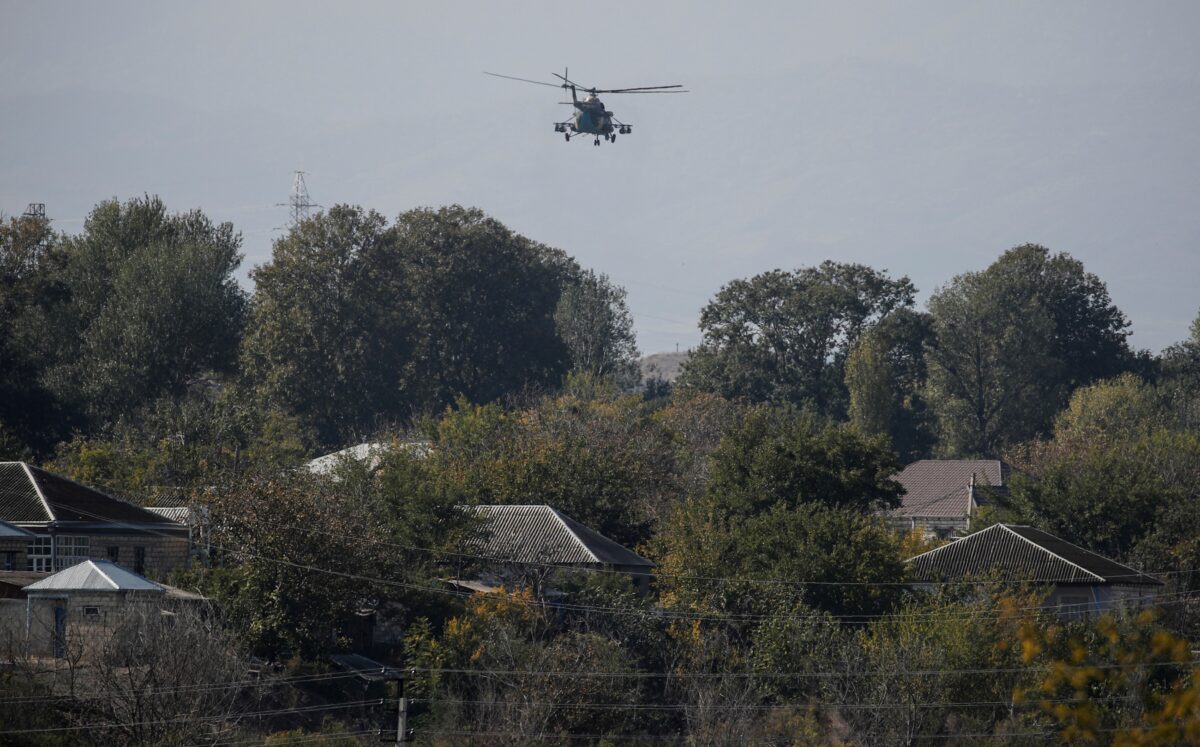
Turkey, which shares a short but significant border with Nakhchivan, views the envisaged route as a means of projecting its influence eastward by creating a land bridge to Azerbaijan, its long-standing ally, and on to the Caspian Sea.
According to Tsereteli, the U.S.-backed transit plan, despite historical rivalries, “will remove artificial barriers for trade and transit between Azerbaijan and Armenia, as well as between Turkey and Armenia.”
“[It will also provide] multiple options for transportation: from the Caspian via Azerbaijan to Armenia, crossing Nakhchivan and then to Turkey, or, via Azerbaijan and Georgia, to Turkey or Black Sea ports of Georgia,” he said.
According to Tsereteli, the TRIPP will afford a huge economic benefit to Azerbaijan by “allowing access to the Nakhchivan exclave directly, in the most cost-effective way, boosting internal economic development.”
“[Turkey] will become an even greater magnet for trade and economic development for the South Caucasus, including for Armenia, boosting Armenia’s growth prospects,” he said.
What’s more, Tsereteli told The Epoch Times, Armenia is receiving security guarantees for its territorial integrity with the U.S. commercial presence on Armenian territory.
Evans agreed that the planned corridor would “stimulate economic integration” between Armenia and Azerbaijan after decades of mutual hostility.
As for the TRIPP’s wider regional implications, Evans said that a “stable transit operation with streamlined regulatory and customs procedures … will also raise the transport capacity of the Middle Corridor, thereby reducing transit times and costs between China and Europe.”
The Trans-Caspian International Transport Route, less formally known as the Middle Corridor, is a multimodal East–West transit route stretching from China’s Port of Lianyungang to Eastern Europe.
Roughly 3,000 miles in length, the Middle Corridor runs through Kazakhstan, the Caspian Sea, and the South Caucasus region via Azerbaijan, Georgia, and Turkey.
Beijing views the Middle Corridor as part of its wider Belt and Road Initiative, which seeks to enhance East–West trade connectivity and project Chinese influence into Central Asia and the South Caucasus.
Outflanking Adversaries
According to the White House, the TRIPP will allow goods to move through the Caucasus region and Central Asia without transiting through Russia, Iran, or China.
“The losers here are China, Russia, and Iran,” a senior White House official told reporters before the agreements were signed.
“The winners here are the West. What this will do for American businesses, and for energy resources across Europe, will be enormously powerful.”
Evans agreed that China, Russia, and Iran “may not be pleased with a U.S. presence and leasing rights on the planned corridor, which is set to become a critical node in the East–West supply chain.”
“U.S. investment in the corridor’s transport infrastructure will contribute to supply-chain diversification, reducing overdependence on Russia and China,” she said.
“China, for example, will likely see its investment in Georgia’s Black Sea Anaklia Port [part of the Middle Corridor] capturing a lower share of trade than originally forecast.”
Evans described the TRIPP plan as an “unexpected and welcome reversal of China’s trade and diplomacy strategy of transport-logistics dominance via the [Belt and Road Initiative].”
“U.S. investment [in the transit route] represents an innovative foreign-policy action that will counterbalance China’s and Russia’s leverage on global supply logistics,” she said.
Evans said that although it will take time, once it becomes operational, “the new route will also further decrease transport volumes along the sanctioned Northern Corridor and bring a U.S. presence to Iran’s doorstep.”
Another transit route linking China to Europe, the Northern Corridor, runs through Russia and neighboring Belarus.
Since Moscow launched its invasion of eastern Ukraine in 2022, the West has imposed numerous sanctions on Russia aimed at discouraging trade along the Northern Corridor.
If realized, the TRIPP would traverse southern Armenia just north of the Iranian border, also potentially threatening Russia’s North–South trade link with Iran.
On July 27, Ali Akbar Velayati, an adviser to Iran’s Supreme Leader Ali Khamenei, said the U.S.-developed transit route would sever Iran’s link with the Caucasus region and “impose a land blockade on Iran and Russia in the region’s south.”
Tsereteli said he views the assertion as an “emotional reaction.”
“Iran, although weakened due to its ideological and geopolitical choices, still will be an actor in the region going forward,” he said.
“[Iran–Russia trade] primarily relies on established corridors through the Caspian Sea, as well as through Azerbaijan via the International North–South Transport Corridor.”
Still under development, the North–South Transport Corridor is another multimodal trade corridor, which, once completed, will link Northern Europe and Central Russia—through Azerbaijan—to maritime ports on the Indian Ocean.
On Aug. 9, a Russian Foreign Ministry spokeswoman said that reconciliation between Armenia and Azerbaijan should be based on “unconditional respect for the priorities of the parties and neighboring states.”
“The involvement of non-regional players should work to strengthen the peace agenda and not create additional difficulties and dividing lines,” she said in remarks cited by Russia’s TASS news agency.
 Friends Read Free
Copy
Facebook
Tweet
Friends Read Free
Copy
Facebook
Tweet