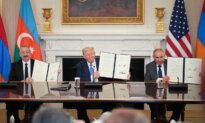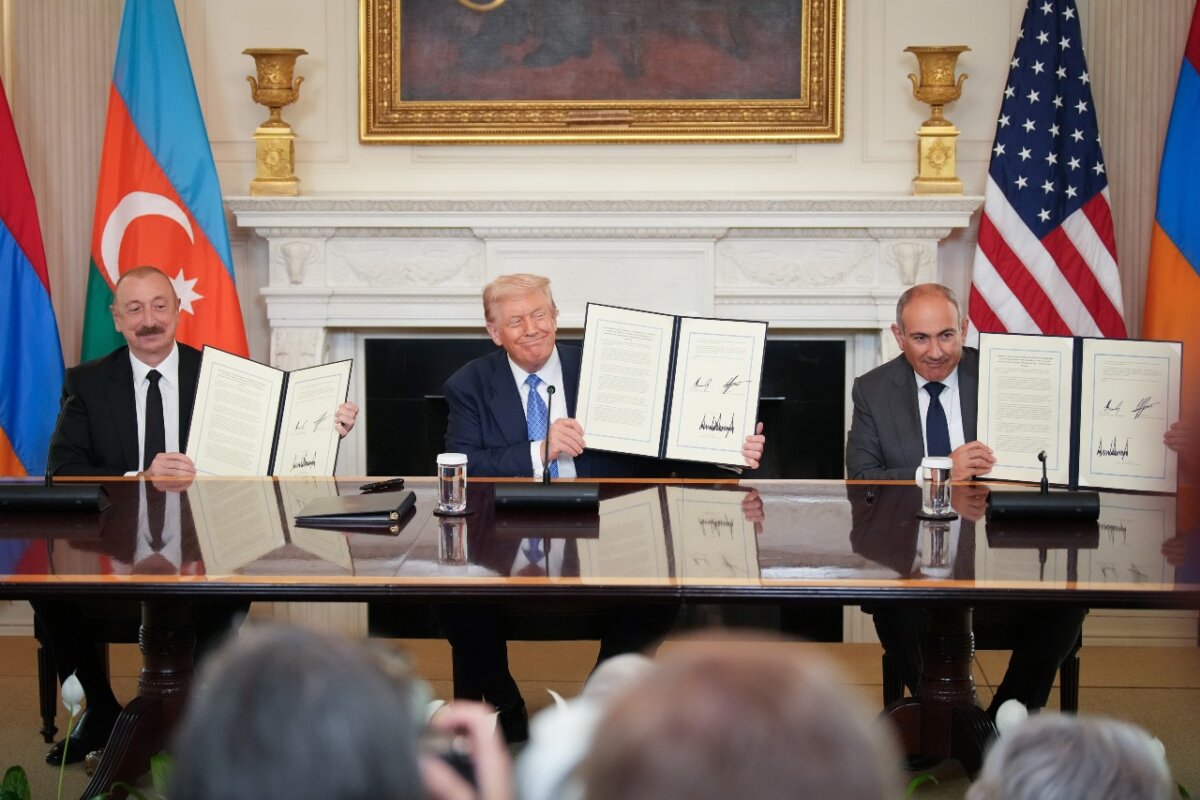

WASHINGTON—President Donald Trump welcomed the leaders of Armenia and Azerbaijan on Aug. 8 to the White House, overseeing the signing of a joint declaration that seeks to end nearly four decades of hostility between the two nations.
“It’s been a long time—35 years they fought—and now they’re friends, and they’re going to be friends for a long time,” Trump said, seated between Azerbaijani President Ilham Aliyev and Armenian Prime Minister Nikol Pashinyan at the State Dining Room.
“Armenia and Azerbaijan have fought a bitter conflict that resulted in tremendous suffering for both nations,” he said, calling the peace summit “historic.”
Trump noted that both sides have signed voluminous documents “committing to stop all fighting forever, open up commerce, travel, and diplomatic relations, and respect each other’s sovereignty and territorial integrity.”
The leaders also agreed on establishing the “Trump Route for International Peace and Prosperity,” or TRIPP, a new transport corridor aimed at unlocking the region’s commercial potential.
The new route will be a multimodal transit corridor linking mainland Azerbaijan and its landlocked Nakhchivan Autonomous Republic, enhancing regional trade routes.
“I just spent a lot of time with these two men,” Trump said jokingly during the White House event. “I think you’re going to have a great relationship. I have no doubt. And if you don’t, call me and I’ll straighten it out, OK.”
During the meeting, Aliyev thanked Trump for lifting restrictions on military cooperation with Azerbaijan, which lasted 33 years.
“It’s a day which will be remembered by the people of Azerbaijan with a feeling of pride and gratitude to President Trump,” he said.
Meanwhile, Pashinyan praised the peace deal, stating that it would “unlock strategic economic opportunities that will create long-term benefits.”
The Trump Route
The Trump route will allow goods to be moved from not just the Caucasus but also Central Asia without transiting through Russia, Iran, or China, according to the White House.
Azerbaijan has long sought a transport corridor through Armenia to connect its main territory with Nakhchivan bordering Turkey. Under the agreement signed on Friday, Armenia will grant the United States exclusive long-term development rights to build a route through the southern part of Armenia.
“What President Trump has done is he’s taken the politics out of the picture and made common sense prevail,” a senior White House official told reporters during a call previewing the agreement.
“What this will do for American businesses, and frankly, for energy resources across Europe, will be enormously powerful.
“The losers here are China, Russia, and Iran. The winners here are the West.”
The U.S. government plans to delegate the project to a consortium to handle both infrastructure and management of the new corridor.
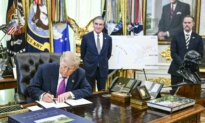
The official said that Trump was going to sign on Aug. 8 a directive to “set up a TRIPP negotiating team” with talks expected to start “in the middle of next week.”
The official noted that since the announcement yesterday morning, they had received calls from nine potential operators, including three American companies.
“We’re going to get everybody around the table. We’re going to find the most first-class operating system,” the official said.
‘Historic Peace Summit’
In a Truth Social post on Aug. 7, Trump announced that he’d be hosting both leaders for a “Historic Peace Summit” at the White House on Friday.
“These two Nations have been at War for many years, resulting in the deaths of thousands of people. Many Leaders have tried to end the War, with no success, until now,” Trump said, adding that his administration has been “engaged with both sides for quite some time.”
The two nations have engaged in cross-border conflicts since the late 1980s.
Early this year, U.S. special envoy to the Middle East Steve Witkoff traveled to Azerbaijan and met with Aliyev. From February through mid-April, U.S. officials expressed significant concern about the potential for renewed hostilities between Azerbaijan and Armenia.
Following Witkoff’s trip, a U.S. team conducted a series of five additional visits to the region, traveling between Azerbaijan and Armenia.
During the White House meeting, the countries also signed a joint letter officially requesting the Organization for Security and Co-operation in Europe to dissolve the “no longer relevant Minsk Group.”
The group, co-chaired by France, Russia, and the United States, was created in 1992 to find a peaceful solution to the Nagorno–Karabakh conflict.
Jacob Burg contributed to this report.
 Friends Read Free
Copy
Facebook
Tweet
Friends Read Free
Copy
Facebook
Tweet