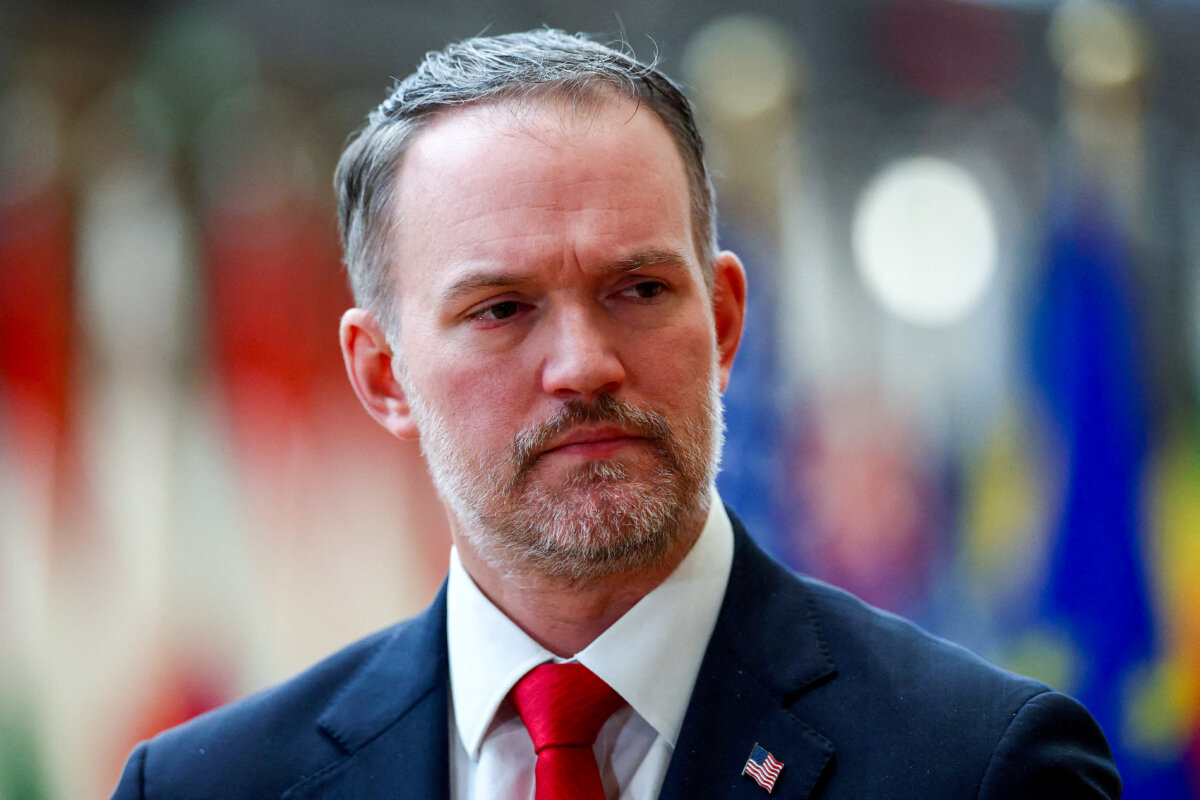

Negotiations to renew North America’s free-trade deal are likely to extend beyond July 1 and lead to separate agreements with Canada and Mexico, the top U.S. negotiator says.
U.S. Trade Representative Jamieson Greer told attendees at an April 7 event at the Hudson Institute in Washington that the White House may need to take steps to reframe the way the United States-Mexico-Canada Agreement (USMCA) functions to successfully negotiate with each country.
There has been extensive discussion in recent months about whether the deal will endure as a trilateral agreement or be split into two separate bilateral accords.
The trade agreement was established during U.S. President Donald Trump’s first term in office to replace the North American Free Trade Agreement. Trump referred to the USMCA as the “best and most important trade deal ever” when it was ratified in 2020, but has changed his stance during his second term as president.
He has described the agreement in recent months as “irrelevant” and has mused about letting the deal expire, saying Canada and Mexico “have taken advantage of the United States.”
Greer expanded on the president’s stance during the April 7 event, saying the current trilateral agreement is no longer working for the United States because auto imports from Mexico and steel and aluminum imports from both countries have surged over the past six years.
“Our baseline is that things have to be changed,” Greer said. “President Trump has been clear that he is dissatisfied with a lot of the outcomes of USMCA.”
‘Two Separate Protocols’
Greer said there are beneficial components of the agreement that will likely be upheld, referring to them as “a bunch of load-bearing pillars” that are functioning well.
“If we get rid of them, I just have to go back and do it again,” he said, but indicated that the White House would likely address certain bilateral complaints with Canada and Mexico in individual side agreements “to deal with issues specific to those countries.”
“Our import-export profile is different with each country, the labour situation in each country is different, the reasons why we have deficits with these countries are different,” he said. “So it necessitates two separate protocols that we can, I think, layer over those load-bearing pillars of USMCA.”
The United States has collaborated closely with Mexico throughout the past year to tackle various bilateral challenges, including both trade and non-trade matters, such as drug cartels and illegal immigration.
Greer’s office, referred to as USTR, initiated “technical discussions” with its Mexican counterparts last month regarding rules of origin, foreign investment, and tariffs.
Canada’s chief trade negotiators in Washington, headed by diplomat Janice Charette and ambassador Mark Wiseman, have re-established communication with the Trump administration over the last month following a period of little interaction. Formal USMCA review discussions between Washington and Ottawa have yet to commence.
The three countries need to approve a renewal of the current USMCA agreement on July 1 or indicate a desire to withdraw from the pact, a process that takes 10 years, but would provide more time for adjustments.
“I think that we aren’t probably going to be able to resolve all issues by July 1, but I think we are on track to resolve many of them and to move as quickly as we can,” Greer said, adding that he is required to inform Congress of U.S. intentions regarding the agreement by June 1.
Greer said he anticipates bilateral discussions with both partners will extend beyond the official review date this summer.
Four Options
USMCA negotiations will result in one of four outcomes: a renewal with the potential to extend the deal to 2052, a partial renegotiation, a period of prolonged uncertainty with annual reviews until 2036 when the current pact expires, or termination.
The third option would mean Canada, the United States, and Mexico were unable to agree to a 16-year renewal, requiring them to hold joint annual reviews until they either agree to approve an extension or the pact expires 10 years from now.
The fourth scenario, a complete withdrawal, could also occur. Any country can withdraw with six months’ written notice, effectively terminating the pact, although that could come with legal ramifications.
Greer suggested the United States is favouring the second option.
“On July 1, what has to happen is the United States tells Canada and Mexico what we intend to do. Do we intend to just rubber-stamp this thing and say, ‘All right, renewed, everything’s fine. Let’s hold hands and move on?’” he asked. “Or do we say, ‘This is not sufficient, we have to have modifications to this agreement, we have to change it.’”
He said that approach would put the countries on a path of going out of the agreement over the 10-year period.
“But we’ll be in negotiations during that time and try to resolve some things sooner rather than later,” he said.
Canadian authorities have expressed their desire to maintain the trilateral framework of the USMCA but said certain matters may require bilateral discussions with the United States.
“We’ve said all along that there will be a bilateral element to these discussions, and there will also be a trilateral element,” Canada-U.S. Trade Minister Dominic LeBlanc told reporters last week.
Despite that, LeBlanc has said separate deals have not come up during his discussions with the Trump administration, although Canada has been pursuing closer ties with Mexico.
LeBlanc led a large trade mission to the country in February and met with Mexican President Claudia Sheinbaum. He said Canada and Mexico are aligned on wanting to review the USMCA, not renegotiate it.
The 2026 National Trade Estimate Report on Foreign Trade Barriers released on March 31 listed several trade grievances with Canada including provincial bans on American alcohol products, Ottawa’s “Buy Canadian” and procurement policies, and its supply management system for dairy and poultry products. Other issues mentioned in the report were aircraft validation in Canada, digital streaming rules, the country’s zero plastic waste agenda, and restrictions on U.S. seeds exports.
Reuters contributed to this report.
 Friends Read Free
Copy
Facebook
Tweet
Friends Read Free
Copy
Facebook
Tweet