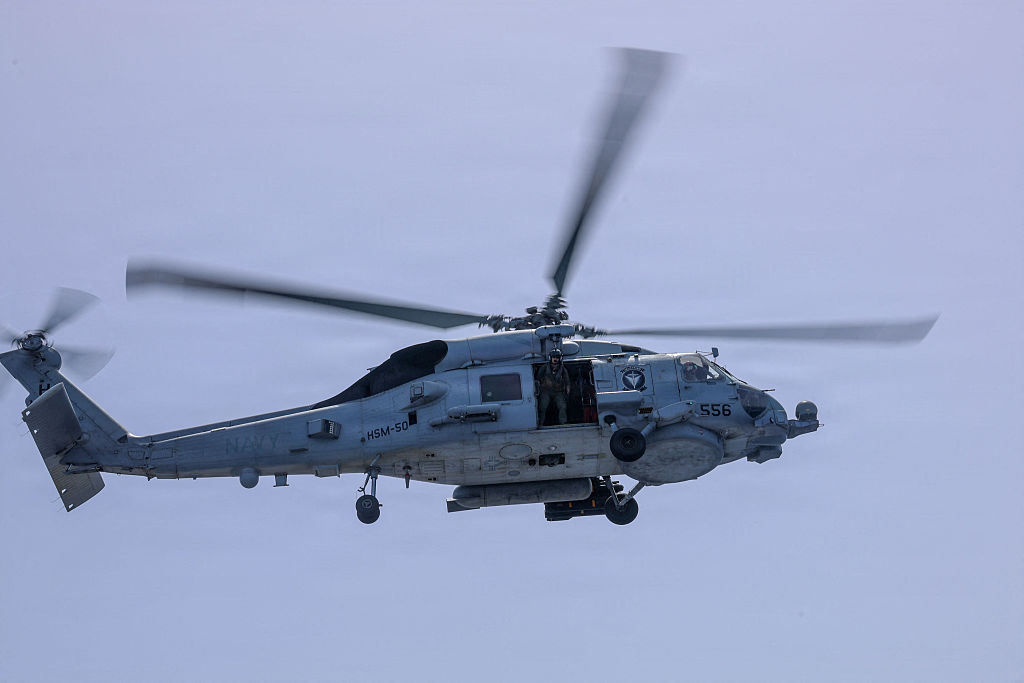

The U.S. military on Oct. 6 disputed Tehran’s claim that an American Navy helicopter crashed in the Red Sea as tensions between the two countries have simmered and as U.S. forces have maintained a blockade against the country.
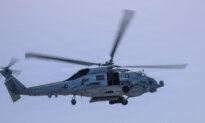
A statement posted by the U.S. Central Command (CENTCOM) on Tuesday said that reports of a downed Navy MH-60R helicopter “are not true,” referring to a claim being made by Iranian state-run media outlets on Monday night.
“All U.S. military aircraft and personnel across the Middle East are safe and accounted for,” CENTCOM wrote.
On Oct. 6, Iran’s semi-official Tasnim News said that the helicopter declared an emergency before crashing near Saudi Arabia on Monday evening.
“The helicopter was shown at an altitude of roughly 475 feet when the emergency was declared,” said Tasnim, citing what it described as publicly available flight-tracking data. “Its displayed altitude subsequently fell to zero before the aircraft disappeared from the tracking service.”
CENTCOM’s statement came hours after it said on Monday that a nearly three-month-long blockade of Iranian ports has resulted in 130 vessels being redirected to or from Iran. The Trump administration imposed the blockade after a memorandum signed between Washington and Tehran in July to end the conflict and open up the Strait of Hormuz fell through in July.
“The U.S. military remains intensely focused on this mission,” said Adm. Brad Cooper, the head of CENTCOM, in a statement posted to X. “We will swiftly act against any vessels trying to run the blockade. Our forces are highly trained, professional, and lethal.”
Tensions between the United States and Iran have remained high even as some talks were held in September during the United Nations General Assembly in New York City.
A top Iranian official, Parliament Speaker Mohammad Bagher Ghalibaf, said on Oct. 4 that the Strait of Hormuz, a key waterway through which about a fifth of the world’s traded oil and gas passes during peacetime, would not be reopened until Iran’s conditions are met.
Since the start of the conflict with Iran in February, Tehran has launched attacks against commercial shipping in the strait. The United Kingdom’s Maritime Trade Organization said on Oct. 5 that an incident was reported in the strait in which an oil tanker was “struck by an unknown projectile” and advised other vessels to transit cautiously.
Tensions around the strait have caused oil and gasoline prices to remain elevated throughout the war. The U.S. Energy Information Administration on Oct. 6 confirmed that it raised its oil price forecast for this year and next year.
Global benchmark Brent crude is now expected to average about $98 a barrel in 2026, up 8 percent from the EIA’s previous forecast, the agency said in its Short-Term Energy Outlook.
Brent crude is forecast to average about $105 a barrel in the fourth quarter, $14 above the EIA’s previous estimate. U.S. retail diesel prices, which hit record highs last month, are expected to remain above $6 a gallon in October before gradually easing to an average of roughly $4.50 a gallon in 2027.
Reuters contributed to this report.
 Friends Read Free
Copy
Facebook
Tweet
Friends Read Free
Copy
Facebook
Tweet