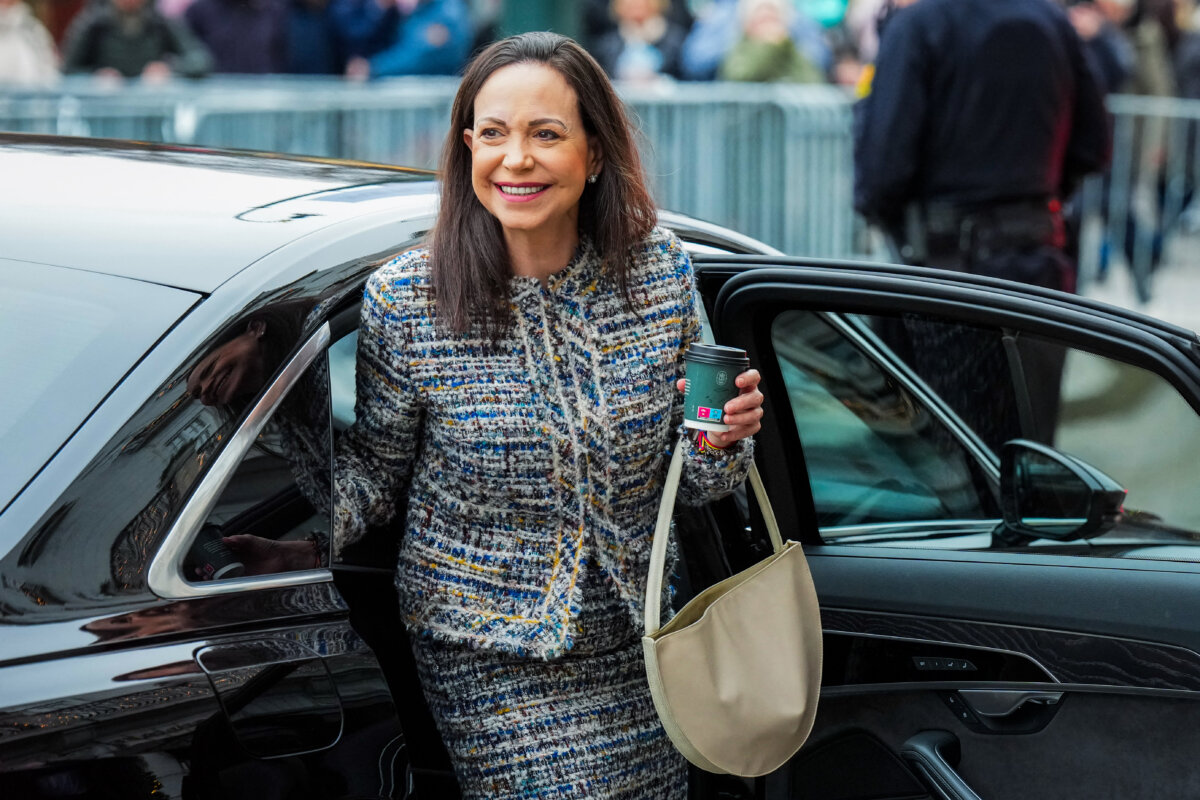
The Norwegian Nobel Institute has responded after Venezuela opposition leader María Corina Machado said she wanted to share or give her Nobel Peace Prize to U.S. President Donald Trump.
“The facts are clear and well established. Once a Nobel Prize is announced, it cannot be revoked, shared, or transferred to others. The decision is final and stands for all time,” the organization said in a Jan. 9 statement.
The Norwegian Nobel Institute referred to one of its statutes, which also outlines that the committee “will not comment upon what the Peace Prize Laureates may say and do after they have been awarded the prize.”
Machado won the award in October 2025 for her fight to achieve a peaceful transition of power in her South American country from leader Nicolás Maduro, who is now in a New York prison facing narco-terrorism charges. He and his wife, Cilia Flores, were both captured in an overnight U.S. military operation in the Venezuelan capital city of Caracas on Jan. 3.
Machado praised Trump and U.S. forces in her most recent comments for the mission that was dubbed Operation Absolute Resolve.
“I certainly would love to be able to personally tell him that we believe—the Venezuelan people, because this is a prize of the Venezuelan people—certainly want to give it to him and share it with him,” Machado said on Fox News on Jan. 5. “What he has done … is historic. It’s a huge step towards a democratic transition.”
Trump has previously suggested that he should win the Nobel Prize. The U.S. president also addressed Machado’s recent comments on Fox News’ “Hannity” this week, calling her desire to share the prize with him a “great honor.”
Machado was going to run against Maduro in Venezuela’s presidential election in 2024, but the regime disqualified her. She went into hiding and was succeeded by Edmundo González. The election results, showing Maduro won, have been widely regarded as fraudulent.
The U.S. president has signaled support for Maduro’s vice president, Delcy Rodríguez, who is now Venezuela’s acting president. However, he warned that Rodríguez could face consequences if she doesn’t “do what’s right.”
Although the United States and Venezuela announced that they are pursuing the possibility of reestablishing diplomatic relations on Jan. 9, the U.S. State Department’s Bureau of Consular Affairs posted on X that Americans in Venezuela should leave the country immediately.
“There are reports of groups of armed militias, known as colectivos, setting up roadblocks and searching vehicles for evidence of U.S. citizenship or support for the United States,” the advisory reads.
A U.S. delegation visited the South American country to evaluate possibly reopening the U.S. Embassy in Caracas, but the United States stated that it remains unable to provide any emergency help to Americans in Venezuela.
 Friends Read Free
Copy
Facebook
Tweet
Friends Read Free
Copy
Facebook
Tweet