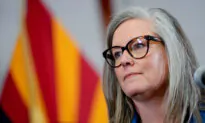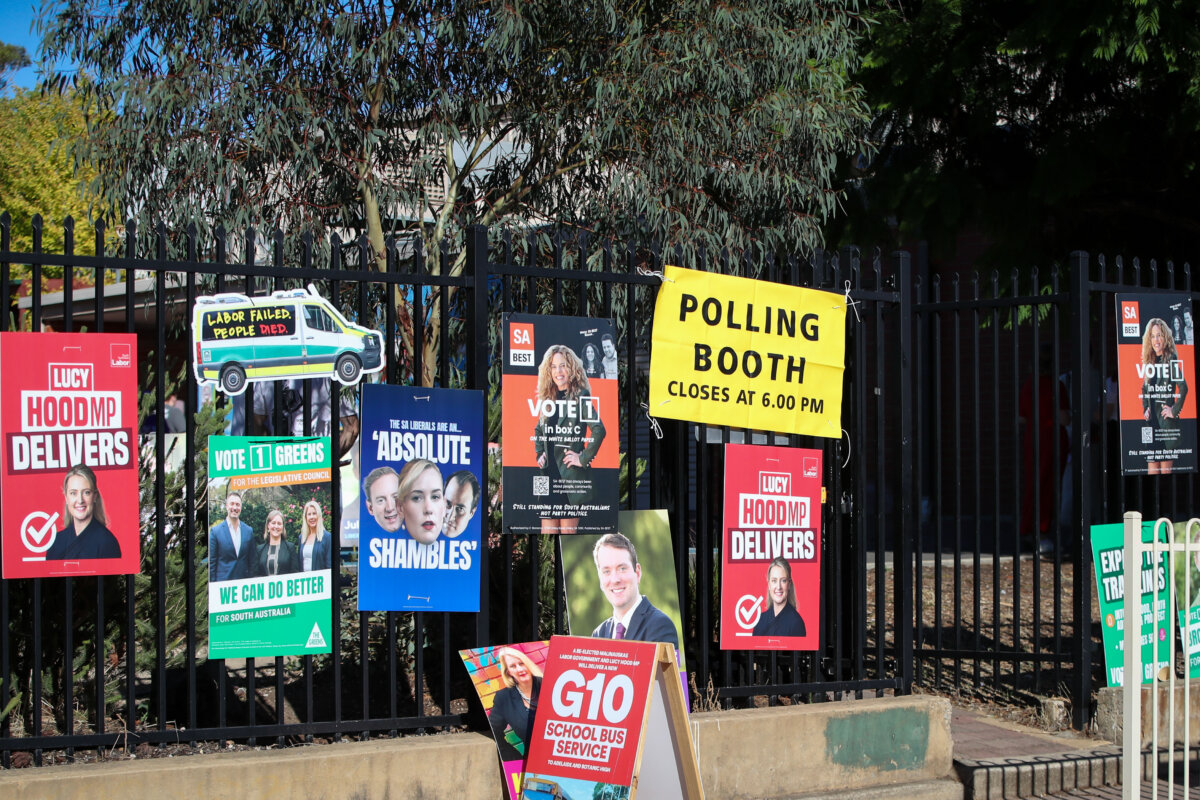

South Australian Senator Leah Blyth says the centre-right Liberal Party need a rebuild after a major swing to One Nation at the state election on the weekend.
One Nation has so far taken 22.4 percent of the South Australian primary vote as of the morning of March 23—a swing of almost 20 percent with one in five voters choosing the conservative-leaning party.
The party is projected to win its first two lower house seats in the state—Ndadjuri and Hammond—while also leading first-preference votes in several others, including Narungga and MacKillop.
By comparison, the Liberals are leading in 10 lower house seats, with Labor on 33.
One Nation did even better on upper house votes, landing 23.9 percent of voter support to the Liberals’ 17.3 percent but beaten by Labor’s 37.2 percent.
Speaking on March 23, Blyth said while it was not the result the Liberals had hoped for, it was still a better outcome than prior projections which placed the party on zero wins.
“We’re tracking on four at the moment, with a few still in play,” she told ABC Radio.
“So it’s very grim, but it could have been worse. So we’ve got to rebuild. We’ve got to think about what this means for us in South Australia.
“Voters obviously rejected us quite definitively at the ballot box, and it’s time for us to get back and really rebuild and think about what we’re offering to the people of South Australia.”
Blyth said she believed One Nation’s uptick in the polls was led by voter anger levelled at the major parties.
“That’s certainly what I felt out on the polling booths,” she said.
“They’re really disappointed in us. They’re disappointed in Labor as well.”
Blyth said she would return to Canberra with a message of discipline and unity for her party.
“We’ve got to make sure that we are putting up policies that are in the interests of Australians at a federal level, and that we’ve got to stop talking about ourselves—that is death politically,” she said.
“And that’s from both major parties, that we’ve actually got to do what we say we’re going to do, and we’ve got to act in the national interest.”
One Nation’s Surge More Than A Protest Vote: Commentator
Many political commentators had waited for a “proof in the pudding” moment given massive polling swings towards One Nation in general polls.
A recent Demos poll of 8,484 Australians showed that if a federal election were held immediately, One Nation would take 55 of 128 seats, becoming the major opposition party.
Redbridge Group director and former Victorian Labor strategist Kos Samaras said the vote in SA was an indicator that widespread polling showing heightened support for One Nation was indeed indicative of voter sentiment.
“We knew they were going to destabilise the market, but if you were to grab what happened in South Australia, put it in Victoria, NSW and Queensland, they win more state seats there,” he said in comments obtained by AAP.
“SA, being a state that normally should not favour a political movement like One Nation, has now shone a great big light on the reality that what we’re seeing in the polling numbers across the country is indeed more than protest.”
One Nation’s Barnaby Joyce congratulated SA voters on the Sunrise program, saying the vote showed a lack of satisfaction with the major parties.
“People are seeing One Nation with the clarity, the unity, the strength to say the clear message which attracts the vote,” he said.
‘We Need to be Vigilant’: Albanese
During a speech on March 22, Prime Minister Anthony Albanese highlighted the fact that Australia is a migrant country.
“It’s important to acknowledge that with the exception of First Nations people, we are all either migrants or descendants of migrants,” he said.
Albanese warned that some people, including politicians, sought to “turn back the clock” to a time when Australia was less accepting of migrants.
“We need to be vigilant,” he said.
“And we need to call out those people.
“And we need to continue to cherish our diversity as a strength for our nation, which it is.”
While the prime minister did not elaborate on who those people were, his comment came as One Nation has recently championed stricter migration policies, including a crackdown on visa offenders and a lower annual immigration cap of 130,000 per year.
 Friends Read Free
Copy
Facebook
Tweet
Friends Read Free
Copy
Facebook
Tweet