
Renewed fighting between Tigrayan rebels and the government in Addis Ababa has broken out in Ethiopia’s northernmost region of Tigray, and clashes are reported in other parts of the country.
The Tigray People’s Liberation Front (TPLF) announced in a Facebook post on Wednesday it was launching a “defensive war” against intensifying Ethiopian attacks.
The Ethiopian military actions included aerial bombardments, drone strikes, and ground operations, the group said.
On Sunday, the TPLF announced it had allied with six other armed groups to overthrow the government of Ethiopian Prime Minister Abiy Ahmed, whose Prosperity Party won a national election in June.
The government and the TPLF fought a two-year war—which killed thousands and left hundreds of thousands at risk of famine—before they signed an agreement in November 2022 on a “permanent cessation of hostilities.”
One of the groups that have joined the alliance with the TPLF is the Fano National Movement, which is ethnically Amhara. Fano sided with the federal government during the 2020–2022 war, but rose against the government in 2023.
Ethiopian federal forces have fired heavy weapons at Fano forces in the town of Lalibela, famed for its rock-hewn churches dating back to the 12th century.
Ethiopian Airlines said on Wednesday it had suspended flights to Tigray’s regional capital Mekelle, and the cities of Shire and Axum, “due to the current situation in Tigray region.”
In a post on X on Wednesday, Getachew Reda, an adviser to Ahmed, said the TPLF had taken over several airports in the region.
In a statement at the U.N. General Assembly in New York on Wednesday, Ethiopian President Taye Atske-Selassie Amde suggested foreign entities were meddling in the country, and his country had shown “immense restraint.”
“Our message to forces of destruction and mayhem is loud and clear. We urge them to respect the sacred right of the people of the Horn of Africa to live in peace and prosperity.”
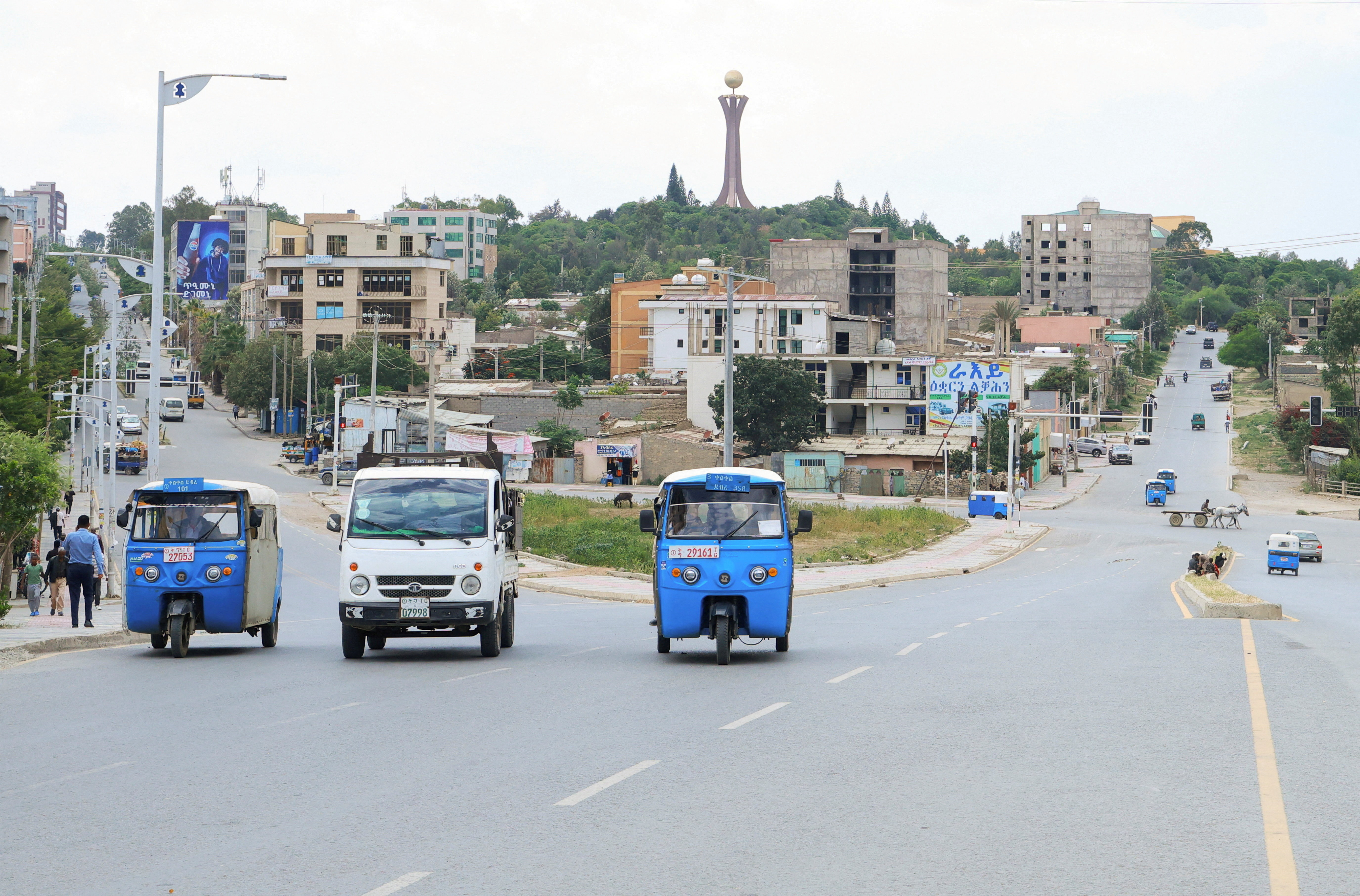 Rickshaw taxis and motorists drive along the street near the Tigray Martyrs monument in Mekelle, Tigray Region, Ethiopia, on Sept. 23, 2026. (Stringer/Reuters)
In November 2020—just over a year after Ahmed won the Nobel Peace Prize for making peace with neighboring Eritrea—the Ethiopian government invaded the Tigray region.
Eritrea denied sending troops across the border in support of the Ethiopians during the war in Tigray, which ground to a halt after two years and resulted in the Pretoria Agreement, which ceased hostilities.
Ethiopia was ruled by Emperor Haile Selassie until 1974, when he was overthrown.
A communist military government, known as the Derg, took over but eventually collapsed in 1991, when rebels from the Ethiopian People’s Revolutionary Democratic Front (EPRDF) conquered Addis Ababa.
TPLF’s Fall From Power
The TPLF was one of the leading rebel groups, and a Tigrayan, Meles Zenawi, was elected prime minister in 1995 and reelected three times, most recently in 2010.
After he died in 2012, the TPLF began to lose power, and in 2018 Abiy Ahmed became leader of the EPRDF, before starting his own party and winning a landslide election victory in 2021.
Under Ahmed, Ethiopia’s economy has continued to grow, but the country’s patchwork of ethnic groups has further fractured.
The seven rebel factions represent different ethnic groups that have challenged Ahmed’s government.
Reuters contributed to this report.
 Friends Read Free
Copy
Facebook
Tweet
Friends Read Free
Copy
Facebook
Tweet