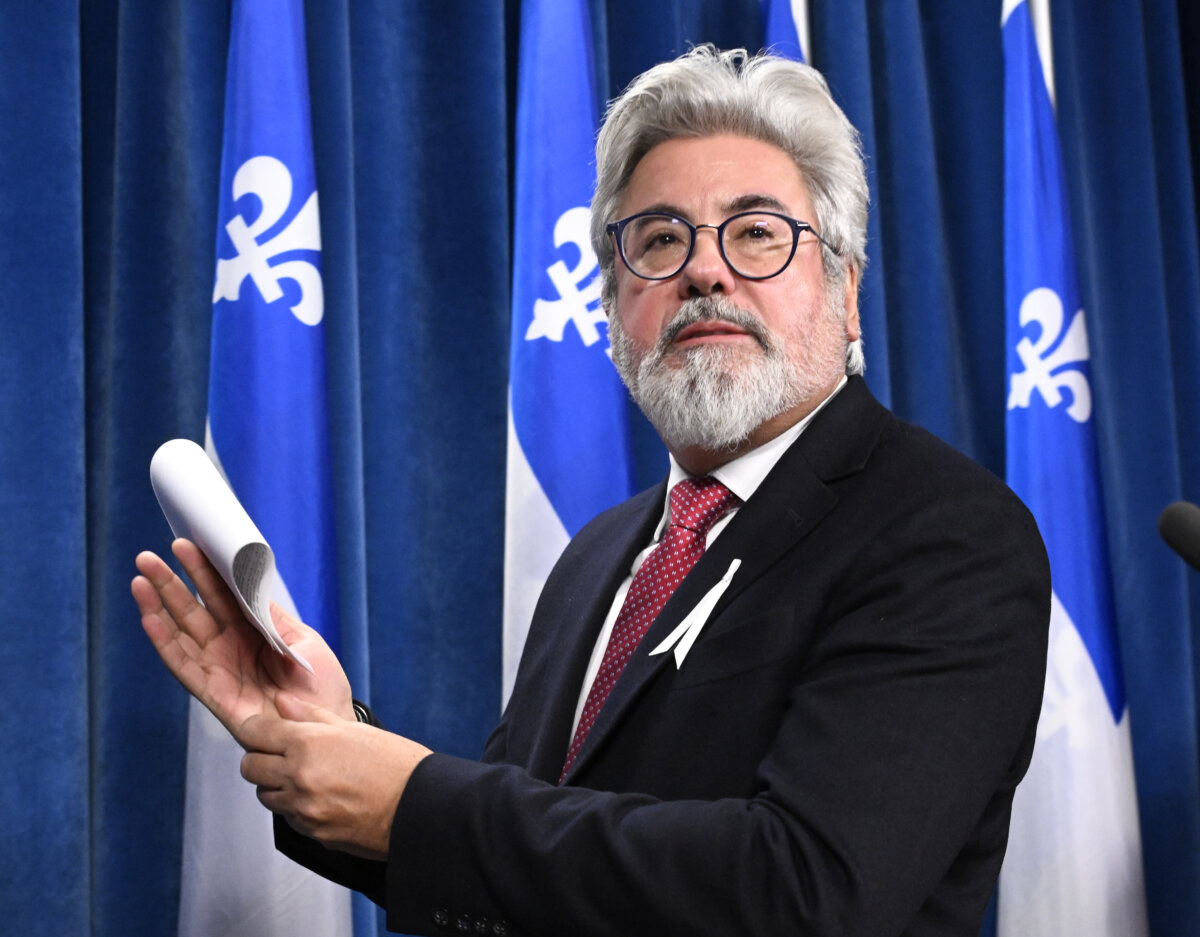

The Quebec Liberal Party has come under scrutiny since claims emerged last month that party members were paid to cast their ballots for current Leader Pablo Rodriguez during the summer leadership race.
The accusations have caused significant unrest within the party in recent weeks. Quebec’s anti-corruption police has said it is looking into the allegations of wrongdoing, although the law enforcement unit has not launched a formal investigation.
This marks the latest development in a succession of events that include the termination of a Quebec Liberal Party chief of staff, the suspension of MNA Marwah Rizqy from caucus, and a substantial lawsuit.
Rodriguez stepped down from the federal cabinet of then-Prime Minister Justin Trudeau last fall to seek the leadership of Quebec’s Liberal Party, which he won in June. Rodriguez represented the Montreal-area riding of Honoré-Mercier and held the role of transport minister. He also acted as Trudeau’s Quebec lieutenant, functioning as his primary advisor and spokesperson on matters pertinent to the province.
Here’s a look at the recent cash-for-votes allegations and the implications for the Quebec Liberal Party, better known as the PLQ.
What Are the Accusations?
The issue first came to the fore when Le Journal de Montréal published an article last month saying Élections Québec was looking into text messages that suggested party members who supported Rodriguez in this year’s leadership race received cash rewards.
The Epoch Times was unable to verify prior to publication if Élections Québec has launched an investigation into the text messages.
The report alleged that two people who “actively worked” to elect Rodriguez as Liberal leader exchanged text messages suggesting some members would receive a “browni”—a reference to a $100 bill—in exchange for votes. The Journal did not identify the individuals behind the text messages.
The report said the text messages had circulated among “several members of the PLQ” in the weeks leading up to the article. It went on to say that the “curiously high number of votes” for Rodriguez in specific constituencies of a region dominated by one of his opponents also generated questions. Rodriguez ultimately bested opponent Charles Milliard in the second round of voting, securing 52.3 percent of the points to win the leadership race on June 14.
Rodriguez has since threatened legal action against the media outlet, demanding to know the names of the people behind the text messages.
“You cannot just put things like that [in] a paper and accuse people,” Rodriguez said during a Nov. 21 press conference. “Explain to us why you think this is valid information.”
Cogeco, another media outlet, reported that the texts were exchanged between Liberal MNA Sona Lakhoyan Olivier and Coalition Avenir Québec MNA Alice Abou-Khalil. Both have refuted the claims, and Rodriguez said Lakhoyan Olivier would issue a formal notice to Cogeco threatening legal action.
Is There an Investigation?
Quebec’s anti-corruption police are considering launching an investigation into the allegations.
A spokesperson for the Unité Permanente Anticorruption (UPAC) has said investigators are actively working to confirm allegations of improper conduct before making a decision on whether to launch an official inquiry.
“Following the analysis of this information, we will be able to decide whether or not to proceed further,” spokesperson Mathieu Galarneau said in a media statement.
Rodriguez said on social media that he “fervently” hopes the UPAC will “shed full light on this matter and, if warranted, lay the appropriate charges.”
The matter is also the subject of an independent, external investigation at the behest of Rodriguez.
He announced in a Nov. 19 social media post that he had asked the president of the party to commission an independent firm to carry out an investigation.
The party said last week it has authorized an independent investigation by retired judge Jacques R. Fournier, a former chief justice of the Quebec Superior Court.
Fournier was tasked with examining whether any payments were made with the intention of influencing votes, as well as identifying the individuals and amounts involved, along with the number of votes affected. He was asked to submit a report by the end of January.
Rodriguez vowed in a Nov. 26 post on X to make Fournier’s report public, saying it is imperative that the report and law enforcement “get to the bottom of things.”
“If someone, somewhere, has committed an illegal act or one contrary to ethics, the truth must come out and we will fully cooperate,” he wrote. “If shortcomings are demonstrated, I will take action. There is no place for that in the PLQ. Zero tolerance. Period.”
Suspension and Lawsuit
The Quebec Liberals have faced turmoil in recent weeks after former parliamentary leader Marwah Rizqy fired her chief of staff Geneviève Hinse, a close associate of Rodriguez, in what the party is calling a breach of trust.
Rodriguez told the media the move was made without consulting him and has insisted he doesn’t know the details of the dispute between Rizqy and Hinse. He has dismissed Rizqy from her position as parliamentary leader and also suspended her from the caucus.
Rizqy was originally chosen to serve as the party’s leader in the National Assembly until the 2026 general election because Rodriguez does not occupy a seat. Rodriguez has said he is hoping to restore the Liberals to power and win a seat in the election next fall.
Lawyers for Hinse demanded Rizqy publicly admit within 24 hours that she had dismissed Hinse without cause.
The MNA for Saint-Laurent instead sent a letter to Hinse that, according to media reports, said she was dismissed due to significant ethical breaches and repeated acts of insubordination. The Epoch Times has been able to independently verify the content of the letter.
Hinse has since filed a $500,000 lawsuit against Rizqy.
Rizqy wrote on Facebook that she could not comment publicly because the issue was a human resources matter.
“Our laws do not allow an employer to comment publicly on an employee’s file in the public place,” she said in French in a Nov. 23 post but said that “throughout the decision-making process in this case, I was closely accompanied by the human resources of the National Assembly of Quebec” and maintained confidentiality “at all times.”
The Journal’s story about the text messages broke a day after Rodriguez suspended Rizqy from caucus.
It’s not known if there is any connection between Hinse’s dismissal and the accusations regarding Rodriguez’s leadership campaign. La Presse reported last week that Fayçal El-Khoury, the member of Parliament for Laval-Les Îles, had a conversation with Rizqy on Nov. 14 that attracted the attention of Élections Québec due to a potential link to Rodriguez’s leadership victory.
Élections Québec has not confirmed if it is investigating and Rodriguez told the media last week he didn’t know if the elections agency was probing the issue.
The Liberal leader did confirm, however, that El-Khoury had solicited donations for his leadership campaign.
“He had a solicitation certificate, which is public information,” Rodriguez said. “That means he was collecting money like many others.”
The Canadian Press contributed to this report.
 Friends Read Free
Copy
Facebook
Tweet
Friends Read Free
Copy
Facebook
Tweet