
News Analysis
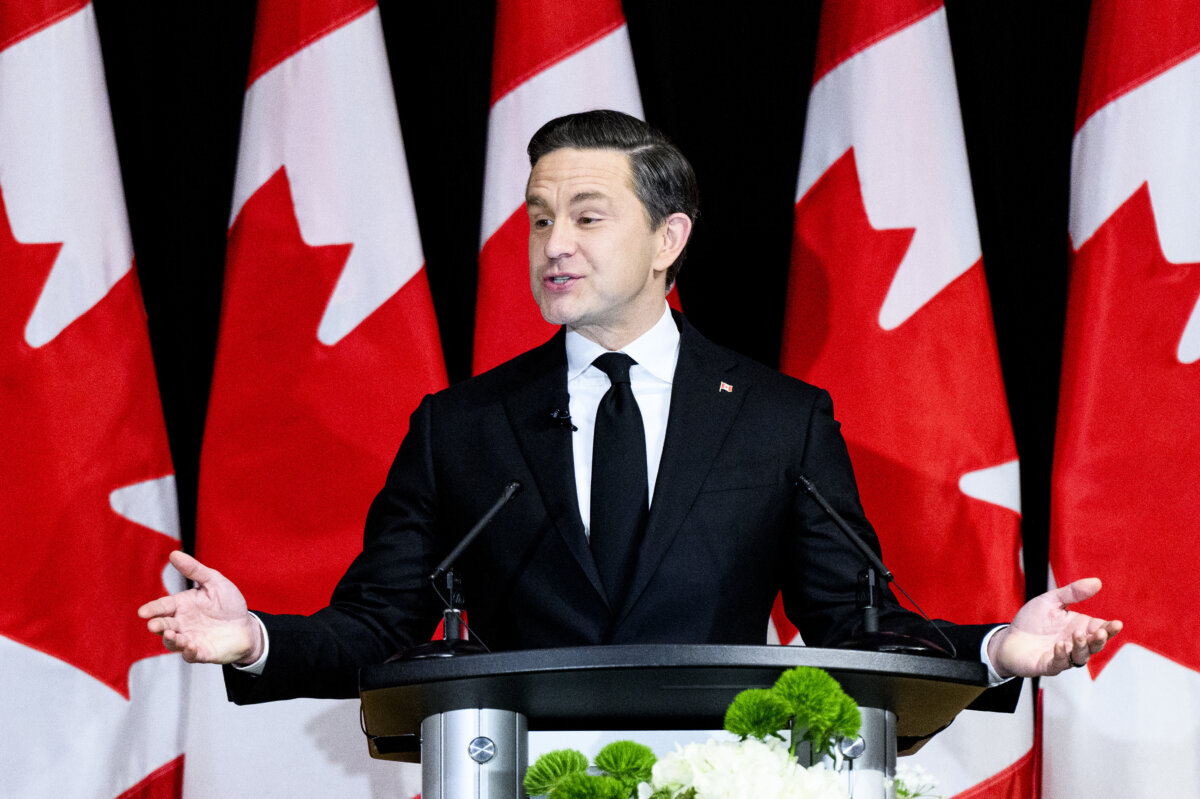
Amid floor-crossings and an upcoming leadership review, Conservative Leader Pierre Poilievre said in several year-end interviews he’s confident of having his party’s support.
Poilievre was pressed repeatedly on the issue of Tory defectors and how that reflects on his leadership in media interviews aired over the weekend.
“I’m not giving up. I don’t quit,” Poilievre told Global News when asked what he intends to do if another Tory MP joins the Liberals. This would give the ruling party a majority and solidify the odds of the Conservatives remaining in Opposition for another three to four years.
In an interview with CTV News, Poilievre accused Prime Minister Mark Carney of seeking to gain a majority by way of “dirty back room deals” rather than at the ballot box.
Carney has defended that his party needs votes to pass legislation and says the defectors have been “attracted” to what his party is doing.
The defections of Chris d’Entremont in November and Michael Ma earlier this month have given Liberals 171 seats in the House of Commons, one shy of a majority. D’Entremont said he had issues with party leadership, while Ma said he believed in the Liberals’ plan around affordability and community safety.
Liberal ministers have suggested there are more Conservative MPs who are considering crossing the floor. Meanwhile, Poilievre has accused the defectors of betraying their constituents and siding with an agenda they recently ran against and criticized.
Amid the turmoil and as media ask further questions about the issue, the Tory leader said the duty of deciding whether he stays on as leader will fall to party members.
“The people of our party—the welders, the waitresses, the plumbers and police officers, the soldiers and small business people—they’re the ones who I’m fighting for, and I’m never going to stop fighting for them,” Poilievre told Global. “They will decide with their democratic vote,” he added, in reference to the upcoming leadership review in late January.
Strategy
Poilievre’s Conservatives were eyeing a majority government before Prime Minister Justin Trudeau announced his planned resignation early last year, U.S. President Donald Trump took office, and Carney won the Liberal leadership race and replaced Trudeau as prime minister.
The Conservatives lost the April election and Poilievre his long-held Carleton seat, while the Tory leader has defended his record, noting he increased his party’s vote share and seat counts.
Poilievre told Global he has reflected on the party loss and on his own leadership and said he plans to make adjustments.
“I think my goal and one of the adjustments that we need to make is that people know that I’m a fighter, but they need to know what I’m fighting for, and who I’m fighting for,” Poilievre told Global.
Conservatives are currently slightly trailing or tied with Liberals in most polls, but on the leader favourability metric the surveys usually show a gap favouring Carney.
An Abacus Data poll released Dec. 14 suggests Carney enjoys a net favourability of plus 10, whereas Poilievre is at minus 5.
Asked by CTV News at what point he could become a “liability” for his party, Poilievre said Tories have been “driving the debate” under his leadership on issues such as “inflation, carbon taxes, crime, immigration, natural resources, drugs, and more.”
“We’re going to continue to demonstrate that if Canadians want those policies that Liberals keep pretending to support, they’re actually going to have to vote for the real deal in the next election,” he said.
In terms of managing the Tory caucus to prevent more defections, Poilievre told the Toronto Sun they will need to “unite around issues,” adding that the core focus of his party will be affordability concerns.
Abacus polled Canadians recently on the affordability issue, asking whether the cost of living is at the highest level they can “ever remember it being.” Sixty-seven percent said that it is.
Pipeline
Much of the year-end interviews focused on the defections and Poilievre’s leadership, but other political issues were also broached.
In these cases, Poilievre didn’t veer far from previous messaging, but he did further clarify his stance on building pipelines that sets him even more apart from the Liberal government.
Ottawa and Alberta signed a Memorandum of Understanding (MOU) on energy in late November, which includes the possibility of a new pipeline to the West Coast, but there are a host of conditions attached. Getting buy-in from the province of B.C. and impacted First Nations has been identified as conditions by the Liberals.
Poilievre’s stance is well-known about wanting Ottawa to “get out of the way” to let proponents of projects be allowed to build, extract, produce, and move natural resources.
Poilievre told Global News that constitutionally, Ottawa has jurisdiction over interprovincial pipelines. He also said that if his party formed government First Nations would not have a veto on building a new pipeline.
“I will thank them for their input,” Poilievre said when asked what he would do if indigenous leaders oppose the pipeline during consultations.
“At the end of the day, the prime minister has to decide, and my decision—and I’m telling Canadians before the election, so they can vote on it—is, I will approve a pipeline. Nobody has a veto,” he said.
Chiefs in the Assembly of First Nations voted unanimously in early December to call for the withdrawal of the Ottawa-Alberta MOU.
National Unity
Poilievre also commented on national unity in the context of separatist sentiment in the east and west. He said that separatist movements ten years ago didn’t have as much wind as they do now, with some Albertans working on an exit referendum and the Parti Québécois (PQ) having a strong lead in the polls while promising a third separation referendum.
“The Bloc Québécois and the PQ were dead in Quebec, dead as doorknobs,” he told the Toronto Sun. The PQ lost power in 2014 and didn’t win again, meanwhile, the Bloc had gone from two to 10 seats in the 2015 election, less than half of the Bloc’s current 22 seats in the House of Commons.
Poilievre said the deteriorating economic conditions coupled with messaging about Canada being a “post-national state with no common identity” has impacted the youth and fuelled separatist sentiment. Justin Trudeau had told the New York Times after becoming prime minister in 2015 that Canada had no “core identity,” making it the “first post-national state.”
“So what binds [Canada] all together?” Poilievre said. “And unfortunately, when the government says that to our youth long enough, eventually they believe it.”
Poilievre said his counter message is that there is a national identity based on common history and heritage. “We should be proud of where we are and where we come from, and that is a both a hopeful message, but also a unifying one,” he said.
Immigration
Poilievre was also asked in one of the interviews to comment on immigration, a topic that was once taboo but has now become mainstream amid a housing crunch and strained services.
Conservatives and Liberals now openly suggest that the federal government lost control of immigration.
The Liberal government in its Budget 2025 said it is “taking back control over the immigration system” and lowering immigration “back to sustainable levels.”
This includes a plan to reduce permanent resident admissions to 380,000 per year for three years. The Trudeau government had initially aimed to reach 500,000 admissions in 2025 and 2026.
The strain also came from high levels of temporary residents, whether foreign workers or students, something the Trudeau government had sought to address in its latter days by reducing intake.
The trend of high population growth has been reversing according to recent data, with Statistics Canada reporting last week a population drop of over 76,000 in the third quarter.
Commenting on the numbers, Poilievre said the amount of newcomers to Canada is “still too high.”
“We have to have more visitors leaving than we have new people arriving for an extended period of time so that our housing, health care, and job market can catch up,” he said.
Poilievre also called for stronger vetting of newcomers to not let in criminals, and for judges to not give lighter sentences to non-citizens convicted of crimes in order not to impact their immigration statuses.
The Tories have highlighted court cases where such reasoning was cited by judges in handing down sentences.
This led Conservative MP Michelle Rempel Garner to table private member’s Bill C-220 in September in a bid to amend the Criminal Code to prevent a court from considering the offender’s immigration status when imposing a sentence.
 Friends Read Free
Copy
Facebook
Tweet
Friends Read Free
Copy
Facebook
Tweet