
DENVER—The first thing you notice is the kids. Hundreds of them, with their families, friends, baseball teammates, streaming into the ballpark.
It’s hours before game time, but the line at Coors Field stretches around the block.
Some have been here before. They’re sporting bright yellow shirts or hats. A few are wearing banana costumes.
Others are first-timers eager to see what the buzz is about.
All have been drawn by the man in the yellow hat—and yellow tuxedo, shirt, and shoes: Jesse Cole, the creator of Banana Ball.
With a nod to P.T. Barnum, Cole bills his creation as “The Greatest Show in Sports.”
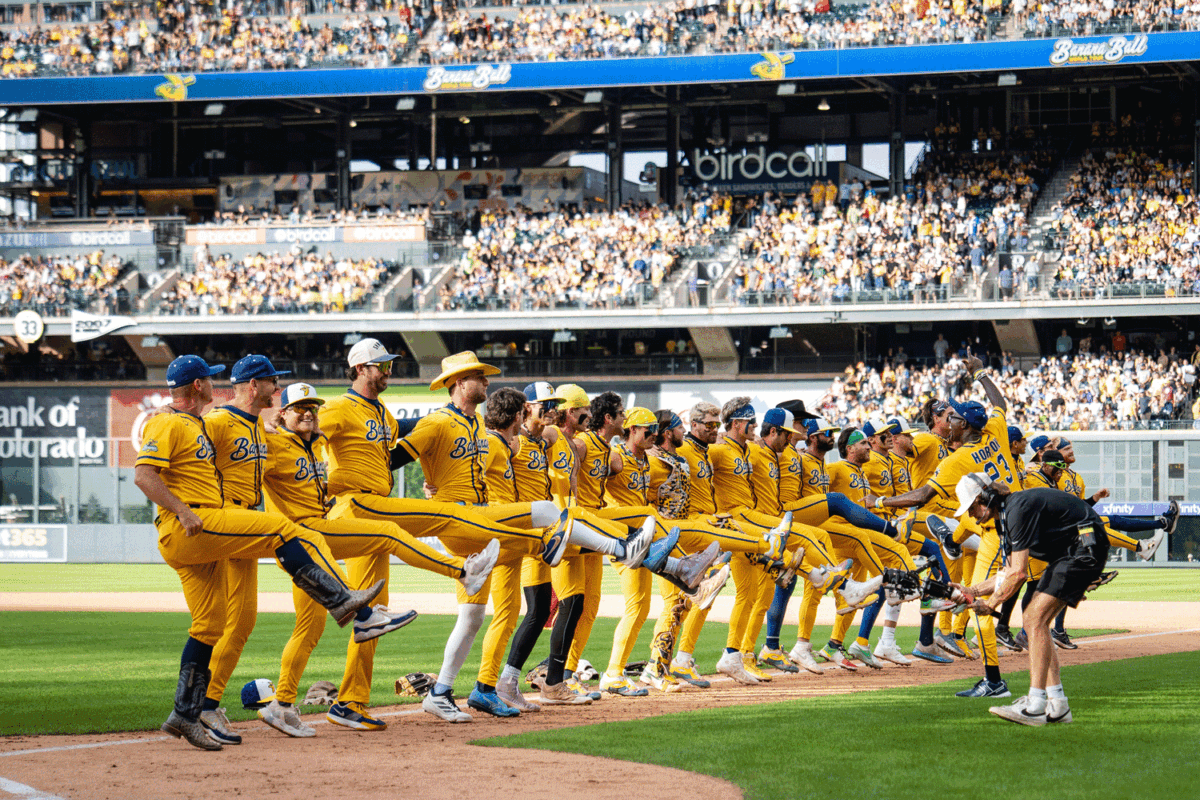
Banana Ball is equal parts minor league baseball, traveling carnival, and Disney extravaganza.
There’s a marching band, a singing princess, actual clowns, and, yes, a baseball game featuring two pretty good teams, some wacky rules, and a former major leaguer or two.
The Savannah Bananas, perpetual home team in this itinerant attraction, started in 2016. But the idea is not exactly new.
Banana Ball is a fresh take on an American sports tradition that saw its heyday in the mid-20th century, then vanished just as major league baseball took a giant step forward.
Jesse Cole has brought barnstorming baseball back to life, and fans can’t get enough of it.
Make It Fun
It’s 1 p.m. on a Saturday, and ladies and gentlemen, boys and girls, children of all ages line the block around the block at Coors Field. The Savannah Bananas won’t face the Indianapolis Clowns for another five hours, but fans know the game itself is just one part of the show.
“We’ve got three generations of Banana Ball fans here,” said Chris Bryan, of the Aspen, Colorado, area. “We’re the Banatics,” he added, trying not to crack a smile.
For the Bryan clan, good, clean entertainment is the appeal of Banana Ball.
“It’s awesome, the whole environment,” said Bryan’s son, Will, 10.
“It’s family friendly,” added Lara Bryan, Chris’s mother. She and her husband, David, made the trip from Shreveport, Louisiana, to attend with their children and grandchildren.
A pregame stage draws onlookers. Others watch on screens throughout the venue. The entertainment includes live music, player appearances, a juggler, and comedy sketches by the Man-Nanas, a cheerleading squad of plus-sized men in matching shorts and crop tops.
The corny jokes and slapstick could be drawn from variety shows such as “Hee Haw” or straight from the vaudeville stage.
Cole, who played baseball through the collegiate level, said Banana Ball started with a simple idea: make baseball fun again.
“As I sat in the crowd watching, I realized there were too many moments that were too long, too slow, and too boring,” Cole said. “How do you change that?”
Inspiration came from the likes of Barnum, legendary baseball promoter Bill Veeck, and Walt Disney, Cole said. “Saturday Night Live,” Cirque du Soleil, and World Wrestling Entertainment added something, too.
Baseball as Entertainment
The Gastonia Grizzlies were a collegiate summer league team when Cole became general manager in 2008. His knack for wacky, family fun broke attendance records for seven consecutive years.
In 2015, Cole relocated to Savannah, Georgia, and created a new team called the Savannah Bananas. Breaking away from league play, Cole focused on baseball as entertainment.
Within a few years, the Party Animals, Firefighters, Texas Tailgaters, Loco Beach Coconuts, and Indianapolis Clowns took their place alongside the Bananas in a touring enterprise that sold 2.2 million tickets in 2025, filling major stadiums.
As game time nears at Coors Field, attention shifts to the field where the Young Professor, a bespectacled emcee sporting a purple and green flowered tux, takes the hype up a notch.
Then comes Princess Potassia, a tiaraed belle in bright yellow, lilting around the bases trailed by a marching band. “Now we’re touring all o-over!” she sings, to the tune of a Stevie Wonder hit.
Next up, Savannah Bananas team captain Bill LeRoy darts into the stands with a bunch of bananas.
On the field, two young men wearing ridiculously oversized clown pants engage in a competition. LeRoy hurls bananas from the upper deck. Whoever catches the most in his pants wins.
The antics don’t stop when the game starts.
Between innings, teen girls compete in a tandem sack race, a boy chooses which parent gets a pie in the face, and comedic chickens stage a running battle à la Foghorn Leghorn and Tweety Bird.
Megan Seacrist of Castle Rock, Colorado, brought her daughter, Mia, 11, to last year’s game and came back for more.
“It was just nonstop back-to-back fun,” Seacrist said. “I think major league baseball needs to take some notes.”
The relentless energy is part of the magic, according to Dan Price, a sports marketing director.
“Their success comes from turning traditional baseball into a nonstop entertainment experience and creating their own fast-paced Banana Ball rules,” Price said.
It’s Like Baseball
Banana Ball follows most baseball rules, with some exceptions. For example, the game is limited to two hours. There’s no bunting, no mound visits, and no walks. And if a fan catches a foul ball, the batter is out.
Most of the rules are to speed up the game, but some are just for fun.
The scorekeeper tracks trick plays, such as behind-the-back catches. If the visiting team makes the most trick plays, it gets an extra point.
Kids love it.
“I like the rule where the batter can run to first base after the fourth ball,” Will Bryan said.
Vincenzo Mattivi, 10, of Pueblo, Colorado., said, “I like watching the players make trick plays.”
Mia likes the nonstop music.
After the seventh inning, actress Kristen Bell emerged from the dugout singing “For the First Time in Forever,” her hit from the animated movie “Frozen.” The crowd erupted in applause as her face appeared on the jumbotron.
Bell then launched into a duet of “The Time of My Life” from the movie “Dirty Dancing” with Bananas pitcher Derek Klena, a Tony-nominated actor, complete with the angel lift.
Purists may wonder if Banana Ball is real baseball.
“It’s close,” said Vinnie Mattivi, Vincenzo’s dad. Despite all the antics, it’s still hard to hit a baseball, he said.
The rule changes make the game appealing to a wider audience, Mattivi said. “True baseball isn’t for everybody,” he added.
Yet there’s a serious side to the game as well.
Throwback to Another Time
During player introductions, a handful of Indianapolis Clowns take to the field bearing flags with the names of former players.
“Long before the lights, the music, the show you see today, there were players who stood for something bigger than the game,” center fielder Jackie Bradley Jr. said.
Bradley spoke of the original Clowns team, which played in the Negro Leagues in the 1940s and ’50s. Baseball legends Hank Aaron and Satchel Paige both played for the team.
Bradley, who retired from major league baseball in 2023, joined the Clowns last season, in part to honor the legacy of the Negro Leagues.
“A strong pull for me was being able to pay homage to the men and women and coaches that played before me, that donned the Indianapolis Clowns Jersey,” Bradley told The Epoch Times in a pregame interview.
After 1947, when Jackie Robinson became the first black player in major league baseball, other black players and fans began to follow. The Negro League disbanded in 1962.
At that point, the Clowns returned to their roots as a barnstorming team, performing traveling baseball shows as they’d done in the 1930s.
Circuses and vaudeville shows were common in the days before television, and players with a knack for showmanship could make a living entertaining crowds with ballgames punctuated by trick plays and comic skits.
The Clowns were the last active Negro League-rooted team when they disbanded in 1989.
Decades later, Cole entered an agreement to revive the Clowns’ name and legacy.
Back on the field, head coach Errick Fox continued the narration. “Each of these players has a story to tell. And tonight, when we all come together, we can bring their stories back,” he said.
Fans First
After the game, Cole stopped near the dugout for a brief interview. “One second,” he said, then turned his attention to the stands where several kids were asking for autographs.
“I’ll be up there in five minutes,” Cole said. “I’ll be signing for two hours.”
That moment exemplified the Bananas organization and its relentless focus on the fan experience.
Kris Dehnert, owner of Dugout Mugs, said he saw that firsthand when visiting the Bananas at their home stadium in Savannah.
“The performance—and the caliber of the performance—was fans first,” said Dehnert, who went on to work with the organization on product licensing.
Cole’s attitude was shared by the players and staff and was even reflected in the quality of the ballpark food, Dehnert said.
“It created an atmosphere that people wanted to be a part of. And I think, from a marketing standpoint, that is the secret sauce,” he said.
The organization sells tickets through a lottery, so scalpers can’t dominate the market. That keeps prices low. Fans said they paid between $50 and $75 apiece. Coors Field, with about 50,000 seats, was sold out for two nights in a row.
The Bananas invent reasons to bring fans onto the field between innings. The lucky fans, mostly kids, get to watch the game from the dugout before being called to the field.
Players jump into the stands at the slightest provocation—to hand out donuts, sign autographs, or bring a boy who caught a foul ball to the field for recognition.
Banana Ball is working, evidenced by the organization’s growth from one team to six, a multiyear waiting list for tickets, and TV deals with major networks including ESPN, Disney+, and HBO Max.
Cole said his fan obsession is the reason why. That obsession extends to the fans in the nosebleed seats.
“Before we come to a city, we meet up in the upper deck,” Cole said. “We say, ‘How are we going to make sure these fans are going to feel it?
“We’ve been to 100,000-seat stadiums. We’re going to be all over this world. And it starts, always, one fan at a time.”
 Friends Read Free
Copy
Facebook
Tweet
Friends Read Free
Copy
Facebook
Tweet