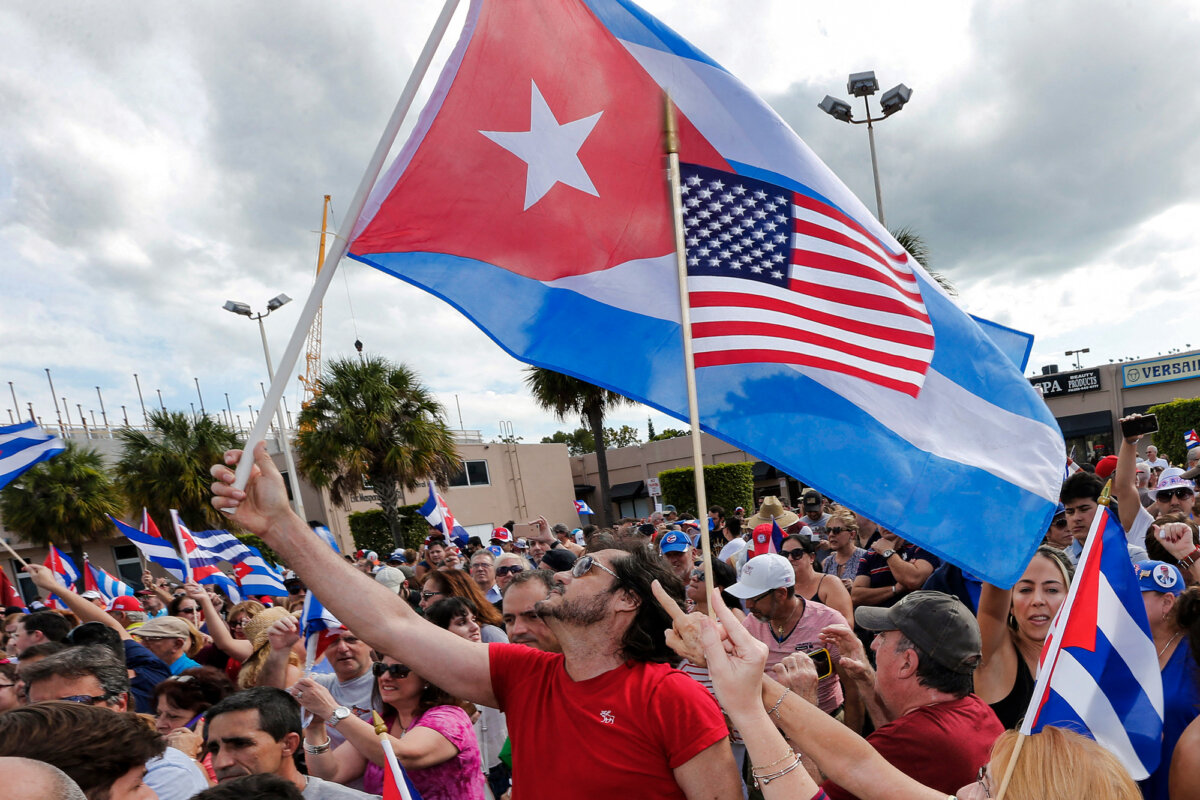

Cuban Americans are hopeful that their country’s communist dictator will be the next to fall in the Western Hemisphere after the U.S. military’s successful operation to capture Venezuelan leader Nicolás Maduro on Jan. 3.
Cuba has been ruled by a communist regime since 1959, when Fidel Castro established a one-party system. Now, the Caribbean country is ruled by Miguel Díaz-Canel.
The Epoch Times spoke to more than 50 Cuban Americans in Miami, who all praised U.S. President Donald Trump and the U.S. military for the capture of Maduro.
The vast majority expressed hope for similar action against Canel, a small number said patience and restraint are better, and one man described his theory that the Trump administration has a wider scheme at play.
After Maduro’s capture and the seizure of the country’s oil, the U.S. president urged Cuba to strike a deal.
But even if Trump orders a similar operation on the Cuban leader, many expatriates said it would not be enough to rid their home country of a deeply entrenched, brutal regime or to ease the decades of suffering their people have endured.
Murder, unjust imprisonment, torture, and unspeakable acts are what have kept the communists in power for so long, they said.
Oscar Perez, a U.S. Marine veteran who served three tours in Iraq, is now the president of the Cuban American Veterans Association.
He said Canel and the entire Cuban system must be disbanded, at which point he would consider visiting his parents’ home country.
“My dad, I wish he would have seen it,” he said. ”That was one of his main things in his life, that he wanted to see a free Cuba, and unfortunately, he couldn’t see it. But hopefully, I do.”
His Cuban-born father was a staunch anti-communist who escaped political imprisonment twice, served a 12-year sentence, and eventually faced the choice of leaving Cuba or dying. He trekked through a jungle for 13 days, jumped a fence at Guantanamo Bay, and navigated a Cold War-era minefield to escape his home. The first American his father met was a U.S. Marine.
Perez described how he sees and feels this sentiment of support for the U.S. military among all Cubans and Cuban Americans he interacts with. Perez said the current regime is already teetering, and with the capture of the former Venezuelan leader and the country’s oil, he theorized that the Trump administration could benefit from being patient.
However, Perez praised Trump and the U.S. military operation against Venezuela and said Cubans are ready for similar, direct action to be taken.
“America’s strength, finally,“ Perez said. ”We have been the global leader for many, many years—many, many decades—and we were just not using our political strength the way it should be.”
Lilly, a woman from the Cuban capital, Havana, who declined to share her last name, became a political prisoner in 1961. She spent nearly a decade behind bars.
Every Cuban had a loved one in prison, she recounted.
“It was beautiful before the ‘60s—before the devil came,” Lilly said about Castro, who established the first communist state in the Western Hemisphere and ruled with an iron fist for nearly 50 years.
Lilly described horrific conditions her family and tens of thousands of other people have suffered under Cuba’s communist regime. The majority of political prisoners, Lilly said, were charged with a vague communist law she called “against the state,” or contempt of authority. Lilly said she was never charged with a crime during her entire imprisonment.
The decline of Cuba was drastic once Castro took power, she said.
She survived her imprisonment because of a sense of unity among the Cubans being held unjustly. They lived day to day, she said.
“Many of them had husbands or boyfriends,“ Lilly said. ”They were going to trial, and sometimes they were sentenced to death. When they returned from the trials, we got together—we had a little Virgin [Mary]—we got together, and we prayed. We knew that they were going to get killed that night.”
The Cuban men in prison had it worse, she said, forced to listen to the death sentences being carried out by firing squads every night.
Prisoners were punished with beatings, solitary confinement, and forced labor, Lilly said, or simply killed. Often, they were not allowed visitors or were given only one small serving of food per day, such as watery soup or beans.
The expatriate said this treatment is still happening.
Once Lilly was released, she said, there was no more freedom beyond the prison walls.
A few months after her release, Lilly fled her home country. She said everything must change for her to ever consider going back to Cuba. Action by Trump and the U.S. military would be overwhelmingly welcomed by the Cuban American community, she said.
“It’s time for us to be free,” she said. ”It’s been 67 years, and nobody has had the guts to do it, but we have a president [Trump] that has the guts to do anything. If everything changed, and there’s still time for me to go back, then I would go back.”
The first place Lilly said she would visit is a cemetery in Havana where her parents are buried.
READ MORE HERE.
—Troy Myers
BOOKMARKS
Texas state agricultural officials issued fresh warnings on Jan. 15 after hundreds of residents received unknown seeds in the mail that they never ordered, The Epoch Times’ Dorothy Li reported. In just the first 15 days of this year, officials collected 126 bags of unsolicited seeds that had arrived in the mailboxes of Texas households, according to state officials.
Trump intends to file a lawsuit against JPMorgan Chase for what he said were efforts to remove his access to banking following the Jan. 6, 2021, U.S. Capitol breach, The Epoch Times’ Jack Phillips reported. In a statement, Trump said he would file suit due to JPMorgan Chase, “incorrectly and inappropriately DEBANKING me after the January 6th Protest, a protest that turned out to be correct for those doing the protesting.”
Minnesota Gov. Tim Walz has mobilized his state’s National Guard as protests and opposition to Immigration and Customs Enforcement (ICE) activity in the city continue, The Epoch Times’ Jacki Thrapp reported. Walz said troops will wear bright yellow reflective vests over their uniforms so protesters can “distinguish them from other agencies.”
European Union leaders said that their nations are ready to defend themselves after Trump imposed new tariffs on Europe as pressure in his bid to take control of the North American island, The Epoch Times’ Jacob Burg and Joseph Lord reported. Following emergency talks, EU Council President Antonio Costa said that member states agree that tariffs “would undermine transatlantic relations and are incompatible with the EU-U.S. trade agreement.”
 Friends Read Free
Copy
Facebook
Tweet
Friends Read Free
Copy
Facebook
Tweet