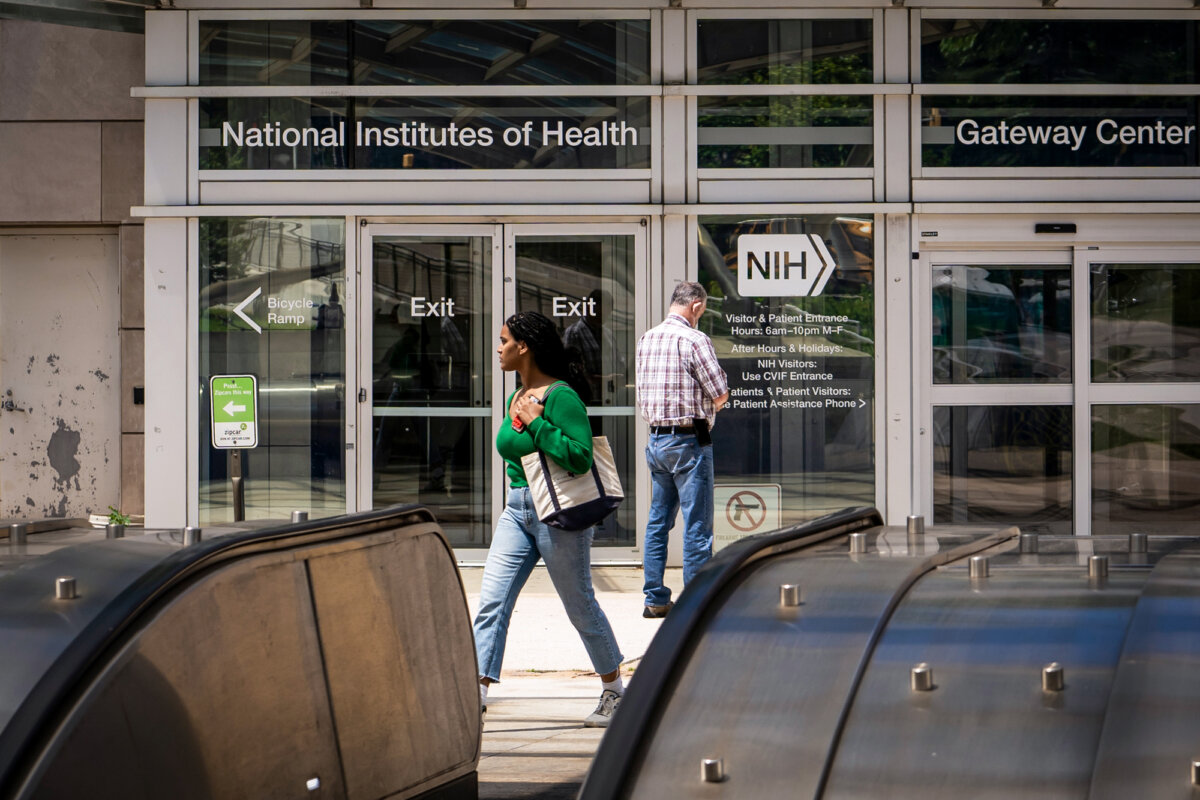

A top government doctor who declined to receive a COVID-19 vaccine in 2021 was worried he would lose his job and medical license in retaliation, according to newly obtained emails.
“There were times when I was worried about losing my job especially when we first started receiving emails about [vaccine] mandate deadlines,” Dr. Matthew Memoli, who led the Laboratory of Infectious Diseases clinical studies unit at the National Institute of Allergy and Infectious Diseases (NIAID) during the COVID-19 pandemic, said in one missive to a NIAID spokesman.
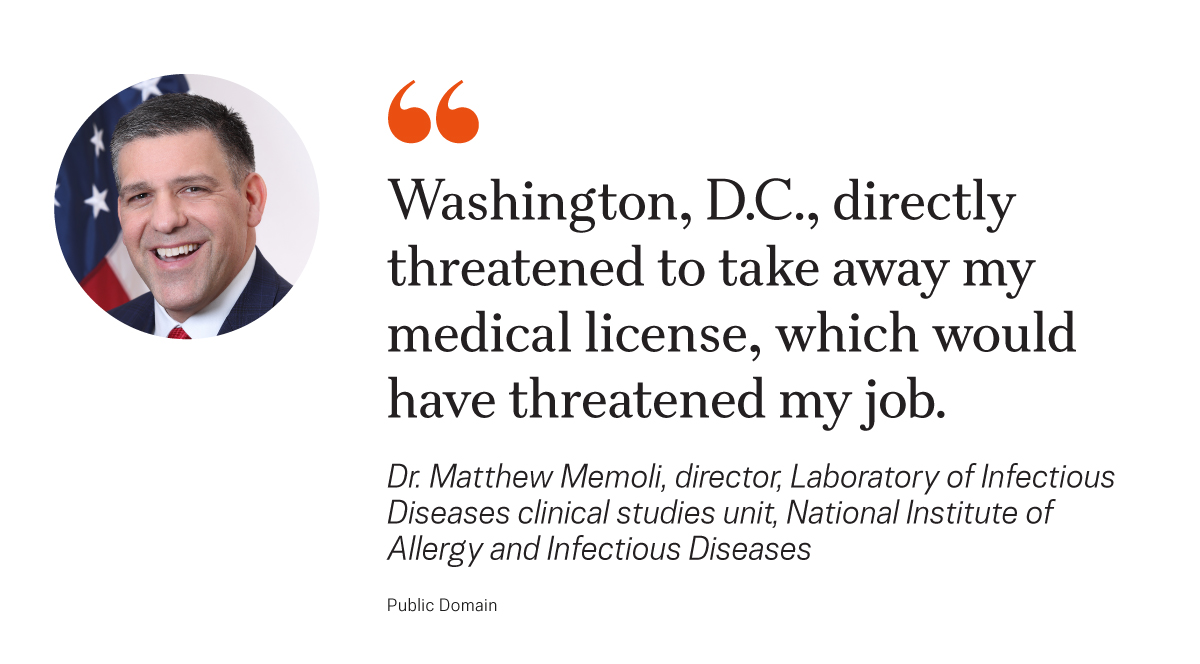
He later said that he was more concerned about losing his medical license because he was aware there were “protections for government employees.”
“Washington, DC directly threatened to take away my medical license which would have threatened my job (I need a medical license) so I applied for a Virginia license and protected myself that way,” Memoli also wrote in the email, sent on Jan. 17, 2024, and obtained by The Epoch Times through a Freedom of Information Act request.
After President Donald Trump took office in 2025, Memoli was made acting director of NIAID’s parent agency, the National Institutes of Health (NIH). He has been the NIH’s principal deputy director since March 31, 2025.
Memoli did not respond to a request for comment.
Spoke Out Against Mandate
Memoli became publicly known in 2021 when he was one of the few government officials to speak out against COVID-19 vaccine mandates, which were being imposed on millions of people and promoted at the highest levels of the government.
Emails obtained by The Epoch Times in 2024 showed that Memoli warned Dr. Anthony Fauci—a White House COVID-19 adviser, the longtime head of NIAID until his retirement, and a proponent of vaccine mandates—that mandating COVID-19 vaccination was a mistake, in part because the vaccines did not prevent transmission of the disease.
“At best what we are doing with mandated mass vaccination does nothing and the variants emerge evading immunity anyway as they would have without the vaccine,” Memoli wrote to Fauci in one email. “At worst it drives evolution of the virus in a way that is different from nature and possibly detrimental, prolonging the pandemic or causing more morbidity and mortality than it should.”
Memoli at the time agreed to answer questions via email from The Epoch Times, but officials blocked the interview.
Memoli sent his answers to NIAID spokesman Ken Pekoc to review. In response, Pekoc said the interview request had been rejected by NIAID’s parent agency, the Department of Health and Human Services, according to one of the newly obtained emails.
The reasoning for the rejection was not detailed.
‘Many Reservations’
The Epoch Times had asked whether Memoli was in danger of being fired because of his opposition to the mandates and whether he wished he had gone public with his opposition to the mandates sooner, among other questions.
“I had expressed many reservations about the vaccines in press interviews that I did far prior to late 2021,” Memoli said in response, in answers that were never sent to The Epoch Times. “I was always honest about that. The reporters I spoke to never seemed to publish any of the information I provided regarding that.”
That changed near the end of 2021, when The Wall Street Journal and other papers published stories about Memoli’s remarks after President Joe Biden and federal agencies such as NIAID and its parent agency, the NIH, mandated COVID-19 vaccination for federal employees and contractors.
Memoli, in comments to reporters and in internal emails, said he opposed the mandates because he said, based on his experience with respiratory viruses, that such viruses evade immunity, and vaccines could drive the evolution of the virus. He also said requiring shots infringed on medical freedom.
“The vaccine was not working well due to the rise of variants, there were safety issues arising, and as my family and I had chosen not to be vaccinated we were dealing with threats of having our medical licenses taken away, loss of employment, etc.,” Memoli wrote to Pekoc in one of the newly obtained emails, dated Jan. 16, 2024.
“We had friends who felt coerced into accepting vaccination as was happening all over the country. Therefore, to again try to be constructive I contacted the NIH ethics office to appeal to them to consider this.”
Spoke at Event
After exchanging emails with NIH ethics personnel, Memoli was invited to speak at an agency event called the Ethics Grand Rounds in December 2021. In his speech, he made the case that mandates should be imposed only in rare situations and should not be imposed for COVID-19 vaccines because the vaccines’ effectiveness dropped over time.
“I was somewhat surprised given the environment, but I have always had the utmost respect for the NIH ethics department,” Memoli said in one of the newly obtained emails. “I have worked with them many times in the past and have even published papers with them. The people in that office have always been very smart, open minded, and able to look at difficult issues and consider them carefully and thoroughly.”
He said that many colleagues thanked him for his presentation and that no colleagues or superiors offered negative remarks. Julie Ledgerwood, another NIAID official, spoke at the event in favor of mandates.
At least one other NIH employee privately criticized Memoli’s position, however. The presentation “made it abundantly clear why his reasoning was so flawed and flaky,” Dr. Steven Holland, director of the NIAID’s Division of Intramural Research, wrote to Pekoc and others.
Holland did not respond to a request for comment. NIH did not respond to emailed questions.
An email from another official, Dr. Jeffrey Cohen, chief of the NIH’s Laboratory of Infectious Diseases, includes several sentences that were redacted.
“Thus, I don’t understand why he would think his job or clinical practice was in jeopardy,” Cohen said after the redacted sentences.
Pekoc said in an email to Cohen and other officials that NIH leadership wanted it made clear that no one at NIH said Memoli would be fired.
“In other words, he may have FELT like his job was in jeopardy because he had a very different view, but that no one ever actually told him or threatened that he could lose his job,” Pekoc said.
Memoli wrote in one of his answers to The Epoch Times, “None of my superiors at NIH or anyone I physically worked with ever threatened me directly or allowed it to affect my work.”
The answer had been edited at the behest of NIH leaders, as shown by prior email exchanges.
Nonetheless, Memoli said in a separate email to Pekoc that it should be clear he was “worried about” losing his job and that he “spent months worrying” and thinking about where he was going to go.
He added: “That is the honest truth. When I gave the ethics grand rounds I thought that might be the last time I gave a talk at NIH and that my scientific career might be over after that. Now in hindsight that may have been a bit hyperbolic, but that is how I felt at the time.”
Should Have Been More Assertive
Memoli said that in hindsight, he wished he had been more assertive as he tried to “help the agency avoid some of the mistakes” he felt it had made, such as issuing mandates.
He added in the unsent responses to The Epoch Times, “I feel I should have been less worried about my situation, and I should have sent emails and had discussions with my leaders sooner expressing my expert opinions.”
But he also told Pekoc that leaders of the NIH and the Department of Health and Human Services should know that never approving exemptions filed by him and others was “a sore point.”
“They let us twist in the wind worried about our jobs for a year, and then never even gave us a final approval which leaves us hanging if there is another mandate in the future,” he wrote. “I feel this was done on purpose to try to coerce us into getting the vaccine and I consider it highly unethical and disappointing.”
Memoli said in the same Jan. 17, 2024, email that he wished that the NIH director or health secretary would apologize and announce that COVID-19 vaccine mandates were a mistake.
NIH Director Jay Bhattacharya and other Trump administration officials have said the mandates should not have been imposed.
“I took the COVID vaccine myself, but I think that the mandates that many scientists pushed have led to the lack of confidence that so many of the public has in science,” Bhattacharya said during his confirmation hearing.
 Friends Read Free
Copy
Facebook
Tweet
Friends Read Free
Copy
Facebook
Tweet