A Nevada lawsuit trickling toward trial could determine how the nation’s most arid state balances the legal rights of upstream landowners to divert water from rivers for agricultural irrigation with the effects those withdrawals have on downstream ecologies and economies.
Water rights exceed water supply across much of the western United States. As many watersheds are failing to deliver enough water for local needs, the suit is being watched by attorneys, state water managers, and federal agencies. It could potentially set a precedent for revising how states across the West regulate access to water.
The Nevada case, filed by the Walker River Paiute Tribe and Mineral County, may also present an opportunity for a win-win solution, in which nonprofits and government entities purchase private water rights from willing upstream sellers and dedicate them to downstream public benefit.
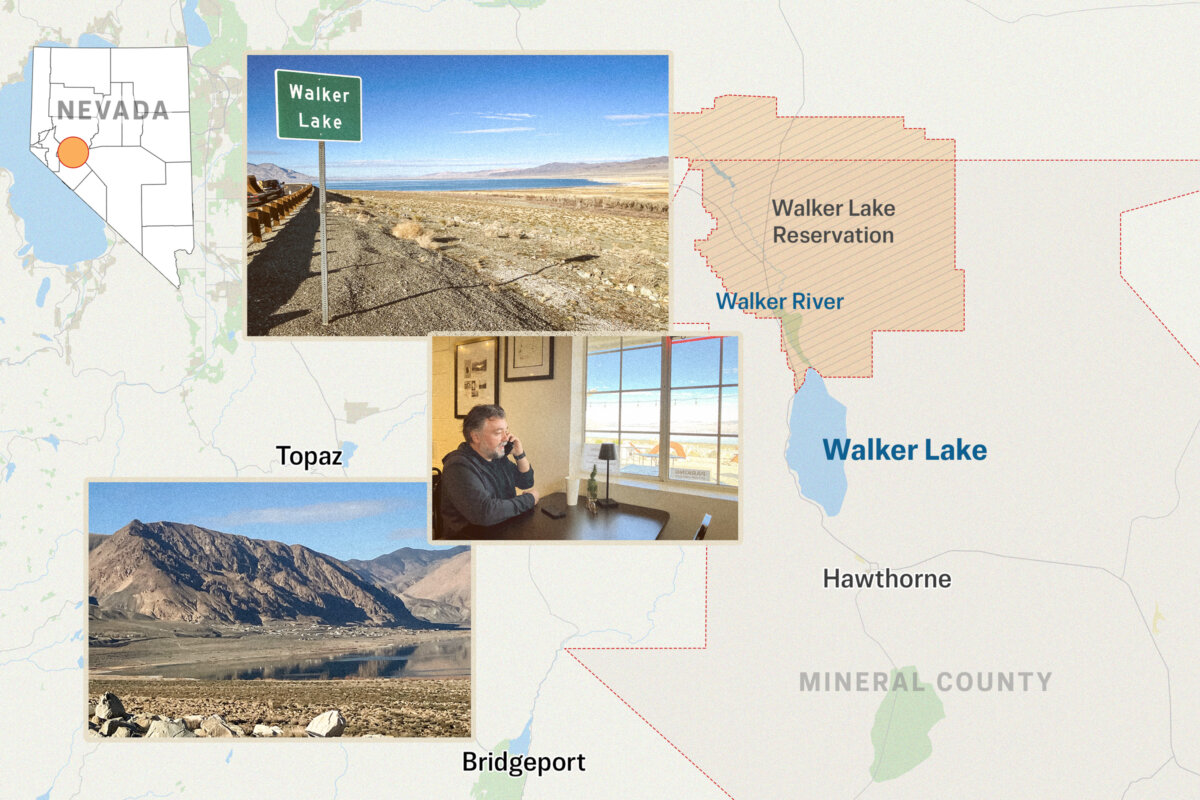
Geologists and environmental experts agree that without public-private intervention and the changes in state water law that the suit seeks, the future is bleak for Walker Lake, a 13-mile-long terminal lake about 75 miles southeast of Reno near the California state line in rural, sparsely populated Mineral County.
The lake is completely dependent on diminishing Sierra Nevada snowmelt runoff into the Walker River—runoff that, for decades now, has been almost entirely diverted for irrigation by upstream farmers and ranchers.
As a result, a desert oasis that once generated more than half of Mineral County’s economic activity through recreational pursuits such as fishing, migratory bird-watching, boating, and camping is now a lifeless “sludge pond,” and the town of Walker Lake faces an accelerating prospect of extinction.
“The last fish was caught in 2013 or 2015, I believe. When the fish died, the fishing died; boating, recreation, that all just disappeared,” Mineral County Commissioner Tony Ruse said.
“There were restaurants here. There were hotels here. There were businesses here. Now? All gone, just 300 residents struggling.”
A Mineral County native, Ruse returned in 2020 after working for 34 years as a chef in Europe and Asia, including 20 years in South Korea, to open The Big Horn Crossing, a restaurant and convenience store in a shuttered bait shop. It’s now Walker Lake’s only remaining retail business.
“It was dead. There was nothing,” he told The Epoch Times. “We should be selling bait here. We should be selling fishing supplies. There should be boats parked in our driveway right now.”
Marlene Bunch and her husband, Glenn, lead the Walker Lake Working Group, created in 1991 to ensure water reaches the lake to sustain its recreational economy.
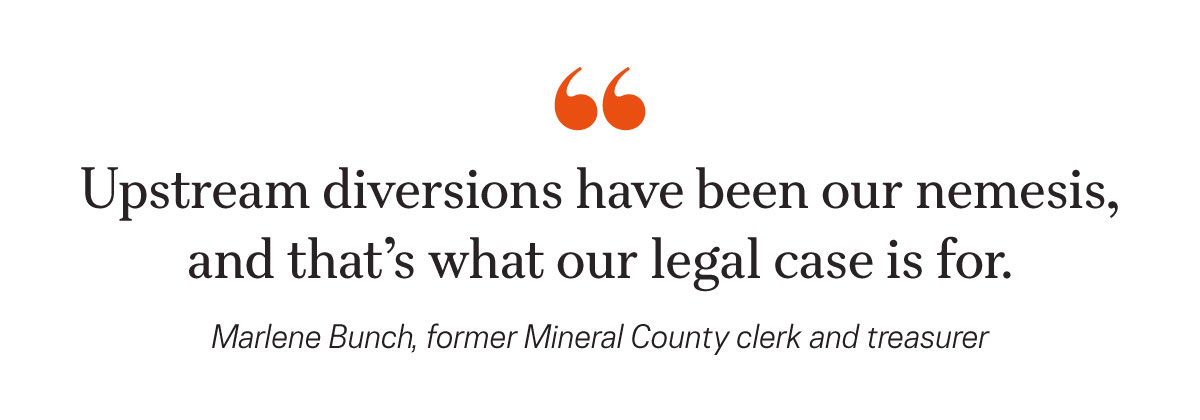
“Upstream diversions have been our nemesis, and that’s what our legal case is for,” Bunch, a former Mineral County clerk and treasurer, told The Epoch Times.
Bunch has lived in Walker Lake since the 1960s. She recalls a 1991 discussion with Nevada Department of Wildlife fisheries biologist Mike Sevon about what would happen if water levels were to continue to drop.
Diminishing Returns
Walker Lake retains water flowing east 100 miles from California’s Bridgeport and Topaz reservoirs through Nevada’s Smith and Mason valleys and the Walker River Paiute Tribe’s reservation. According to the U.S. Geological Survey, its water levels have declined by more than 160 feet since 1882. The lake was nearly 30 miles long in 1850 but is only 12 miles long today.
The runoff provided hydrological pressure that sustained area water wells, especially in Walker Lake, where Ruse said residents are seeing lower-quality water coming from taps, a potential death knell for the town.
“It’s getting harder and harder to keep the federal standards for potable water,” he said. “So there’s going to be a day—and I’m waiting for the call—that we need to put a reverse-osmosis system in, which we couldn’t afford to do.”
Walker Lake and nearby Hawthorne, the Mineral County seat, struggle in the desert—Hawthorne’s population has declined by 60 percent to a little more than 3,000 in 2020 from 10,000 in 1980. Agriculture in the Smith and Mason valleys has thrived.
But because mountain runoff has been unreliable for decades now, when upstream users divert their share, little to no water makes it to Walker Lake, leaving once-bustling waterfront businesses marooned as hulking shells far from a distant, receding shore.
The case, United States and Walker River Paiute Tribe v. Walker River Irrigation District, is not a new case but ongoing litigation arising from a lawsuit filed in 1924.
It’s part of a flood of litigation stemming from Walker River allocations, going back to 1902, when rancher Henry Miller sued Thomas Rickey over water rights on the river.
A 1936 Walker River Decree issued by the U.S. District Court for the District of Nevada finalized water rights for more than 500 private landowners, primarily farmers and ranchers, within the Walker River Basin, including those in the Walker River Irrigation District, under a “first in time, first in right” policy that remains the standard almost a century later.
Like Nevada, most western states allocate water by the policy, known as prior appropriation. Therefore, under the 1936 decree, upstream users have legal priority to Walker River water.
But in 2015, Mineral County filed a lawsuit citing the public trust doctrine, the legal principle that certain natural and cultural resources be preserved for public use.
The lawsuit claimed that under the public trust doctrine, it is the state’s duty to maintain minimum inflows into public waters, such as Walker Lake, to sustain environmental, wildlife, recreational, and economic resources.
The U.S. District Court ruled in the county’s favor. The irrigation district appealed. The U.S. Ninth Circuit Court overturned the ruling; the public trust doctrine, it held, was a state law issue that had not been decided in Nevada.
That kicked the case back to the Nevada Supreme Court, which in 2020 determined that all Nevada waters will now be allocated under the public trust doctrine but that water rights that had already been issued would not be, and could never be, reallocated.
The court directed Mineral County to recommend ways to restore the lake without reallocating water rights and to work with the Walker Basin Conservancy, a nonprofit created in 2014 with federal funding initially secured by Sen. Harry Reid (D-Nev.) and the National Fish and Wildlife Foundation’s Walker Basin Restoration Program.
In 2021, Mineral County amended its 2015 complaint to intervene in the decades-long parallel suit by the Walker River Paiute Tribe seeking to boost Walker River flows into a reservation reservoir and secure water rights for 167,460 acres added to the reservation since 1936.
The county’s complaint includes 24 “actions … necessary to restore and maintain Walker Lake’s public trust values.”
After years of procedural delays, including a requirement to individually serve more than 1,000 watershed landowners across the country, the case is set to proceed into discovery. A potential trial looms.
But an alternate “win-win” solution orchestrated by the Walker Basin Conservancy is gaining traction and could mitigate the need for a court-ordered resolution.
‘The Only Solution’
Since its creation, the conservancy has restored public access to 33 miles along the Walker River and purchased more than 13,700 acres of water rights, enough to restore about 60 percent of the river inflow that biologists maintain is needed to restore the lake’s fishery.
Conservancy CEO Peter Stanton and Water Program Director Carlie Henneman did not return emails and repeated phone requests from The Epoch Times for comment about the program. Nor did the Nevada Department of Conservation and Natural Resources, Walker River Irrigation District attorney Gordon DePaoli, or Walker Basin Working Group’s Oregon-based legal advisers, Jamie Saul of the Wild & Scenic Law Center and Kevin Cassidy of Lewis & Clark Law School’s Earthrise Law Center.
Several attorneys representing different parties would speak only off the record.
Roderick E. Walston, an attorney with Best Best & Krieger in Walnut Creek, Calif., told The Epoch Times that his clients above the Bridgeport Reservoir in California are apprehensive about Mineral County’s suit, which he said essentially demands that the federal court reallocate existing water rights under the public trust doctrine.
“Our response is basically that the Nevada Supreme Court resolved that issue four years ago,” he said.
Walston was a California deputy attorney general in 1983 and argued the Mono Lake case before the California Supreme Court. In that case, the state’s public trust doctrine was used to thwart Los Angeles from purchasing Mono Lake water rights that would have devastated the lake’s ecology and Sierra Nevada economies.
“So I argued both the case in California Supreme Court 40-something years ago and then also argued the case in the Nevada Supreme Court about four years ago,” he said.
Walston said the case could have “great impact” on water disputes in states that uphold the prior allocation doctrine.
Mineral County District Attorney Ryan McCormick, who assumed his post seven weeks ago, told The Epoch Times he’s playing catch-up in reading filings “from decades and decades of litigation.”
“In a perfect world, if we get some specific performance and find a way to divert water back into the lake and have the levels rising again, that would be absolutely ideal,” he said.
He also said that he isn’t privy to the reasoning behind all 24 actions assembled by the Walker Lake Working Group.
It’s a complicated case in a long-litigated watershed, but the best resolution is simple, McCormick said.
“With the best interests of Mineral County, Hawthorne, and Walker Lake in mind here, we would like the lake to be receiving fresh water again,” he said. “It would be nice to see some economic development right now, right?”
But Walston said odds are slim the court will cast aside the state’s Supreme Court determination that existing water rights cannot be reallocated.
Working with the conservancy and other groups to purchase water rights from willing landowners at $3,000 to $4,000 per acre foot—an acre of one-foot deep water—is a win for all involved, he said.
“It’s the only solution, really. The Nevada Supreme Court has said you can’t just take water rights that have been adjudicated and take that water and put it into Walker Lake,” Walston said.
“But you can go to various water users and negotiate with them and buy their water rights. In that case, then you could reallocate.”
 Friends Read Free
Copy
Facebook
Tweet
Friends Read Free
Copy
Facebook
Tweet