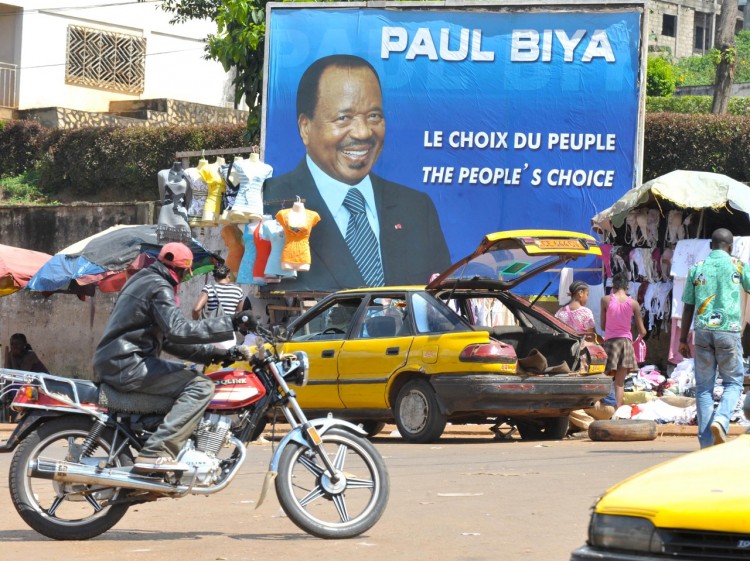
Last week the Supreme Court of Cameroon announced that the incumbent, President Paul Biya, had won 77.98 percent of the votes in a battle against 22 opponents. For the first time in this year’s elections, the diaspora was also allowed to vote.
But while Biya’s success may seem noteworthy, reality in the country reveals a different picture.
“People are not just dissatisfied with Biya’s ruling: this is a low estimate. They are disgusted!” said Dibussi Tande, Cameroonian blogger and writer living in Chicago, in a telephone interview. “They call him the ‘do nothing’ president, because he doesn’t do anything for the country.”
The opposition seems also unable to deliver, as it is weakened and divided.
“In any normal, democratic country, if you face an incumbent who has the state resources, the money, the state TV, the administration at national and local level, and then you have 22 candidates against this person, even if this person is unpopular, it is obvious he is going to win.”
The blogger recalled Radio France International’s (RFI) interview with Bernard Muna, one of the presidential candidates, in which he was asked what the opposition was going to do after the Supreme Court announces Paul Biya as a winner. That candidate replied: “There is nothing we can do.”
Julie Owono, Cameroonian blogger and political commentator, living in Paris, said there were mainly two reasons behind the massive political apathy in Cameroon: first, people had lost faith in the ability of the opposition to deliver; and second, after several violent episodes in Cameroon’s recent history, people don’t want instability, but peace. Thus, the elections resulted in a very low turnout.
“A lot of people didn’t vote. It was a way for them to show that they don’t trust the electoral system and don’t want to participate in Paul Biya’s victory,” added Owono in a telephone interview.
She said that even in Douala, one of the two main cities in Cameroon, many polling stations were empty, which was an incredible sight during Election Day. In her estimate, the people who came out to vote did so mainly in favor of the incumbent president. The same was in the diaspora, whose members were allowed to vote for the first time. But the abstention was huge even there.
“In France, where I live, there are 40,000 Cameroonians, of whom only 1,000 registered to vote. I think only 900 went to vote in the end,” added the blogger.
More than 4 million Cameroonians are estimated to live outside the country. Those eligible to vote were allowed do so in 33 diplomatic and consular missions worldwide, according to the Cameroon Ministry of Foreign Relations. But it was still not easy.
Election Reality
Presidential elections in Cameroon were announced only six weeks prior to the election date, with parties having only two weeks to register: a time frame, which was virtually impossible for presidential candidates to prepare and wage political campaigns.
“Political parties with resources much less than those of the ruling party, had to prepare within four weeks after registering: to build teams, to run a campaign, and to visit every one of the 10 regions of the country. This is impossible, even in the best of the situations,” said Dibussi Tande.
The blogger explained that Cameroon has very bad communications infrastructure and the airlines fly to only three of the cities in the country. That is why, the opposition leaders did not even go to some parts of Cameroon.
“One week before the elections, the president went to the northern part of the country to campaign. Then the next day, three opposition parties wanted to go there as well. But they could not do it, because the president had booked all the planes.”
Usually it takes several hours to cross Cameroon by plane, and this is the usual way of transportation. By train it takes around 24 hours.
“So how are you expected to win, when you are not even allowed to go? That is why now it is impossible for any opposition parties to win any elections in Cameroon,” concluded Tande.
On a positive note, an electoral commission, called ELECAM, was established in the capital Yaounde, tasked with overseeing the electoral process. But critics say that commission was basically made up of members of the ruling party and the government, with few civil society neutral observers. The resources were scarce and disorganization was common.
On Oct. 13, 10 presidential candidates filed an appeal before the Supreme Court to nullify the elections due to fraud and irregularities. The court rejected the claim, but RFI announced Monday that France had decided to revise its original position that the elections were held under “acceptable terms.” Last Saturday the spokesman of the French Ministry of Foreign Affairs, Bernard Valero said, “In the election were found many failures and irregularities.”
“Registering in the elections in Cameroon is not a straightforward process as it is in the U.S., for example,” explained the blogger Dibussi Tande. “It is complicated: you have to show your ID card, check where your polling station is; often polling stations are moved from one place to another, there is no computerized system. Even if you register, it happens that your name is not on the list.”
What is more, in Cameroon there is a decentralized system for governance and each governor has to do what he has to in order to keep his place. This is done by making sure the president wins.
“Even if the president doesn’t go out and say: ‘I want you guys to rig the elections,’ that is what those guys at the local level will go out and do,” added Tande.
The financial enticement is also not one to ignore. According to Ntemfacofege, a Cameroonian blogger from the Global Voices initiative, Paul Biya’s regime is betting each presidential opponent the equivalent of $50,000 (25 million CFA francs) to present a challenge to his candidacy. The money is not audited, is a good deal, and the government cannot be accused of lack of democracy.
Continued on the next page … Turning Point
 Friends Read Free
Copy
Facebook
Tweet
Friends Read Free
Copy
Facebook
Tweet