
Socialist ideology has made headway in the United States in recent years.
New York’s leading candidate for mayor is a self-described democratic socialist, and the number of Americans having a positive view of capitalism has fallen to 54 percent, a 6-point decline in just five years, according to Gallup.
Support for socialism is rising, especially among Democrats and younger people. Gallup also reported that 66 percent of Democrats have a favorable view of socialism, while a 2025 survey by Cato Institute and YouGov found that 62 percent of 18- to 29-year-olds view socialism favorably, and 34 percent have a favorable view of communism.
Support for socialism has grown even among conservatives, as 14 percent of Republicans—up from 9 percent in 2019—view the ideology favorably, according to Gallup.
We asked The Epoch Times readers for their opinion on how prevalent socialist and communist ideas are, where they observe them in culture and policy, and if they see a connection to current events.
Identifying Communism and Socialism
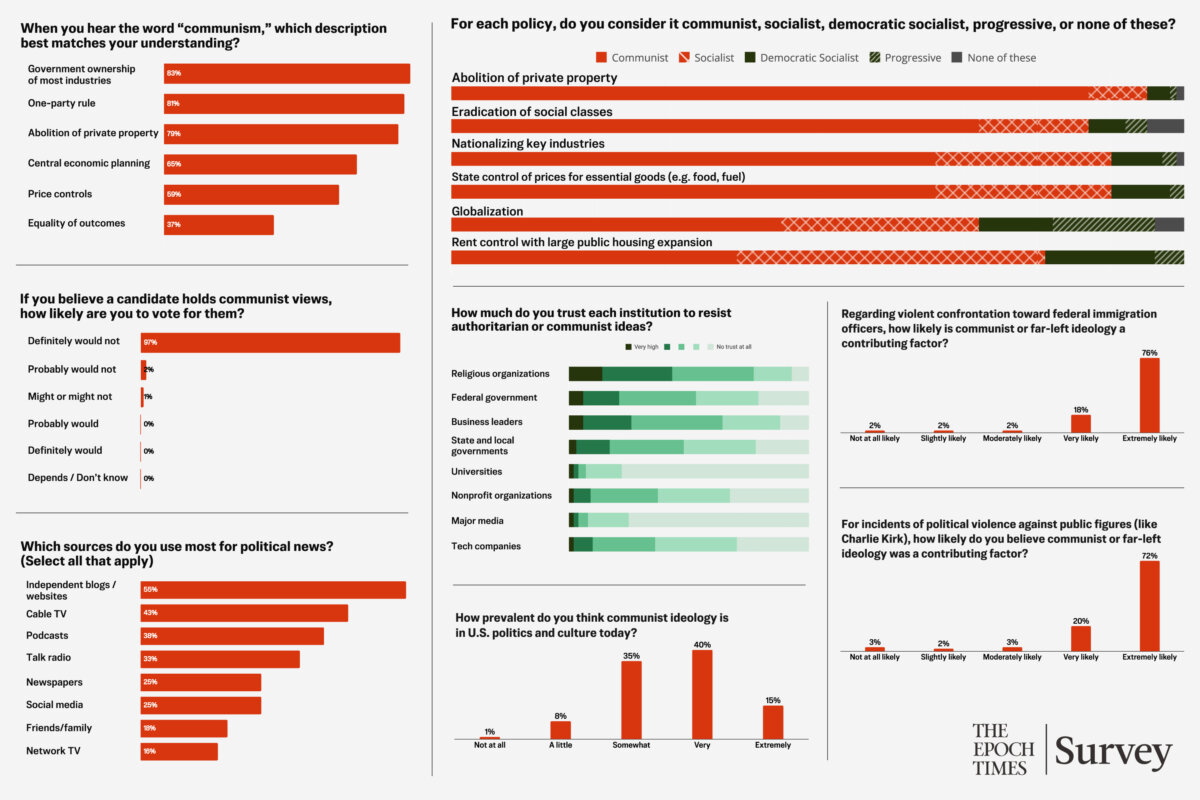
Asked which of five potential classic markers matched their own definition of communism, respondents zeroed in on three, each selected by about 80 percent of respondents. Those three were: Government ownership of most industries (83 percent), one-party rule (81 percent), and the abolition of private property (79 percent).
The other two markers were central economic planning, selected by 65 percent of respondents, and price controls, selected by 59 percent.
Many readers said that communism produces an authoritarian government that exerts control over many aspects of society, including the media, the economy, and personal freedom.
Many others pointed to the loss of personal freedoms, seen in censorship, denial of free speech, confiscation of property, religious persecution, and surveillance by the state.
One reader wrote, “All of the above–[it is] total government control of society.”
Some political philosophers place communism and socialism on a spectrum, with communism more strongly emphasizing state control over economic life and personal liberty.
We asked readers to rate certain ideas as communist, socialist, democratic socialist, progressive, or none of those.
Responses show that many readers are aware of distinctions between the various ideologies.
A sizable majority of respondents named each of the following as communist ideals: abolition of private property (87 percent), eradication of social classes (72 percent), nationalizing key industries (66 percent), and state control of prices for essential goods (66 percent).
Respondents in roughly equal numbers named as socialist the nationalizing of key industries (24 percent), state control of prices for essential goods (24 percent), and globalization (27 percent).
Of all the ideas, globalization was the one most often categorized as progressive at 14 percent. The ideas most likely to be identified as socialist were globalization (27 percent) and rent control with large public housing expansion (42 percent).
Readers appeared to see little difference between democratic socialism and progressivism.
Prevalence of Communist Ideology
Most respondents believed that communist ideology is either very (40 percent) or extremely (15 percent) prevalent in U.S. culture and politics. Only 1 percent saw no evidence of communist ideology today.
An overwhelming majority of readers saw a connection between communist ideology and political violence.
Nearly all said communist or far-left ideology was very likely (18 percent) or extremely likely (76 percent) a factor in violent confrontations with immigration officers.
Similar numbers believed that it was also very likely (20 percent) or extremely likely (72 percent) a factor in political violence against public figures.
Dealing With Communist Thought
When it came to voting for candidates with communist views, a resounding 97 percent of respondents said they definitely would not do so.
Religious organizations were ranked as most trusted to resist authoritarian or communist ideas, followed by business leaders.
The federal government, tech companies, state and local governments, and nonprofits were near the middle of the pack.
The least trusted were universities and major media, each rated as untrustworthy by about three-quarters of respondents.
Respondents reported using a variety of sources for political news. More than half (55 percent) said they rely on independent blogs and websites, and some 43 percent get news from cable television.
Podcast and talk radio are the choice of about a third of respondents, while a quarter report using newspapers and social media.
Network television was the least-used news medium, chosen by just 16 percent of respondents.
Many readers stressed that they seek independent news sources while relying on books, religious publications, and common sense.
As one reader put it, “[I use] all of the above, but most importantly, my own critical thinking skills to digest it all and make my own decisions from there.”
 Friends Read Free
Copy
Facebook
Tweet
Friends Read Free
Copy
Facebook
Tweet