
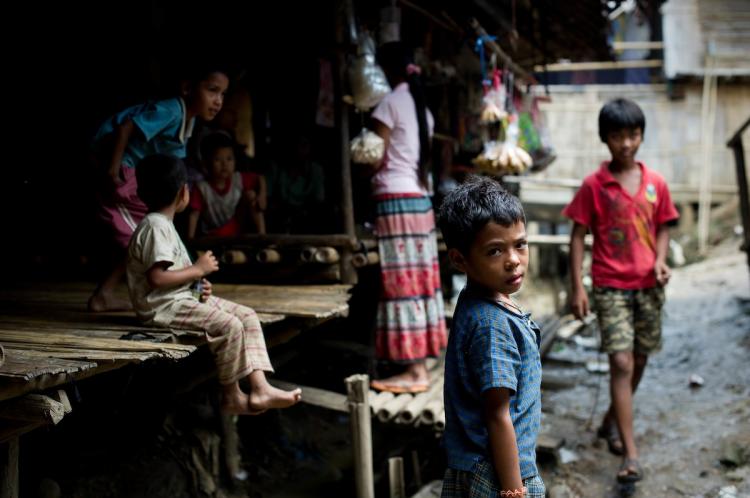
Having surveyed 21 townships in conflict zones, researchers discovered that over 40 percent of children below 5 years of age are acutely malnourished and one in seven of them will die before reaching this age.
Conducted by a network of community organizations, the report “Diagnosis: Critical” says the chronic health crisis witnessed in eastern Burma is the result of official disinvestment in health, a protracted conflict, and widespread human rights abuses.
“In eastern Burma the mortality rate for under 5-year-old children is comparable to conflict zones of the DR Congo and Sudan,” said Nai Aye Lwin from the Backpack Health Worker Team, which assists communities inside Burma.
“We found that 60 percent of these deaths of children under 5 were due to preventable diseases,” he said.
“Our survey shows a clear link between human rights violations and poor health indicators in families who suffer forced labor: children will be two and half times more likely to die,” said Nai.
The report also found that one in three people had experienced in the previous year some form of human rights abuse at the hands of the military.
“Community groups are constrained by [a] lack of resources and ongoing human rights abuses by the military regime. … In order to properly address the needs of eastern Burma’s health crisis, the human rights abuses must end,” said Nai.
Burma last year had a US$2.5 billion trade surplus, said Nai, but the military junta only spends 1.8 percent of its total budget on health and 40 percent goes to the military.
Targeting Civilians
Since Burma gained independence from Britain in 1948, various ethnic groups in the east of the country have sought greater autonomy, resulting in cases of armed rebellions. Currently a number of armed groups in eastern Burma, such as the Karen National Liberation Army and the Shan Army-South, continue to oppose the military junta that has ruled the ethnically diverse country since 1962.
In dealing with these groups, part of the Burmese military’s strategy includes the targeting of the civilian population, which has resulted in ongoing human rights abuses.
Dr. Cynthia Muang, who has a health clinic on the Thai-Burma border and is chairwoman of the Burma Medical Association, said the health crisis over the past decade has gradually been getting worse.
Contiuned on the next page…
 Friends Read Free
Copy
Facebook
Tweet
Friends Read Free
Copy
Facebook
Tweet