
WASHINGTON—The Make America Healthy Again (MAHA) agenda has helped shape the second Trump administration, with early actions targeting mercury in vaccines, artificial food dyes, and ultra-processed foods.
That’s thanks in large part to Health Secretary Robert F. Kennedy Jr., who dropped out of the presidential race in August 2024 and joined forces with then-presidential candidate and former President Donald Trump.
Tune in to Constitution Avenue, where Epoch Times reporters explain the three branches of the U.S. government.
Kennedy stressed one notable MAHA agenda item just two days before Election Day.
On Nov. 3, 2024, he asked voters to support Trump “so we can ban pharmaceutical advertising”—such as the commercials for brand-name drugs that pepper many network shows.
The United States consumes more prescription drugs than any country in the world and spends nearly twice as much for them as all other developed nations combined, according to a Rand report.
For now, independent and Democratic senators are leading the legislative charge to eliminate direct-to-consumer drug ads, including on social media, with House Democrats following with a parallel bill.
Sen. Josh Hawley (R-Mo.) has voiced openness to his Senate colleagues’ proposal. The Missourian is also part of a bipartisan effort to get rid of tax deductions available to drug companies for promotions.
Though some legislators are enthusiastic, past court decisions might throw up roadblocks—any sturdy leash on Big Pharma’s marketing could get tangled on the First Amendment.
MAHA Versus Commercial Speech
Critics of direct-to-consumer drug advertising, including Kennedy, have long pointed out that the practice is rare around the world. It is only allowed in the United States and New Zealand.
In May, the MAHA Commission released a report on childhood chronic disease that raised concerns about pharmaceutical ad campaigns aimed at everyday Americans. It suggested that they encourage “a notable level of reliance on the industry by those that benefit financially.”
The report also highlighted medical publications that have linked those advertisements to the over-diagnosis of disease and the overuse of drugs, including by children.
By 2023, Americans were consuming more than 210 billion daily doses of medication, data from analytics company IQVIA show.
Dr. Marty Makary, the commissioner of the Food and Drug Administration, said in April, “We don’t have any plans to ban direct-to-consumer advertising.”
“There are some things we can do to make sure that the information being presented is a complete picture,” he added.
Legal precedent could make it difficult to eliminate such advertisements. Corporations, including drug companies, have wide latitude for commercial speech in the United States.
In 2002, the Supreme Court ruled that a federal law restricting advertisements for certain drugs ran afoul of the First Amendment.
About a decade later, it struck down a Vermont law banning the sale of prescription drug users’ data for drug marketing, again on free speech grounds.
Sanders, King, Shaheen, and Hawley
Despite the Supreme Court’s record, some lawmakers want to bring the issue to a head.
In June, Sens. Bernie Sanders (I-Vt.) and Angus King (I-Maine), independents who caucus with the Democrats, unveiled the End Prescription Drug Ads Now Act.
The measure would alter the Federal Food, Drug, and Cosmetic Act to define all direct-to-consumer advertising as misbranding, thereby banning it.
“This bill is a great step to ensure that patients are getting the best information possible and from the right source: their providers and not biased advertisements,” King said in a statement.
The senators attracted five Democrats as cosponsors: Sens. Tammy Duckworth (D-Ill.), Peter Welch (D-Vt.), Dick Durbin (D-Ill.), Jeff Merkley (D-Ore.), and Chris Murphy (D-Conn.).
It is now in the Senate’s health committee, where Sanders is the ranking member. Sanders’s office did not respond to requests for comment.
On July 21, King told The Epoch Times he was unaware of any Republicans in the Senate who supported the proposal.
That same day, Hawley, who has carved out a reputation as an economic populist, said he was receptive to the bill.
“I haven’t read Bernie’s bill, but it sounds very complementary to me,” he told The Epoch Times.
He suggested that it paired well with one of his own bills, one that targets pharmaceutical ads in a way that Kennedy has also highlighted.
In May, Hawley and Sen. Jeanne Shaheen (D-N.H.) introduced the No Handouts for Drug Advertisements Act.
Under current law, drug companies can claim tax deductions for ads for both compounded medications—drugs combined or otherwise customized to individual patients—and prescription drugs. Hawley and Shaheen’s proposal would make that impossible.
“HHS Secretary RFK Jr. has made it clear that he wants to ban prescription drug commercials, and I’m proud to introduce legislation to do just that,” Hawley said in a statement on the bill.
Like Sanders and King’s bill, it is awaiting action in a committee—in this case, the finance committee.
Interest Grows in the House
Rep. Greg Murphy (R-N.C.), a medical doctor, introduced a House version of Hawley and Shaheen’s bill in April. It, too, was referred to that chamber’s finance committee.
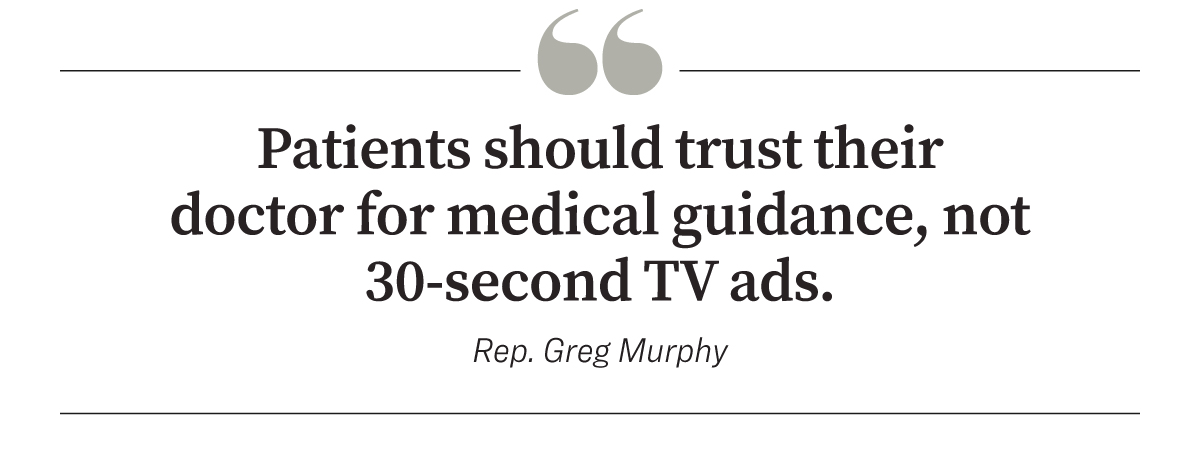
“Patients should trust their doctor for medical guidance, not 30-second TV ads,” Murphy said at the time.
His cosponsors include a Republican, Alaska’s Nick Begich, and two Democrats, Hillary Scholten of Michigan and Angie Craig of Minnesota.
On July 22, Rep. Ilhan Omar (D-Minn.) told The Epoch Times that she would back a House version of Sanders and King’s measure.
When asked whether she worried about the courts striking it down, she said, “I think we should give it a shot.”
Two days later, Omar cosponsored the House’s End Prescription Drug Ads Now Act with Reps. Jerry Nadler (D-N.Y.) and Maxine Dexter (D-Ore.). Dexter, like Murphy, is a medical doctor.
The Department of Health and Human Services did not respond to a request for comment.
 Friends Read Free
Copy
Facebook
Tweet
Friends Read Free
Copy
Facebook
Tweet