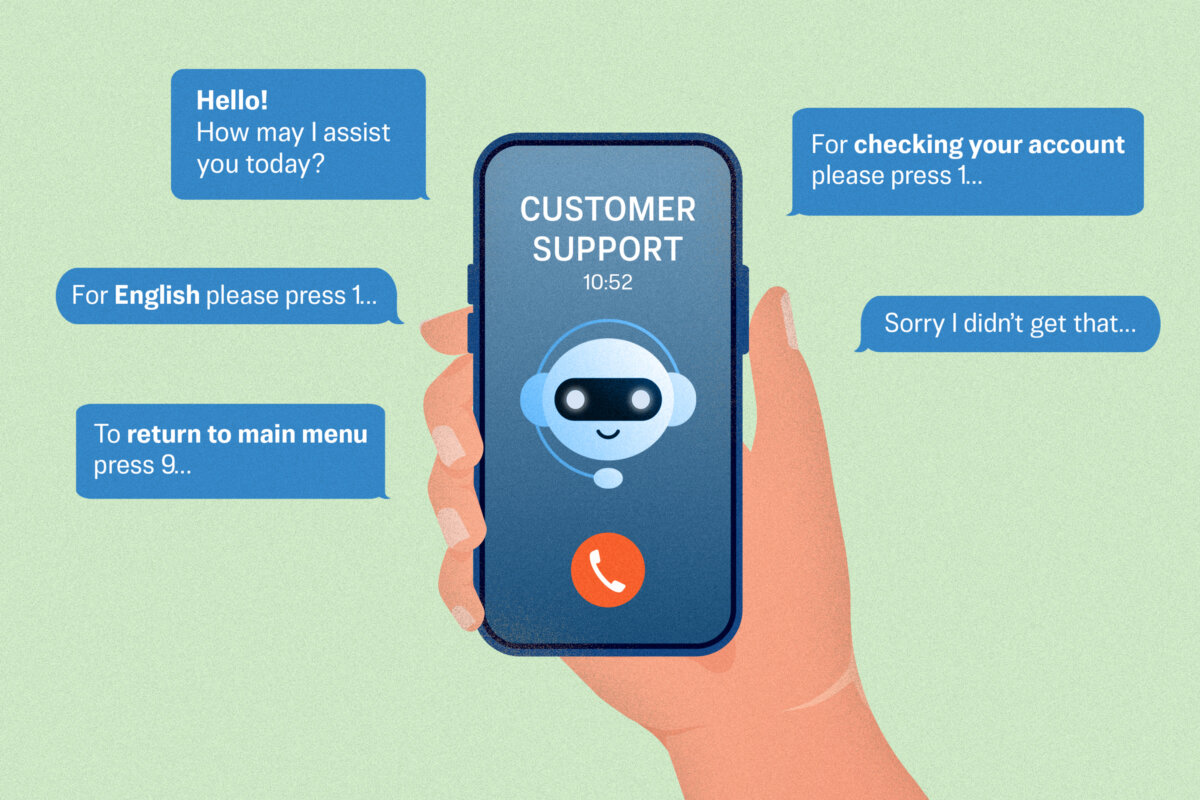

Artificial intelligence is revolutionizing customer service across multiple industries. However, both industry professionals and American consumers say it’s a mixed blessing that requires a clear integration path and reliable, easy-to-access human support. This is especially true when problems require more complex interactions to resolve.
AI is used in 70 percent of customer contact centers, according to an April report from market research firm Gitnux. Chatbots—virtual agents that simulate human conversation on the phone or online—reduced customer service call volumes by up to 30 percent. Meanwhile, 65 percent of managers at contact centers say AI has improved employee efficiency.
However, while industries rush ahead to optimize contact and call center efficiency, customers are getting frustrated with AI interactions that make it difficult to reach an actual person.
Corey Colwell had one such interaction during a recent attempt to troubleshoot an issue with the popular communications platform Zoom.
“I spent 20 minutes trying to get help with a Zoom account feature, going in circles with an AI bot. [There was] no resolution, just frustration,” Colwell told The Epoch Times.
Colwell is the chief operations officer of the personalized supplement company SNiP Nutrigenomics, which requires her to interact with AI in service-related roles regularly. Over the past few months, she’s noticed that her daily AI dealings have become more frustrating.
“Nearly every company seems to have adopted some form of AI customer service bot, and I’ve rarely found them effective. Unless the issue is extremely basic, the experience is often confusing, impersonal, and unhelpful. It reflects poorly on the brand,” she said.
An estimated 70 percent of customer interactions will involve AI in 2025, according to a WifiTalents analysis.
Research shows that the majority of people still prefer speaking with a human when they’re trying to get an issue resolved. A 2023 McKinsey & Company survey indicated that 71 percent of Generation Z and 94 percent of baby boomers preferred live calls for problem-solving.
One long-time customer of telecommunications company Xfinity, who asked to be referred to only as Dana, said she was frustrated with a recent experience with AI.
“I’ve been getting billed for a service I canceled, and it’s happened twice now. It’s nearly impossible to get someone on the phone, so I had to go into one of their offices in person, which was incredibly inconvenient,” Dana told The Epoch Times.
Dana felt increasingly annoyed with a series of AI prompts that didn’t put her in touch with an actual customer service agent. “You can bet I’ll never recommend their service to anyone—like, ever!” she said.
Thankfully, many businesses are recognizing that there’s no substitute for good old-fashioned human problem-solving.
Xfinity did not respond to a request for comment.
Zoom previously experienced some technical issues with its AI interface, which caused some difficulties for clients seeking support. However, a company spokesperson told The Epoch Times those issues have been addressed to the best of their team’s knowledge.
Digital Tightrope Walk
Michael Podolsky, CEO of review platform PissedConsumer.com, collects data on angry customers looking for a place to share their bad experiences.
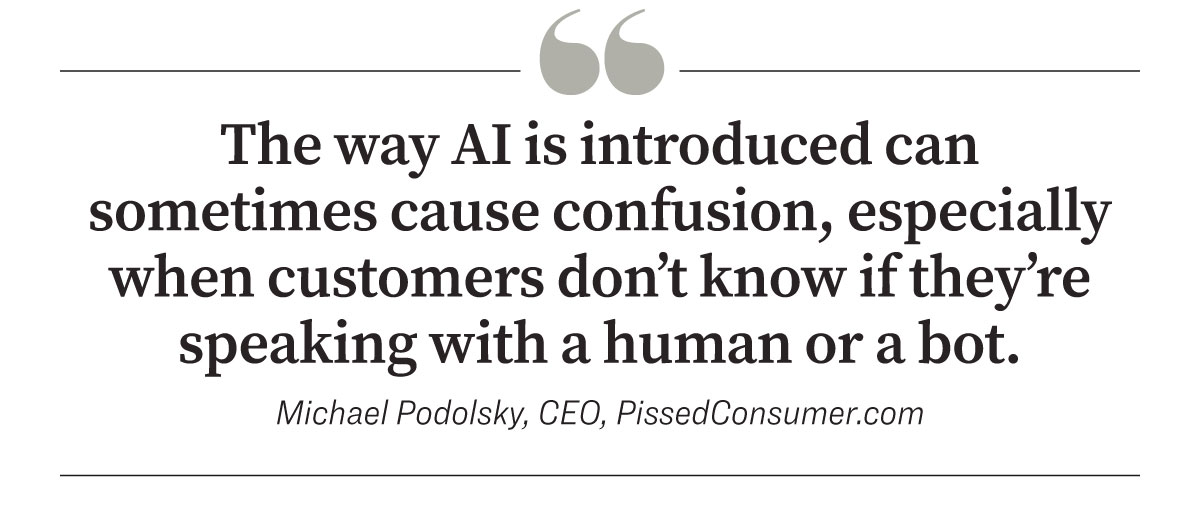
“The way AI is introduced can sometimes cause confusion, especially when customers don’t know if they’re speaking with a human or a bot,” he told The Epoch Times.
“When there is no clear option to talk to a human agent, the experience often worsens, leading to frustration and mistakes in communication.”
Podolsky said it comes down to one question for companies using AI in customer service roles: Can your team catch and fix AI errors before they damage the customer experience?
“For AI to work effectively, it requires a large volume of data specific to your organization. You can’t simply use customer service data from one company and expect it to perform well in another,” he said.
“Teams must gather and analyze customer interactions over time to build a strong data foundation so that AI can learn, understand context, and improve its responses.”
He also shared his own experience with a leading auto dealership, where he encountered problems with the company’s AI support systems while trying to get updates on the status of his vehicle repair.
“The AI-powered system kept looping, insisting my vehicle did not exist in their records, even though I was a long-term customer. It took seven days and countless hours of chasing phone numbers before I finally drove to the dealership to speak with a manager in person,” he said.
“When I asked whether they were satisfied with their AI customer service, the manager pointed to reduced call times and statistics provided by the third-party vendor supplying the AI system.”
Podolsky’s experience highlights how quickly human–AI interactions in customer care can go downhill and potentially affect client retention.
Ellie Wu, founder of executive advisory firm CSuiteCX, focuses on customer growth and retention.
She believes the real risk comes from how ill-equipped many companies are to manage the transition to using AI in customer service, which is only half the equation, she said. The other half is organizational readiness, which is where many customer service teams fall short.
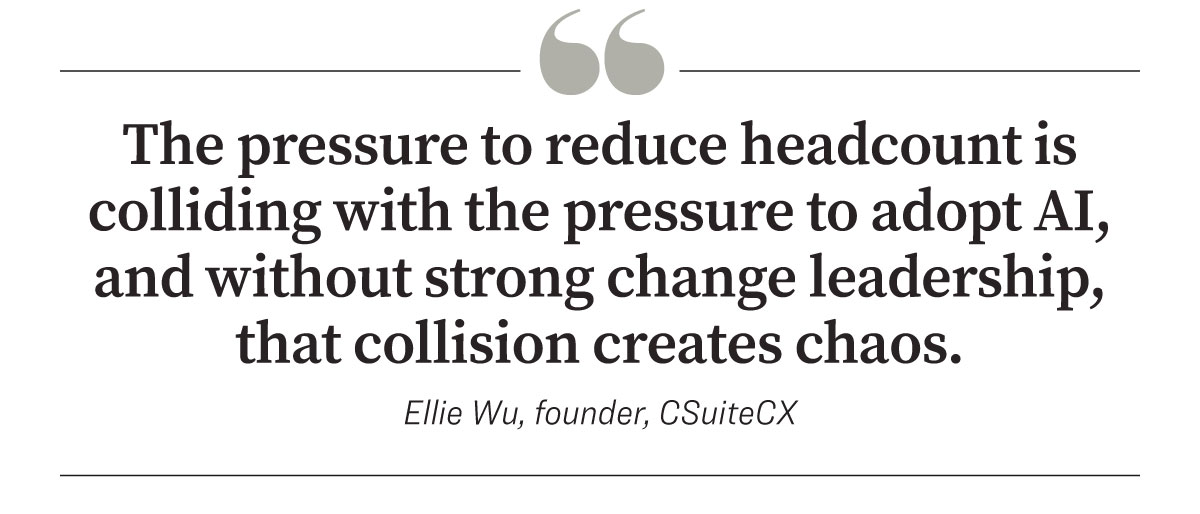
“The pressure to reduce headcount is colliding with the pressure to adopt AI, and without strong change leadership, that collision creates chaos,” she said. When AI is implemented “without clear escalation paths or reliable human support, people get stuck.”
“And when they get stuck, they leave,” she said.
She saw this play out in real time when payment company Klarna replaced about 700 support agents with AI chatbots in 2024. Customer satisfaction dropped over the next year, and by mid-2025, Klarna began reintroducing human agents “and rebuilding escalation paths,” she said.
Wu believes the message from Klarna’s cautionary tale is clear: Greater efficiency isn’t worth the loss of client trust.
In June, a Gartner report predicted that by 2027, 50 percent of organizations that anticipated a significant customer service workforce reduction in favor of AI will scrap their plans amid ongoing integration challenges.
In a survey of 163 customer service and support leaders conducted in March, Gartner found that 95 percent of support team leaders “plan to retain human agents to strategically define AI’s role.”
Gartner called this a “digital first, but not digital only” approach.
Striking a Balance
Not all companies are putting the proverbial cart before the horse when it comes to AI integration. Some are moving forward with caution and staying attuned to how their customers feel about AI problem-solving.
Eric Turney, president at The Monterey Co., said the company has started using AI voice agents on weekends to help manage incoming calls and basic questions when the live team is offline.
“It’s been helpful for triaging requests and making sure customers aren’t met with silence,” he said.
The company has also used AI to follow up on orders and encourage customers to leave positive reviews. That has increased online feedback without requiring manual outreach from customer service representatives.
That said, Turney noted that AI’s attempts to address client concerns have presented challenges.
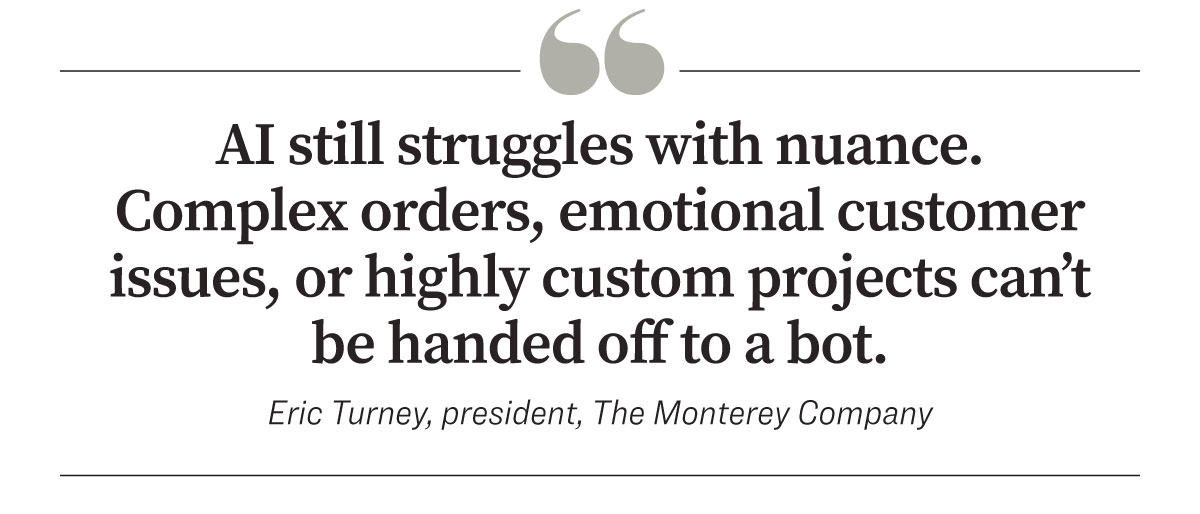
“AI still struggles with nuance. Complex orders, emotional customer issues, or highly custom projects can’t be handed off to a bot,” he said. “It’s great for generating positive reviews, [but] it doesn’t know when not to ask, so we’ve had to implement human oversight to avoid awkward moments after a bad experience.
“The key is balance—using AI to handle the repetitive stuff so our team can focus on the personal, high-impact moments that truly build loyalty.”
Wu agrees. “AI can absolutely add value, but only when the rollout is matched with structure, alignment, and clear accountability,” she said.
Podolsky warns businesses against using the wrong metrics to measure the success of AI-powered customer service rollouts. “It cannot simply be about reducing call time,” he said.
This article has been updated with a response from Zoom.
 Friends Read Free
Copy
Facebook
Tweet
Friends Read Free
Copy
Facebook
Tweet