
A little less pain at the pump lifted U.S. consumer sentiment higher in June.
June’s final Consumer Sentiment Index climbed by almost 11 percent to 49.5, from the previous month’s 44.8, according to new data from the University of Michigan on June 26.
This came in slightly below the consensus forecast of 50.
Additionally, the indexes for current economic conditions and expectations also rebounded this month, with increases seen across income, political affiliation, and wealth.
Crude oil and gasoline prices had rocketed at the start of the war in Iran in late February, leading headline inflation to rise to the highest level since 2023.
Amid prospects for a peace deal between Washington and Tehran that would reopen the Strait of Hormuz, global energy markets have stabilized.
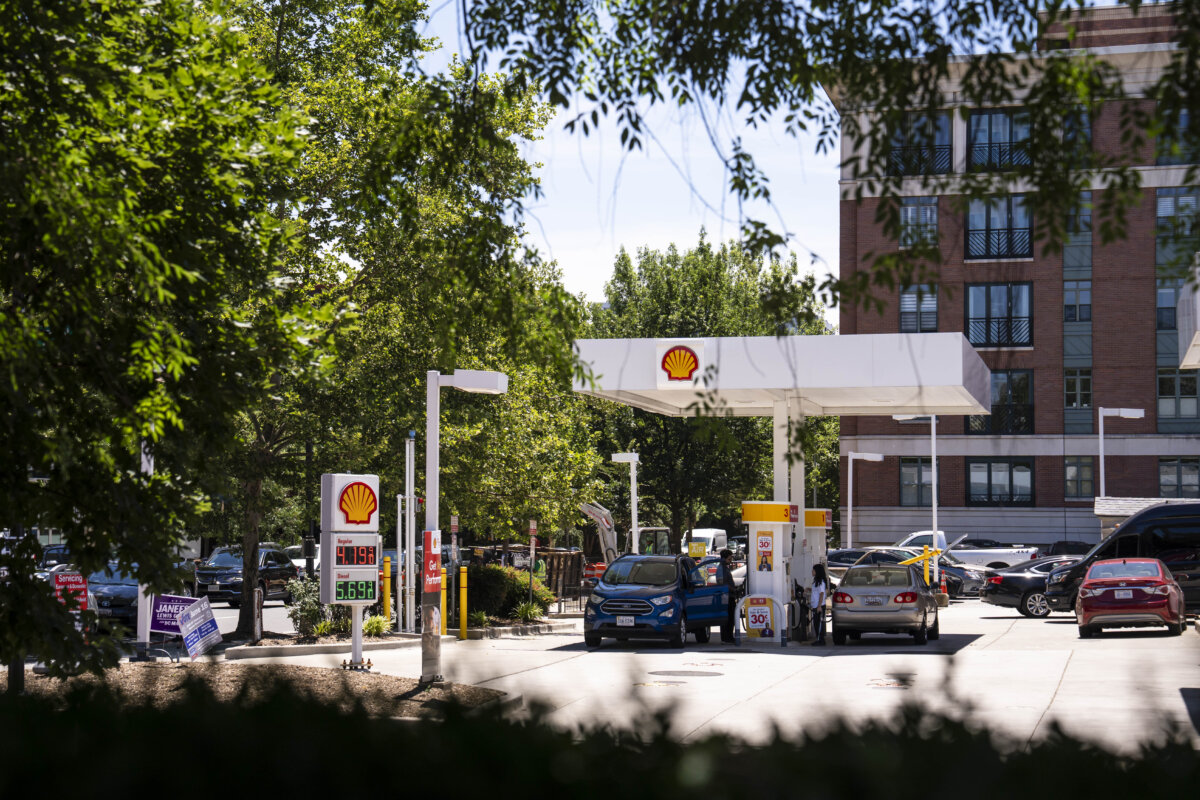
A barrel of U.S. oil is trading at pre-war levels, hovering around $70. The national average for a gallon of gas is firmly below $4, falling about 60 cents from a month ago.
Still, consumer sentiment remained down almost 19 percent from a year ago.
“The cost of living remains at the forefront of consumers’ minds; for the third straight month, over half of consumers spontaneously mentioned that high prices are weighing down their personal finances,” Joanne Hsu, director of consumer surveys, said in a statement.
Weaker confidence and renewed price pressures have not stopped consumers from opening their wallets.
Consumer spending surged at a higher-than-expected pace of 0.7 percent, or $156 billion, in May, from the downwardly revised 0.4 percent gain in April, according to the Bureau of Economic Analysis.
While some of the increase is due to higher spending at the pump, market watchers say shoppers are spending elsewhere as well.
Gas prices have affected shoppers’ spending habits in recent months, but market watchers say they are still spending in other areas.
“Real spending on gasoline and other energy goods plunged 2.4%, giving consumers a bit more room to spend in other areas last month. Real services spending held up better than we expected, rising a moderate 0.2% in line with April’s increase,” Scott Anderson, chief U.S. economist at BMO Economics, said in a June 25 research note.
Internal Bank of America data show that credit and debit card spending—excluding gasoline—was also robust last month.
“U.S. consumers returned to the stores with open wallets in May,” Anderson stated.
Disinflationary Picture
The 12-month Personal Consumption Expenditure (PCE) Price Index—the Federal Reserve’s preferred inflation measure—advanced to a three-year high of 4.1 percent in May. Annual core PCE inflation, which strips out volatile energy and food categories, was tamer at 3.4 percent.
Upcoming data could depict a temporary disinflationary picture, says Nancy Tengler, CEO and CIO of Lagger Tengler Investments.
The sharp drop in oil and retail gas “will exert a strong disinflationary impulse on headline CPI and PPI in the near term,” Tengler said in a note emailed to The Epoch Times.
“However, because oil and refined product prices exhibit mean-reverting tendencies—correcting from geopolitical extremes toward fundamentals-driven equilibria—the disinflationary drag is likely to be transitory.”
June’s annual consumer inflation rate could ease to 4 percent, according to the Cleveland Fed’s Inflation Nowcasting model.
Consumers’ inflation outlook remained elevated in the university’s latest report.
One-year inflation expectations slowed to 4.6 percent, from 4.8 percent, higher than the 3.4 percent reading registered prior to the Middle East war. The five-year horizon declined to a pre-conflict level of 3.3 percent, from 3.9 percent.
How this influences the Federal Reserve is still unclear.
Investors continue to price in at least one rate hike this year, and statements from the central bank suggest inflation is spooking monetary policymakers.
Chicago Federal Reserve president Austan Goolsbee agreed that recent data show some bright spots on inflation, but it is still heading in the wrong direction.
“You have seen now little bit of improvement on this services inflation, and I’ve been identifying that as something that we would want to see,” Goolsbee told CNBC on June 25. “But right now, as between the two sides of the Fed’s mandate, the inflation side and the job market side, clearly the problem’s on the inflation side.”
Odds of a September rate hike remain high, but have eased slightly in recent days, according to new CME FedWatch data.
 Friends Read Free
Copy
Facebook
Tweet
Friends Read Free
Copy
Facebook
Tweet