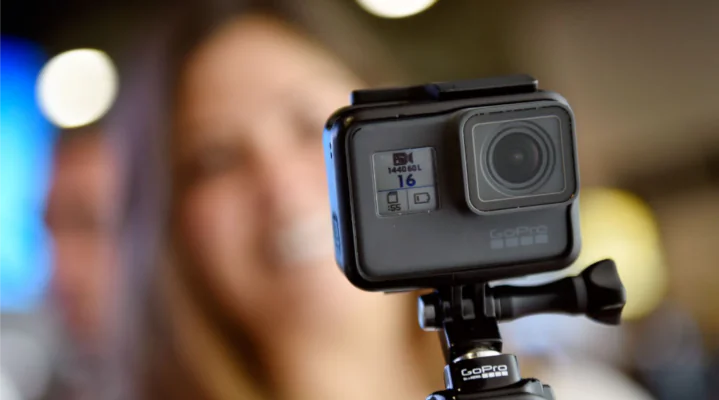

Action-camera maker GoPro is being acquired in a $285 million deal, as the struggling company pivots into new markets such as artificial intelligence and defense.
Under the merger announced on Tuesday, privately held Starman Optical will acquire roughly a 90 percent stake in GoPro.
Existing GoPro shareholders will receive $1.14 per share in cash and retain about 10 percent of the combined company.
GoPro will remain publicly traded on the Nasdaq after the transaction, which is expected to close by the end of 2026, subject to regulatory and shareholder approvals.
Its roughly $92 million in outstanding debt will also be repaid in full at closing.
Starman makes optical transceivers in the United States. The components convert electrical signals into light and back again, allowing large amounts of data to move quickly through fiber-optic networks, including those used in AI data centers.
Under the deal, Starman’s optical transceivers will be added to GoPro’s product portfolio. The combined company also plans to venture in “government, defense, robotics, and aerospace markets” while continuing to “fully support” GoPro’s existing consumer camera business.
“We expect this merger to enable GoPro to grow across consumer, commercial, and defense markets as a leading American imaging and optical solutions company, addressing important areas of national security related to cameras, optics and AI infrastructure,” GoPro founder and CEO Nick Woodman said in a statement.
Starman Holding CEO Charles Tebele said the companies also intend to bring production of more critical optical components back to the United States.
“The combination of GoPro’s world-class optical expertise and intellectual property with Starman’s advanced transceiver capabilities and U.S. manufacturing platform creates a unique opportunity,” Tebele said.
GoPro became nearly synonymous with action cameras after building a large following among athletes, travelers, and social media influencers. But the company has struggled in recent years as sales declined and competition intensified from Chinese competitors such as DJI and Insta360.
GoPro has also faced higher component costs, including rising prices and supply constraints for memory and other semiconductors.
In an August filing, the company told federal regulators that years of operating losses and its deteriorating finance had raised “substantial doubt” about whether it would have enough cash to pay its bills and debts over the next year.
According to its latest earning report, revenue fell to $105 million in the second quarter of 2026, down 31 percent from a year earlier. GoPro also reported a $51 million net loss for the quarter.
The decline is even more pronounced compared with GoPro’s peak. Quarterly revenue reached more than $630 million during the final three months of 2014, shortly after the company went public.
GoPro’s move beyond consumer cameras had already begun before the Starman deal.
In April, GoPro announced that it was exploring opportunities for its technology in defense and aerospace. The company hired consulting firm Oliver Wyman to identify potential uses for its cameras and imaging technology in military, government, and aerospace applications.
The merger now gives GoPro direct exposure to the rapid expansion of AI data centers.
Starman describes itself as an “optical-photonics company focused on the development and domestic manufacturing of optical transceivers.” Such components are important in large AI data centers, where thousands of processors must exchange enormous amounts of information at high speeds.
Starman Optical is part of Starman Holding, which also owns consumer technology brands including Incase, Incipio, and Griffin.
 Friends Read Free
Copy
Facebook
Tweet
Friends Read Free
Copy
Facebook
Tweet