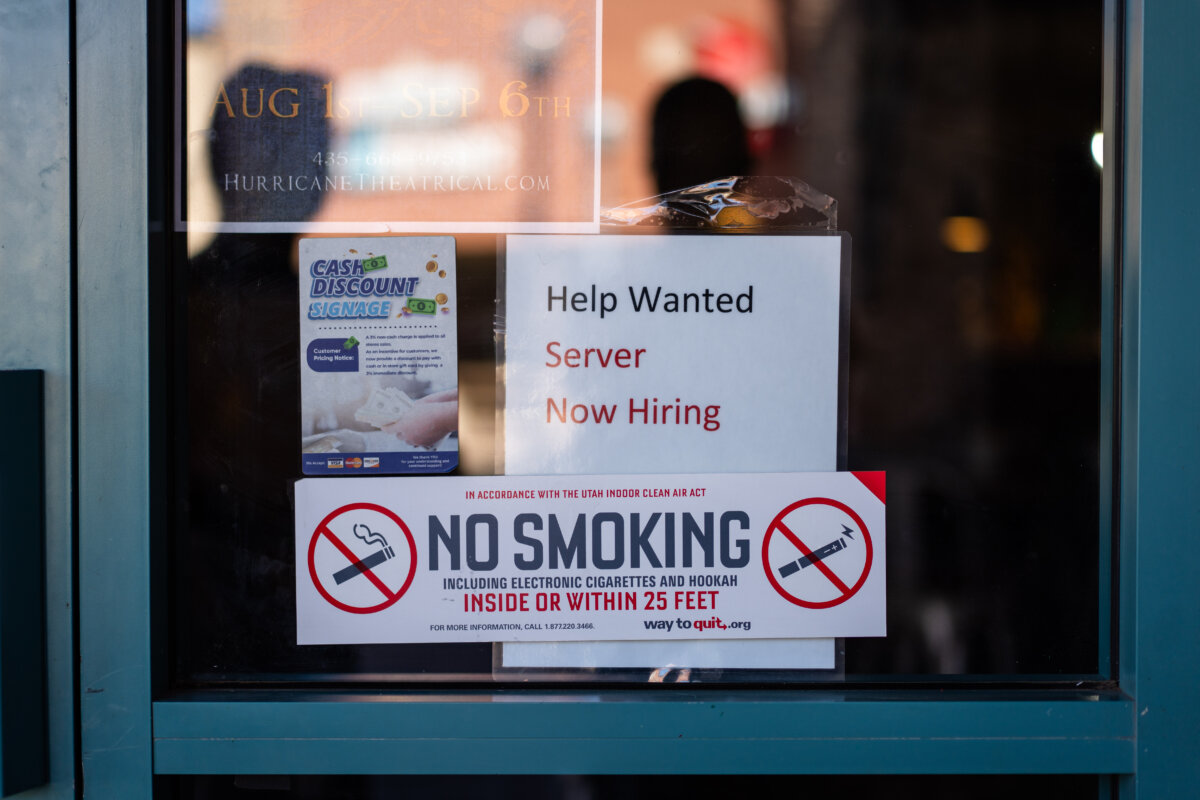

U.S. employers terminated fewer workers last month as the country experiences a “stagnating labor market,” new data released on Oct. 2 show.
In September, U.S.-based companies announced 54,064 layoffs, representing a 37 percent decline from August, according to global outplacement firm Challenger, Gray and Christmas. Planned job cuts were also down by 26 percent from the same month a year ago.
Despite the lower number, year-to-date layoffs total 946,426, the highest since 2020, when nearly 2.1 million job cuts were announced.
Andy Challenger, the firm’s senior vice president, says it is likely that job cut plans will exceed 1 million for the ninth time in the organization’s series by the year’s end.
“Right now, we’re dealing with a stagnating labor market, cost increases, and a transformative new technology,” Challenger said in a news release.
“With rate cuts on the way, we may see some stabilizing in the job market in the fourth quarter, but other factors could keep employers planning layoffs or holding off hiring.”
Technology, retail, and media have been the dominant private sectors registering sizable job cuts this year.
In the tech industry, noted Challenger, companies are experiencing tremendous disruption from artificial intelligence, which is “not only costing jobs, but also making it difficult to land positions, particularly for entry-level engineers.”
“Tech leaders have stressed that AI is changing the nature of work, and more companies are requiring their teams be trained on it,” he added.
Through September, tech companies have announced 107,878 layoffs. While this is down by 8 percent from the same span a year ago, the sector has eliminated 241,866 positions since January 2024.
For retailers, this is typically the time of year when businesses maintain their headcount or add to their payrolls. However, with lower consumer confidence and tariff-driven pressures, the sector’s employment conditions have been slower than usual.
The government sector, meanwhile, has announced 299,755 planned layoffs this year, but terminations have slowed. In fact, Challenger discovered 5,656 rescinded layoffs and attempts to rehire previously fired workers at eight federal agencies.
As for hiring endeavors, employers plan to add 204,939 jobs this year, a decrease of 58 percent from last year. This marks the lowest year-to-date hiring plans since 2009.
This week, August data highlighted the persistent “low fire, low hire” economic landscape. The number of job vacancies, new hires, and layoffs was flat, according to the Bureau of Labor Statistics’ Job Openings and Labor Turnover Survey, or JOLTS.
At the same time, payroll processor ADP reported that the private sector eliminated 32,000 positions in September and 3,000 jobs in August.
“The job market continues to look stagnant, especially for the younger demographic,” Eric Teal, chief investment officer for Comerica Wealth Management, said in a note emailed to The Epoch Times.
These figures should be sufficient to push the Federal Reserve to shift to a more accommodative stance, “and stimulate the economy and consumption,” Teal added.
The Federal Reserve, at the September policy meeting, lowered interest rates by a quarter point for the first time since December 2024. The Fed has signaled two additional 25-basis-point rate cuts this year, as well as another single reduction in 2026.
Government Shutdown
The federal government shutdown has impacted critical economic data used to assess the health of the U.S. labor market.
As a result of Republicans and Democrats being unable to hash out their differences, the Department of Labor will not release its weekly jobless claims on Oct. 2. Without an agreement to reopen the government, the Bureau of Labor Statistics may not release the September jobs report.
Prior to the shutdown, economists had forecast that the economy would create 50,000 new jobs in the month and that the unemployment rate would remain steady at 4.3 percent.
Still, investors have barely reacted to the shutdown, with the leading benchmark indexes gaining ground during the Oct. 1 trading session. Stocks were mostly up in the early part of the Oct. 2 session.
Markets have generally performed well during previous shutdowns, even when they linger, according to Mark Malek, chief investment officer at Siebert Financial.
“The most recent one—the longest on record—was unusual because the market was already declining,” Malek said in a note emailed to The Epoch Times.
“In December 2018, the Fed was raising rates before making a last-minute shift, which influenced how markets reacted. Still, if you look six months after each shutdown ended, the results have generally been positive.”
 Friends Read Free
Copy
Facebook
Tweet
Friends Read Free
Copy
Facebook
Tweet