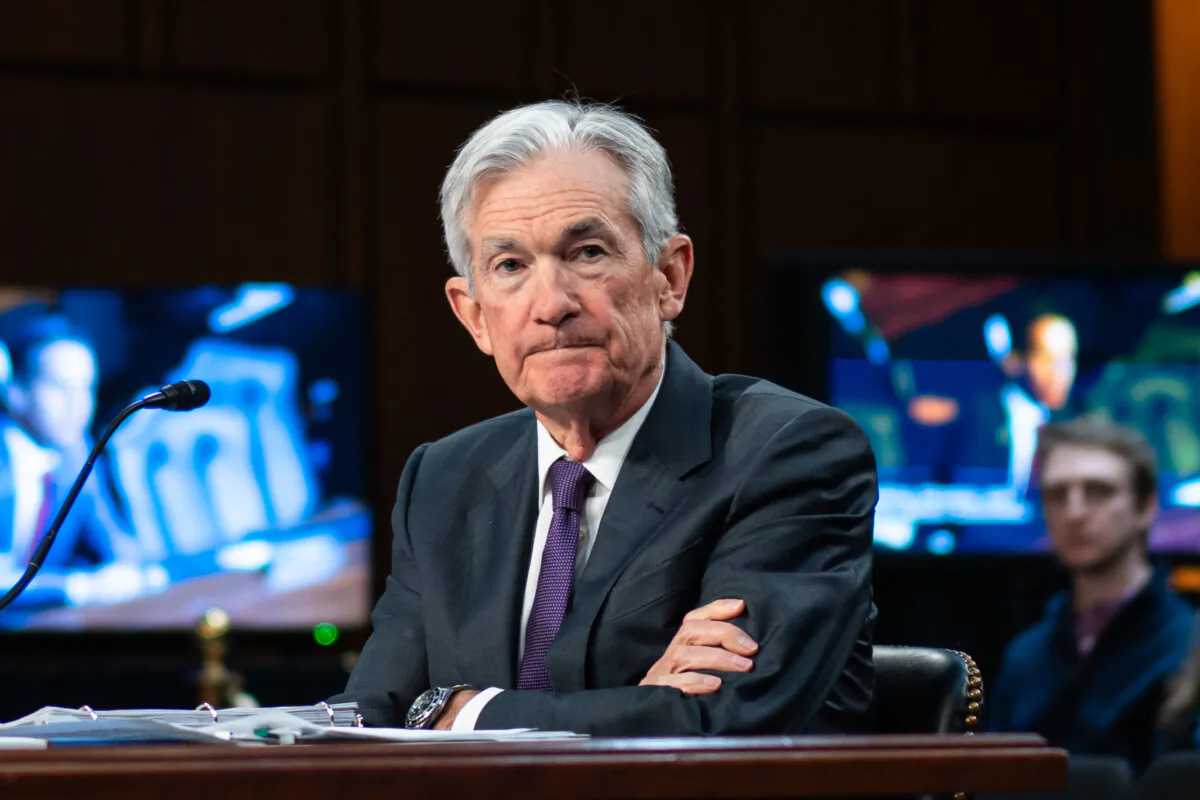

President Donald Trump on June 4 repeated his demand for Federal Reserve chair Jerome Powell to cut interest rates.
“ADP number out! ‘Too Late’ Powell must now lower the rate,” Trump said in a Truth Social post. “He is unbelievable! Europe has lowered nine times!”
Trump’s remarks came minutes after the worse-than-expected ADP jobs report.
According to the payroll processor’s National Employment Report, private payrolls rose by just 37,000 in May, the lowest increase since March 2023.
The disappointing number comes days before the Bureau of Labor Statistics releases the May jobs report. Early forecasts suggest the U.S. economy added 130,000 new jobs last month.
Trump has regularly pressured Powell to follow through on rate cuts to bolster economic growth.
For the first time this term, Trump met with Powell at the White House last week to talk about the economy.
In a May 29 readout, the Fed confirmed that the future path of monetary policy was not discussed. “Chair Powell did not discuss his expectations for monetary policy, except to stress that the path of policy will depend entirely on incoming economic information and what that means for the outlook,” the central bank statement said.
White House press secretary Karoline Leavitt, speaking to reporters at a press briefing, confirmed that the president expressed his opinion that the Federal Reserve is “making a mistake” by not restarting its rate-cutting cycle and is placing the United States at an economic disadvantage.
“The president’s been very vocal about that, both publicly and now I can reveal privately as well,” Leavitt said.
Last month, Trump wrote on the social media platform that “the consensus of almost everybody” is that the Fed should lower interest rates.
Navigating Fed Thinking
Federal Reserve officials have indicated they can afford to be patient before adjusting the policy rate.
Inflation is slightly above the 2 percent target, U.S. economic activity is robust, and the labor market is in balance. This satisfies the Fed’s congressionally authorized dual mandate of price stability and maximum employment.
However, the challenge for the monetary authorities this year has been the tariff-driven uncertainty.
“There is a great deal of uncertainty out there, making it quite difficult to forecast the economy with confidence,” said Federal Reserve Bank of Atlanta president Raphael Bostic in a June 3 speech.
“Given that, I continue to believe the best approach for monetary policy is patience,” he continued. “As the economy remains broadly healthy, we have space to wait and see how the heightened uncertainty affects employment and prices. So, I am in no hurry to adjust our policy stance.”
At an April 16 event hosted by the Economic Club of Chicago, Powell stated that levies could trigger a temporary jump in inflation or the inflationary effects “could also be more persistent.”
According to the central bank chief, it will depend on Fed policymaking to ensure long-term inflation expectations are well anchored. Doing so, however, could threaten the institution’s dual mandate simultaneously, he noted.
“We may find ourselves in the challenging scenario in which our dual-mandate goals are in tension,” Powell said. “If that were to occur, we would consider how far the economy is from each goal, and the potentially different time horizons over which those respective gaps would be anticipated to close.”
So far, the potential adverse effects of the president’s sweeping global tariffs have yet to materialize in the hard data: The economy continues to add jobs, the GDP growth rate is forecast to exceed 4 percent in the second quarter, and inflation projections have been revised downward.
Meanwhile, the Fed and Powell operate under the decades-old assumption that monetary policy operates with long and variable lags, a theory developed by economist Milton Friedman.
While speaking at the Economic Club of Washington in July 2024, Powell stated that if policymakers wait for inflation to hit that 2 percent target before easing monetary policy, then “you’ve probably waited too long.”
“The tightening that you’re doing, or the level of tightness that you have, is still having effects, which will probably drive inflation below 2 percent,” he said.
The Fed does not want inflation to fall below 2 percent, because it can trigger a bout of deflation, fearing a slowdown in economic activity, falling wages, and less flexibility to stimulate the economy.
Officials, including Dallas Fed president Lorie Logan, worry that lowering interest rates could rekindle the inflation flame.
So, while rate cuts could bolster employment prospects in the short term, she says inflation would eliminate potential economic gains.
“People might enjoy that for a little while, but over time, excessive rate cuts would trigger a spiral of inflation. And those rising prices would wipe out whatever temporary benefits people experienced from a hot labor market,” Logan said in prepared remarks.
Fed governor Christopher Waller, however, is open to rate cuts later this year. “I support looking through any tariff effects on near-term inflation when setting the policy rate,” he said at a conference in South Korea.
Still, echoing his colleagues, Waller says solid fundamentals afford the Federal Reserve additional time to monitor trade negotiations and evolving economic conditions.
However, waiting too long could result in monetary policy errors, according to one expert.
What Will Likely Happen
The futures market is betting that the Fed will leave interest rates in a range of 4.25–4.50 percent later this month. According to the CME FedWatch, investors do not expect monetary policymakers to implement a quarter-point rate cut until September.
Market watchers closely monitor the benchmark federal funds rate because it influences borrowing costs, such as mortgages and auto loans, and impacts the U.S. Treasury market.
A prolonged wait-and-see approach could lead to the Fed making a mistake, says Michael Arone, the chief investment strategist at State Street.
“Fed officials claim that monetary policy is in a good place, and they prefer to wait and see what happens to the labor market and inflation over the next few months before making any changes,” Arone said in a June 2 note.
“But as the Fed waits, the risks of a monetary policy mistake are rising.”
That said, there is a reason for optimism, as the central bank has “plenty of room” to restart its easing cycle in the second half of 2025.
“Recent data indicate that inflation was moderating before any potential tariff-related price increases,” Arone added. “The Fed mistakenly assumed that tariffs were inflationary in 2018, but they weren’t.”
The Fed, he noted, could cut interest rates by 0.25 percent three or four times and ensure the policy rate is still 1 percent above core inflation.
Economic observers will comb through the updated Summary of Economic Projections following the meeting of the policy-making Federal Open Market Committee (FOMC) on June 17–18. This is a quarterly survey of where officials believe policy and the economy are heading.
For now, it would be safe to assume that an unemployment rate hovering slightly above 4 percent would allow the institution to postpone rate cuts, says LPL Financial chief economist Jeffrey Roach.
“If the labor market holds, the Fed can remain in the ‘wait and see’ mode before they restart their rate cutting,” Roach said in a note emailed to The Epoch Times.
 Friends Read Free
Copy
Facebook
Tweet
Friends Read Free
Copy
Facebook
Tweet