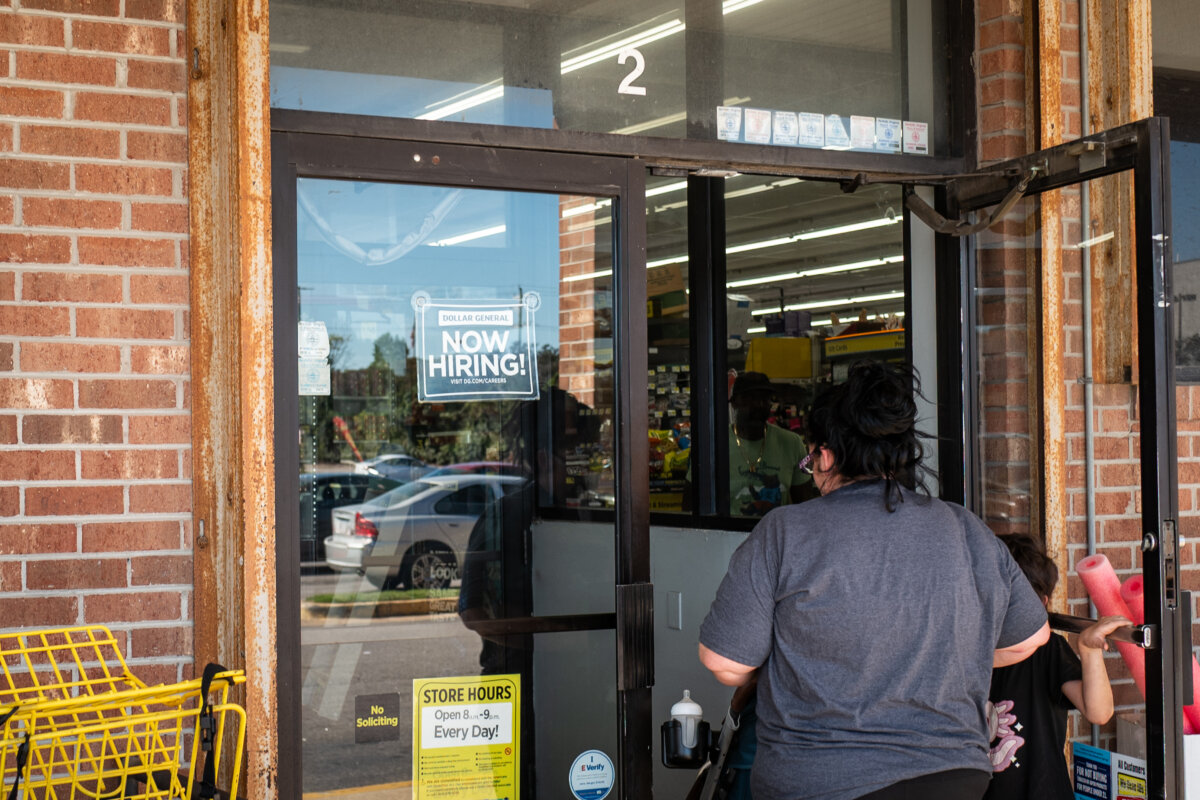

The number of Americans filing for unemployment benefits reached a four-month high, according to Department of Labor data released on June 4.
Initial jobless claims increased by 13,000 to 225,000 for the week ending May 30. This was the highest level since the first week of February, when the U.S. economy was digging out from a severe winter storm.
Economists had forecast a reading of 212,000.
Despite the sharp jump, unemployment claims continue to hover around historically low levels, furthering the low-fire trend of the past two years.
The four-week average, which strips out week-to-week volatility, edged up to nearly 215,000, from the previous week’s downwardly revised 208,250.
A plethora of metrics show that companies have refrained from aggressively terminating employees—and workers are not leaving their positions either.
The layoff rate—the number of discharges during the month as a percent of total employment—dipped to 1.1 percent in April, according to the Bureau of Labor Statistics.
Likewise, the quits rate—a measure of individuals voluntarily resigning as a share of total employment—slipped below 2 percent, the federal agency reported this week.
Year-to-date job cuts are 43 percent lower than the same time a year ago, according to data released on June 4 by global outplacement firm Challenger, Gray, and Christmas.
At the same time, demand for labor has accelerated. Job vacancies topped 7.6 million in April, private payrolls surged by 122,000 in May, and planned hires spiked by 92 percent last month.
Employment has also been stable nationwide, maintaining that “low-hire, low-fire” environment.
“Most Districts described a low-hire, low-fire environment, with workers increasingly reluctant to change jobs because of economic uncertainty,” the Federal Reserve wrote in the latest Beige Book, a periodic report summarizing economic conditions across the central bank’s 12 districts.
“Hiring remained selective and primarily focused on critical roles or attrition replacement. Professional services occupations had mixed demand conditions, partly reflecting shifts in technological and operational changes.”
All of this sets the stage for the highly anticipated May nonfarm payrolls report, which could spotlight further momentum in the U.S. labor market or a hiring slowdown and affect Federal Reserve policy expectations.
Flying High in May
The Bureau of Labor Statistics will publish the May jobs report on June 5.
The consensus forecast calls for 85,000 new jobs and an unemployment rate holding steady at 4.3 percent. Wages are expected to be mixed, rising 0.3 percent monthly but slowing to 3.4 percent year over year.
But although the headline numbers will capture the attention, what lies underneath the surface will also be critical, according to Jay Woods, chief market strategist at Freedom Capital Markets.
“Investors should pay just as close attention to labor force participation, wage growth, and the growing number of Americans working part-time as clues about the true health of the job market,” Woods told The Epoch Times in an emailed note.
Job creation has improved this year from the first four months of 2025.
The economy added more than 300,000 jobs from January to April, compared with 169,000 over the same period last year.
Payroll growth has been centered entirely in the private sector as the current administration trims government jobs and embraces a strategy of “reprivatizing the economy.”

Employment gains have been, for the most part, led by only a few industries, particularly healthcare.
Recent ADP figures, however, suggest that growth was broad-based last month. Construction, financial activities, professional and business services, trade, transportation, and utilities were some of the other industries recording robust payroll increases.
Economists still forecast solid growth for the remainder of the year. Or, at the very least, enough jobs to keep the unemployment rate low.
The breakeven rate—the number of jobs needed to ensure that the jobless rate holds steady—has fallen sharply over the past year because of shrinking immigration and lower labor force participation. Estimates vary, but Dallas Federal Reserve economists have estimated that the breakeven rate is close to zero.
Fed Policy Implications
The May jobs report will be the final one before the Fed convenes its June 16–17 Federal Open Market Committee policy meeting.
Strong numbers should reinforce the higher-for-longer narrative at the central bank, meaning the Fed will keep interest rates in the current target range of 3.5–3.75 percent. But a weaker reading could support the dovish position of cutting rates.
“In a market searching for clarity on the timing of the next Fed move, Friday’s jobs report may prove to be the most influential data point of the month,” Woods said.
Fed Chair Kevin Warsh will preside over his first policy meeting and will navigate whether to push for rate cuts at a time of elevated inflation or tighten monetary policy and threaten growth and employment prospects.
In this type of climate—an economy still absorbing tariffs and an oil price shock—the playbook for officials is to look past these issues and examine underlying inflation trends. Although they are tamer than headline figures, structural price pressures could be building.
 Friends Read Free
Copy
Facebook
Tweet
Friends Read Free
Copy
Facebook
Tweet