

The yield on the 10-year Treasury, a benchmark government bond, has fallen below 4 percent.
Despite this year’s volatility, especially during the tariff-driven springtime upheaval, the 10-year yield has been on a steady downward trajectory—achieving one of the Trump administration’s goals.
The 10-year Treasury yield declined to 3.97 percent during the Oct. 21 trading session, down by 83 basis points since the mid-January peak of 4.8 percent.
Other long-term yields have also eased in recent weeks.
After exceeding the 5 percent threshold in the summer, the 20- and 30-year yields have fallen to about 4.55 percent. Year to date, they are down by more than 50 basis points.
But while the United States is experiencing falling interest rates, other key global markets are seeing rates head in a different direction.
In the UK, the 10-year yield has risen by almost 50 basis points to about 4.48 percent. In Germany and France, 10-year yields have climbed by about 40 basis points to 2.58 percent and 3.36 percent, respectively.
Japanese yields have climbed to multidecade highs, with the 10-year yield increasing by close to 70 basis points to 1.67 percent, and the 30-year yield climbing by 86 points to 3.14 percent.
Flying Doves
When the Federal Reserve initially started its easing cycle in September 2024, U.S. Treasury yields ventured higher, driven, in part, by fiscal worries. This time, now that the central bank has signaled lower rates ahead—although a more conservative outlook—yields have followed the Fed.
Monetary policymakers and the futures market anticipate two more rate cuts this year, including a quarter-point reduction next week.
While investors had previously expected a more aggressive rate-cutting cycle, the updated Summary of Economic Projections—a periodic survey of Fed officials’ expectations for policy and the broader economy—pointed to a single cut in 2026. Policymakers forecast the median policy rate settling at roughly 3 percent by the end of 2027.
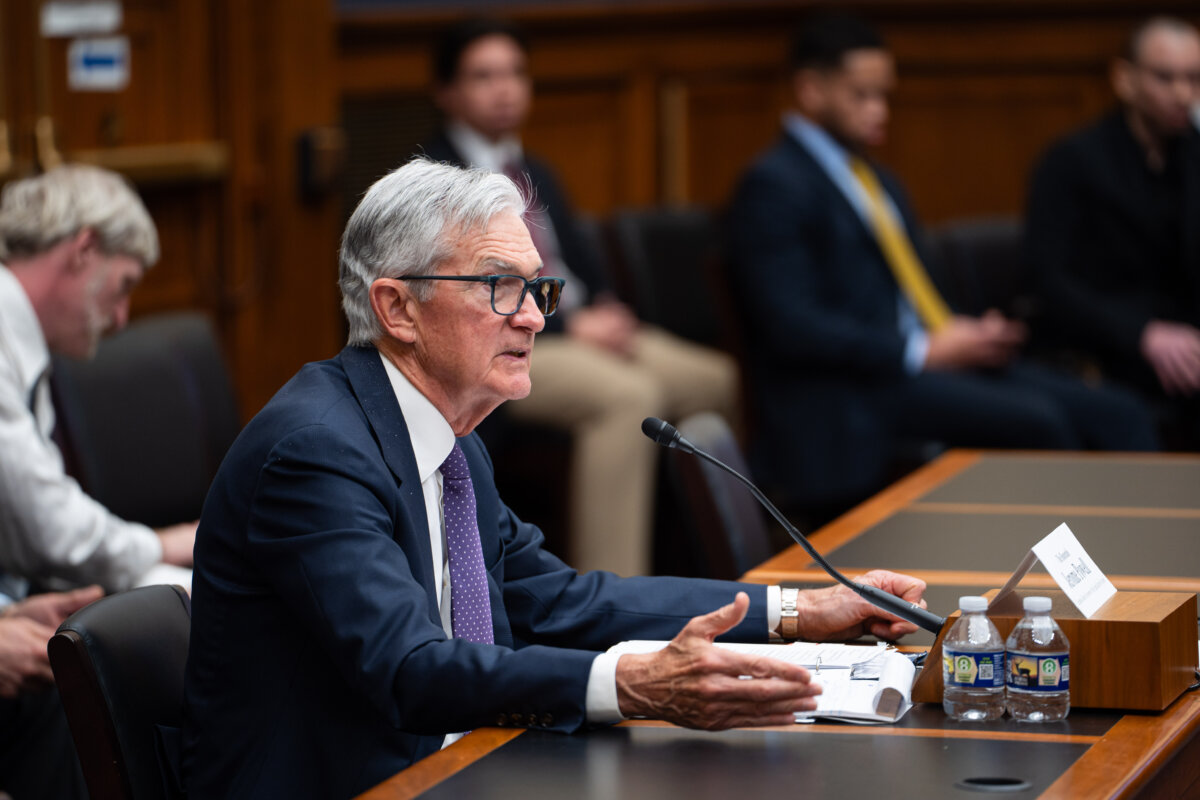
In addition to recent actions and the dot-plot of officials’ expectations, comments by Federal Reserve Chair Jerome Powell sent the message of a more dovish stance at the central bank.
Appearing at an Oct. 14 address to the National Association for Business Economics, Powell suggested that the Fed’s three-year quantitative tightening may soon come to an end because of tightening liquidity in the financial markets.
“This marks a shift in the Fed’s priorities from fighting inflation to supporting employment and preserving market liquidity,” Giuseppe Sette, co-founder and president at market research firm Reflexivity, said in a note emailed to The Epoch Times.
“Markets interpreted the speech as confirmation that policy easing is imminent.”
Investors have been seeking shelter amid economic uncertainty, as well as geopolitical and trade tensions.
The U.S. government shutdown, now in its third week, has prevented key economic data, such as inflation and labor, from being released. This has forced markets and policymakers to rely on alternative private-sector data.
Predictive markets suggest that the government shutdown could end next month.
National Economic Council Director Kevin Hassett told CNBC’s “Squawk Box” on Oct. 20 that the shutdown is “likely to end sometime this week.”
Reviving ‘Abenomics’ and a French Downgrade
In the world’s fourth-largest economy, Tokyo investors worry that incoming Japanese Prime Minister Sanae Takaichi will revive the “Abenomics” brand—the economic ideology of Prime Minister Shinzo Abe, who championed aggressive monetary easing, fiscal stimulus, and structural reforms to resuscitate the economy.
“Takaichi won a key vote to become Japan’s next Prime Minister. She will push for looser monetary policy and larger fiscal stimulus—if, of course, markets will let her,” Ipek Ozkardeskaya, senior analyst at Swissquote Bank, said in a note emailed to The Epoch Times.
“Because note that long-term Japanese yields are already near multi-decade highs, which suggests she and Abe (to whom she’s compared) do not share the same margin to maneuver.”
Japan’s parliament elected Takaichi as the next prime minister on Oct. 20.
“Political stability is essential right now,” she said. “Without stability, we cannot push measures for a strong economy or diplomacy.”
Fiscal woes have persisted in Europe.
The latest hurdle came after S&P Global Ratings downgraded France’s sovereign credit score this past week. The Oct. 17 downgrade has led to France losing its double-A rating at two of the three major credit agencies in about a month.
Traders are still absorbing the impact of Germany’s 500-billion-euro infrastructure fund and relaxed borrowing rules for greater defense spending.
For the broader regional economy, eurozone inflation expectations have risen slightly, and gross domestic product growth projections have improved at a modest pace. This has prompted investors to adjust their forecasts, penciling in fewer interest rate cuts by the European Central Bank (ECB) and higher long-term yields.
Upcoming purchasing managers’ indexes (PMIs)—monthly measurements depicting a sector’s prevailing economic direction—could play a role in bond yields this week, according to ING strategists.
“Considering the European economic sentiment, we believe that the PMIs at the end of the week should still support the notion of a weak but ongoing economic recovery, which would help limit the downside to rates,” they wrote in an Oct. 21 note.
S&P will release the flash October eurozone composite, manufacturing, and services PMIs on Oct. 24. The market consensus indicates little change to the initial estimates.
Aldgra Fredly contributed to this report.
 Friends Read Free
Copy
Facebook
Tweet
Friends Read Free
Copy
Facebook
Tweet