
Consumer confidence recovered slightly in late April, driven by the two-week ceasefire and softer gasoline prices, according to the University of Michigan’s final estimate, released on April 24.
The April Consumer Sentiment Index came in at 49.8, down almost 7 percent from March and nearly 5 percent from a year ago.
But this came in slightly higher than the preliminary reading of 47.6, which was an all-time low.
The two-week ceasefire announced between the United States and Iran, along with a tepid decline in gasoline prices, buoyed sentiment, says Joanne Hsu, director of consumer surveys.
“The Iran conflict appears to influence consumer views primarily through shocks to gasoline and potentially other prices,” Hsu said in a news release.
“In contrast, military and diplomatic developments that do not lift supply constraints or lower energy prices are unlikely to buoy consumers.”
Short and long-term expectations for business conditions fell 7 percent to 48.1, matching last year’s readings following the president’s unveiling of his sweeping global tariff agenda.
The deterioration in sentiment was broad-based across age, education, income, and political party.
State of Gas Prices
Washington and Tehran announced a two-week truce earlier this month.
The deal was set to expire on April 22, but President Donald Trump extended the truce at the request of Pakistani mediators, without a specific deadline.
U.S. crude oil prices have stabilized, though they remain elevated at above $90 per barrel.
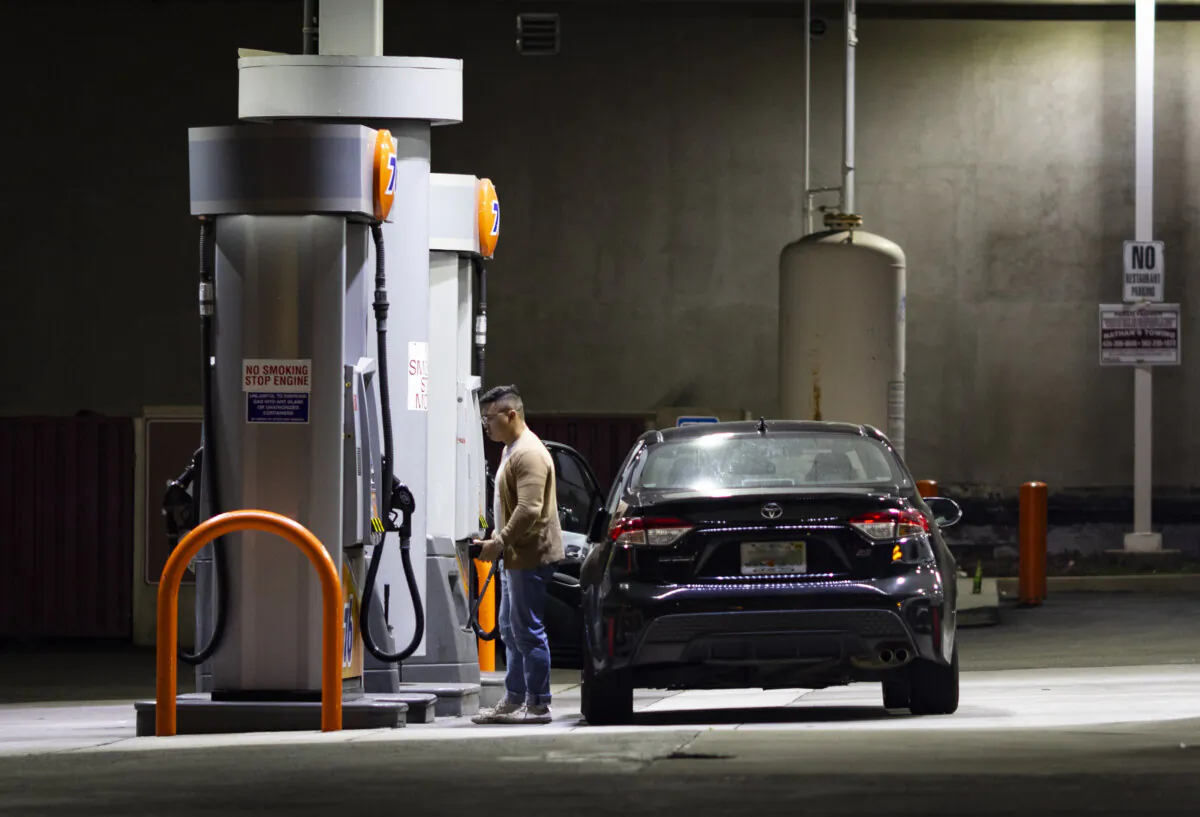
Since oil accounts for half of the sticker price at the pump, motorists are paying more to fill up their tanks.
Still, drivers have been given a bit of relief, with the national average for a gallon of gas falling about 2 cents from a week ago to below $4.06.
The White House’s expectations for gasoline prices have fluctuated over the past week.
Trump warned that Americans may pay higher gas prices “for a little while” due to the Iranian conflict, approaching its ninth week.
“I thought oil would go up to maybe $200 a barrel. And oil is a very different number than anyone thought,” Trump told reporters in the Oval Office on April 23.
“In fact, this country is much lower because we have all the oil we can use.”
Treasury Secretary Scott Bessent had said gas prices could ease back toward $3 by September.
“I’m optimistic that during the summer, we will see gas with a three in front of us sooner rather than later,” Bessent told reporters at an April 15 press briefing.
“I’m optimistic that sometime between June 20 and September 20, we can have $3 gas again.”

In an April 19 interview with CNN’s “State of the Union,” Energy Secretary Chris Wright estimated that sub-$3 gas may not happen until next year.
“I don’t know, that could happen later this year, that might not happen until next year, but prices have likely peaked,” Wright said. “Certainly, with a resolution of this conflict, energy prices will go down.”
Inflation Expectations
Consumers’ inflation outlook improved slightly in the University of Michigan’s final April estimate.
The one-year inflation forecast came in at 4.7 percent, down from 4.8 percent earlier in the month.
Still, this is up from 3.8 percent in March and 3.4 percent in February, representing the largest one-month jump since April 2025.
Long-run inflation forecasts remain well anchored, something that monetary policymakers want to see.
The five-year outlook rose to a six-month high of 3.5 percent, from 3.2 percent last month.
April’s reading was revised slightly higher from 3.4 percent from the preliminary report.
Despite the public’s higher inflation projections, consumers are still keeping their wallets open.
March retail sales rose by a higher-than-expected rate of 1.7 percent, from an upwardly adjusted 0.7 percent in February.
While the headline reading was largely driven by higher gas-station transactions, the underlying numbers remained solid. Retail sales excluding gas and automobile purchases climbed 0.6 percent, representing the sixth consecutive month of growth.
Additionally, the retail sales control group—a steadier measure that omits volatile components such as autos, gasoline, office supplies, and tobacco—advanced 0.7 percent, topping the consensus forecast of 0.2 percent.
This is a vital metric since it contributes to gross domestic product (GDP) calculations.
The consumer will be critical for the first quarter, says David Miller, senior portfolio manager and CIO at Catalyst Funds.
“So far, the economy has held up better than many expected, with March retail sales coming in solidly, but there is a real question about how long that resilience lasts if gasoline prices stay elevated and broader cost pressures continue feeding through the system,” Miller said in a note emailed to The Epoch Times.
January–March economic growth is expected to come in at around 1 percent, according to the Atlanta Fed GDPNow Model estimate.
This would be a rebound from the previous quarter’s anemic 0.5 percent expansion.
Aldgra Fredly and Bill Pan contributed to this report.
 Friends Read Free
Copy
Facebook
Tweet
Friends Read Free
Copy
Facebook
Tweet