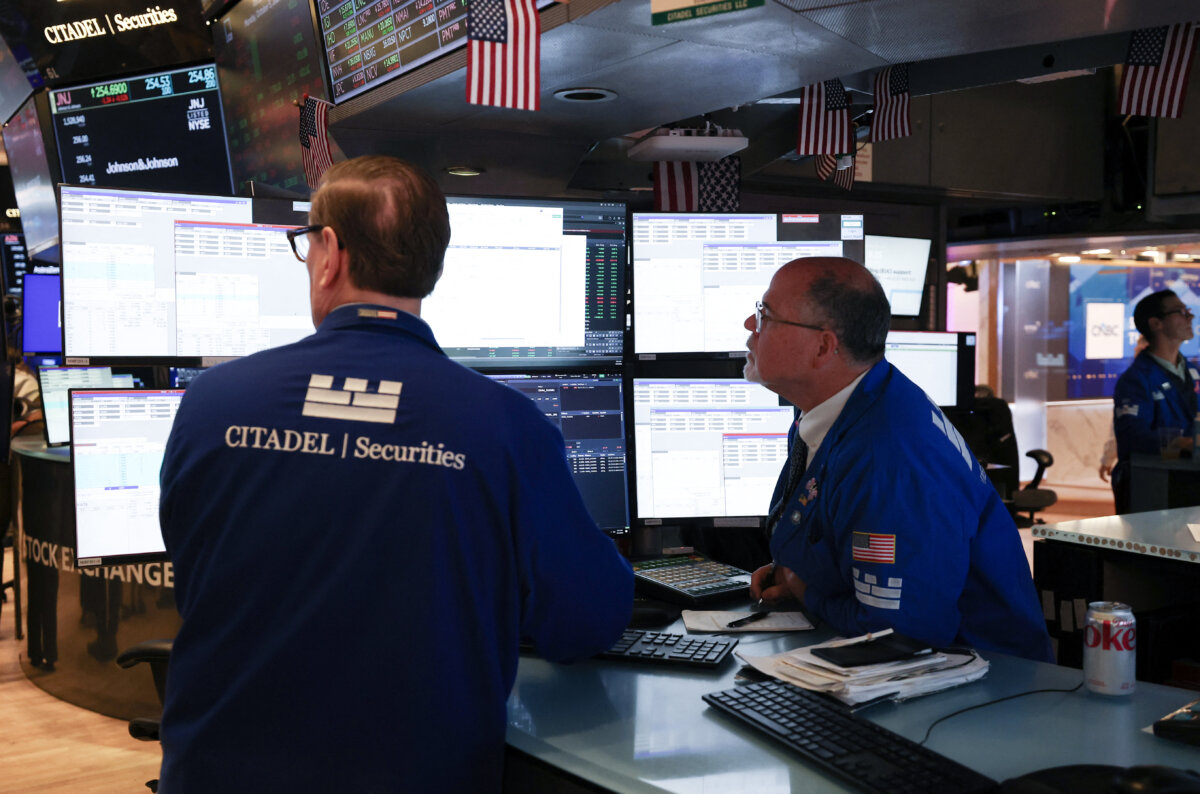

U.S. stocks ended Friday on a stronger note after another weaker-than-expected consumer sentiment report and steadying oil prices eased pressure on bond yields. The rally helped equity markets close mostly higher for the week, led by the S&P 500, which finished just shy of an all-time high, as investors rotated funds across sectors rather than pulling out of the market altogether.
All major sectors finished higher on Friday, as investors moved money from leaders such as semiconductors into laggards such as healthcare.
The Dow Jones Industrial Average led the rally, up 0.83 percent to close at 51,654. The S&P 500 increased 0.64 percent and ended at 7,811, near its all-time high of 7,818 reached on Tuesday. The Nasdaq gained 0.64 percent and the small-cap Russell 2000, among the stock indexes most sensitive to interest rates, added 0.46 percent.
The gains came even as the University of Michigan’s consumer sentiment index dropped to 46.3 in early October, its lowest level since May’s record low and well below the 47.6 economists expected.
Weekly performance among the four major indexes was mixed. The Dow rose 0.93 percent, the S&P 500 gained 1.15 percent, and the Nasdaq Composite advanced 0.64 percent, while the Russell 2000 slipped 0.91 percent.
The CBOE Volatility Index fell 3.07 percent to 14.84.
Bond Yields and Oil Drive Volatility
Bond yields and oil drove the market’s volatility throughout the week. The 10-year Treasury yield rose to 5.33 percent on Monday after the Institute for Supply Management’s services Purchasing Managers’ Index came in at 54.9 for September, in line with expectations. A reading above 50 indicates that the service sector, which accounts for close to two-thirds of the economy, continues to expand.
The yield eased to around 5.26 percent on Tuesday after wholesale fuel prices temporarily dipped.
Brent crude fell below $102 a barrel on Monday amid easing supply pressures and news that Saudi Aramco cut the November selling price of Arab Light for Asian buyers to $5, a deeper discount than the $2 offered for October. Prices steadied around $100.1 on Tuesday after dipping to $97.8 in early trade, then raced toward $106 on Thursday before easing to around $103 amid a disruption to U.S. oil supplies caused by Hurricane Isaias.
Bond yields followed oil’s course, with the 30-year Treasury yield climbing to 5.73 percent in early Thursday trade before easing to 5.60 percent by late afternoon.
Global Bond Yields Add Pressure
Technology shares powered the early-week rally. The Nasdaq gained 1.05 percent on Monday to a record high on big gains in Microsoft and Nvidia, and the S&P 500 closed at a record, up 0.66 percent. The Dow rose 0.18 percent, and the Russell 2000 gained 0.50 percent.
On Tuesday, bullish comments from Marvell Technology on AI spending sent its shares up 5.81 percent and helped lift the Nasdaq and S&P 500 to new records, up 0.45 percent and 0.48 percent, respectively. The Dow gained 0.49 percent, while the Russell 2000 was the only major index in the red, down 0.59 percent.
The rally stalled Wednesday on profit-taking after the Kospi fell 2 percent overnight. Further rises in global bond yields added pressure, led by a spike in French bonds. The benchmark 10-year OAT (Obligation Assimilable du Trésor) yield hovered around 4.90 percent in early trade, edging closer to the more-than-two-decade high above 5 percent reached late last week, amid persistent concerns over elevated inflation, fiscal deficits, and social unrest.
Interest-rate-sensitive stocks took the brunt of the selling. The State Street SPDR S&P Homebuilders ETF (XHB) dropped 2.55 percent, and the Russell 2000 fell 1.31 percent. The broader market recovered much of its early losses in the afternoon, with the S&P 500, the Dow Jones, and the Nasdaq closing 0.22 percent, 0.66 percent, and 0.22 percent lower, respectively, helped by slightly lower oil prices and bargain hunting.
Stocks began Thursday on the back foot amid another spike in oil prices and yields. Semiconductor shares were hit particularly hard as investor concerns grew over tech giants such as Oracle’s ability to finance AI-related capital expenditures. The Nasdaq and the S&P 500 closed down 1.25 percent and 0.47 percent, while the Dow Jones and the Russell 2000 posted fractional gains.
Analysts Expect Another Rate Hike
Minutes of the Federal Reserve’s September meeting, released on Wednesday, eased upward pressure on yields, reassuring investors of the central bank’s commitment to fighting inflation. However, analysts said the minutes also point toward another rate increase.
“The striking feature of the [Federal Open Market Committee] minutes is how many routes led officials to the same conclusion,” eToro Global Market Strategist Lale Akoner told The Epoch Times. “Some backed higher rates as insurance against inflation picking up again; others thought the strong economy already justified them.”
She said the situation makes the case for another rate hike harder to dismiss, “even if the Fed waits for more data first.”
Heather Long, the chief economist at Navy Federal Credit Union, told The Epoch Times that “another Fed rate hike is almost certainly coming in December.”
Akoner also sees the bond market at a turning point following Wednesday’s strong 10-year Treasury auction, suggesting investors are beginning to see value at these yields.
“I would treat that as a sign the bond sell-off may be losing momentum, rather than proof it is over. For a lasting recovery in bonds, investors need evidence that inflation is easing and that the Fed can stop tightening,” she said.
Earnings Season in Focus
Wall Street’s attention now turns to the fourth quarter and the start of earnings season.
“Several major catalysts remain on the calendar over the next month, including the Fed, earnings season, and the midterm elections—and each has the potential to either extend the rally or disrupt it before year-end,” eToro investment analyst Bret Kenwell told The Epoch Times.
He said stocks have defied skeptics despite persistent inflation, geopolitical concerns, and oil prices hovering near $100 a barrel. However, although concerns at the beginning of the year had eased by the end of the third quarter, rising Treasury yields have become investors’ primary concern.
Bob Edwards, chief investment officer of Naples, Florida-based Edwards Asset Management, said that investors may have been too focused on rising bond yields and geopolitical uncertainty while underestimating the strength of corporate earnings.
“Corporate earnings may be stronger than investors appreciate. Third-quarter S&P 500 earnings growth year-over-year is expected to approach 30 percent, an extraordinary pace,” he told The Epoch Times.
“As earnings estimates for 2027 continue to rise, I believe stocks may become more attractively valued on a forward earnings basis even as market indexes advance.”
 Friends Read Free
Copy
Facebook
Tweet
Friends Read Free
Copy
Facebook
Tweet