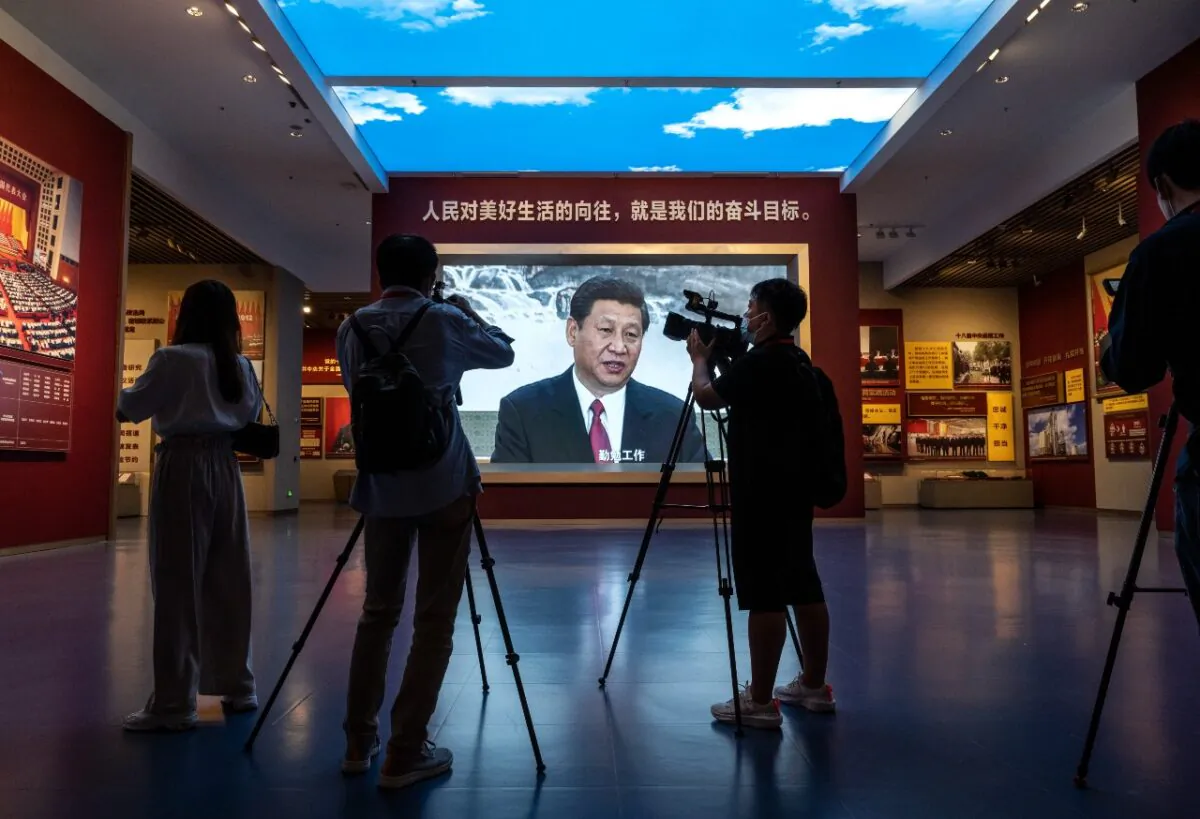
Chinese Communist Party (CCP) leader Xi Jinping is building a massive network of political and cultural education centers throughout the country with the goal of reaching every village and neighborhood in China with his vision of socialism. More than 100,000 of these centers have been created since the project was launched in 2018, according to a report published on Jan. 31 by the New York-based nonprofit Asia Society.
Called “New Era Civilization Practice Centers,” these facilities are part of an effort to bring Xi’s official ideology—known as “Xi Jinping Thought”—directly to Chinese citizens, according to the report, which was published in the Asia Society’s ChinaFile magazine.
“The centers are designed to deliver a mix of social services and political indoctrination, to draw China’s citizens ever nearer to the Party,” the report reads.
Little known outside of China, these centers are quickly becoming an important part of the CCP’s internal propaganda project, advancing its goals of “propagandizing to the masses, educating the masses, leading the masses, serving the masses,” according to the report.
The centers are located in both rural and urban areas, implementing the CCP’s plan for what Xi Jinping has called the “new era” in Chinese history.
“The centers’ agenda includes shaping people into ‘new’ citizens with ‘new’ habits, and pushing the doctrine known as ‘Xi Jinping Thought on Socialism with Chinese Characteristics for the New Era’ into the hearts and minds of the masses,” the report reads.
Each center offers instruction on a variety of topics, from health and hygiene to cooking and holiday party planning. Other activities include organizing neighborhood clean-ups, bringing food to the poor, and providing support to the elderly.
Political indoctrination also is an important part of the centers’ agenda. That includes presentations of patriotic movies, lectures on Xi Jinping theory, classes on good citizenship, and discussions on the achievements of the CCP.
“By intertwining practical services with Party theory, the CCP seeks to reassert itself as a source of well-being and meaning in individual and collective life,” the report reads.
‘New Era’
The “New Era Civilization Practice Centers” trace their roots to a 2013 speech by Xi in his role as leader of the CCP, during which he said that China’s development had entered a “new era.” Xi described this new era as the next step in the transformation of China from a poor agrarian nation to the world’s industrial powerhouse.
After decades of growing rich as the world’s factory, Xi has focused attention on China’s domestic issues in order to address many of the economic and social problems caused by the country’s rapid development. A great contradiction of Chinese communism is the massive imbalances in wealth that now exist between the coastal cities and the countryside, observers have noted.
Eliminating this economic inequality and building what Xi calls “common prosperity” are new priorities for the Chinese regime. This marks a big change from the CCP’s past emphasis on rapid economic growth based on exports. While China’s economic growth has lifted hundreds of millions of Chinese people out of abject poverty, it has also created more millionaires and billionaires than any country on earth outside of the United States—in a nation where 600 million people live on less than 1,000 yuan (about $157) per month.
China’s widening wealth gap has been a source of embarrassment for the regime and a potentially serious threat to the legitimacy of the CCP.
“Since 2017, the Xi Jinping administration has identified the volatile mix of socioeconomic inequality and citizens’ rising expectations as the country’s current ‘principal contradiction’—a term used in Party theory to label the root cause of society’s ills that the country’s leaders must cure, or face being overthrown,” the report reads.
Xi’s regime is no longer just concerned with economic growth, but also with addressing the inequalities that have arisen from that growth. And the CCP’s “New Era Civilization Practice Centers” are meant to be at the heart of that effort, both in practice and in the minds of citizens who will be presented with a helpful, generous, and locally-focused arm of the ruling party.
Maoist Inspiration
According to the report, the centers’ operations depend heavily on the work of volunteers, which are primarily drawn from CCP membership: 80 percent of communist party members are expected to volunteer their time to their local center’s activities. Local citizens are also encouraged to volunteer, with the government setting a goal of convincing 13 percent of residents to donate their time.
This sort of state-mandated volunteerism is an important part of the propaganda effort, according to professor Ming Hu of Nanjing University, who’s quoted in the report.
“Volunteer services absorb citizens’ interest in public participation … which contributes to social stability and state legitimacy,” he said.
Since the days of Mao Zedong, the regime’s first leader, it has been a tradition of the CCP to regularly present a new vision of China’s long-term future. This vision is communicated to Party officials and to the general public through slogans, propaganda publications, and new programs that attempt to shape a national consensus and move the country toward the new objectives.
For ChinaFile Senior Editor Jessica Batke, author of the report, the new centers are very much in line with this tradition and are reminiscent of the Mao-era “work units”—organizations that combined communist propaganda with control of labor and social services.
Mao’s work units linked each citizen directly with the national communist party and engaged each worker in implementing national CCP policy at a local level.
“In many ways, the New Era Civilization Practice Centers feel anything but new,” Batke wrote. “They continue a decades-long effort to minister to the spiritual health of the masses … to inculcate a set of shared socialist values.”
Whether Xi can create his new China and build a new Chinese citizen in this way won’t be known for some time.
“The coming years will tell whether or not these centers can ensure the people’s ‘spiritual progress’ when they are controlled by ‘an atheist Party mostly concerned with its own salvation,’” the report reads.
 Friends Read Free
Copy
Facebook
Tweet
Friends Read Free
Copy
Facebook
Tweet