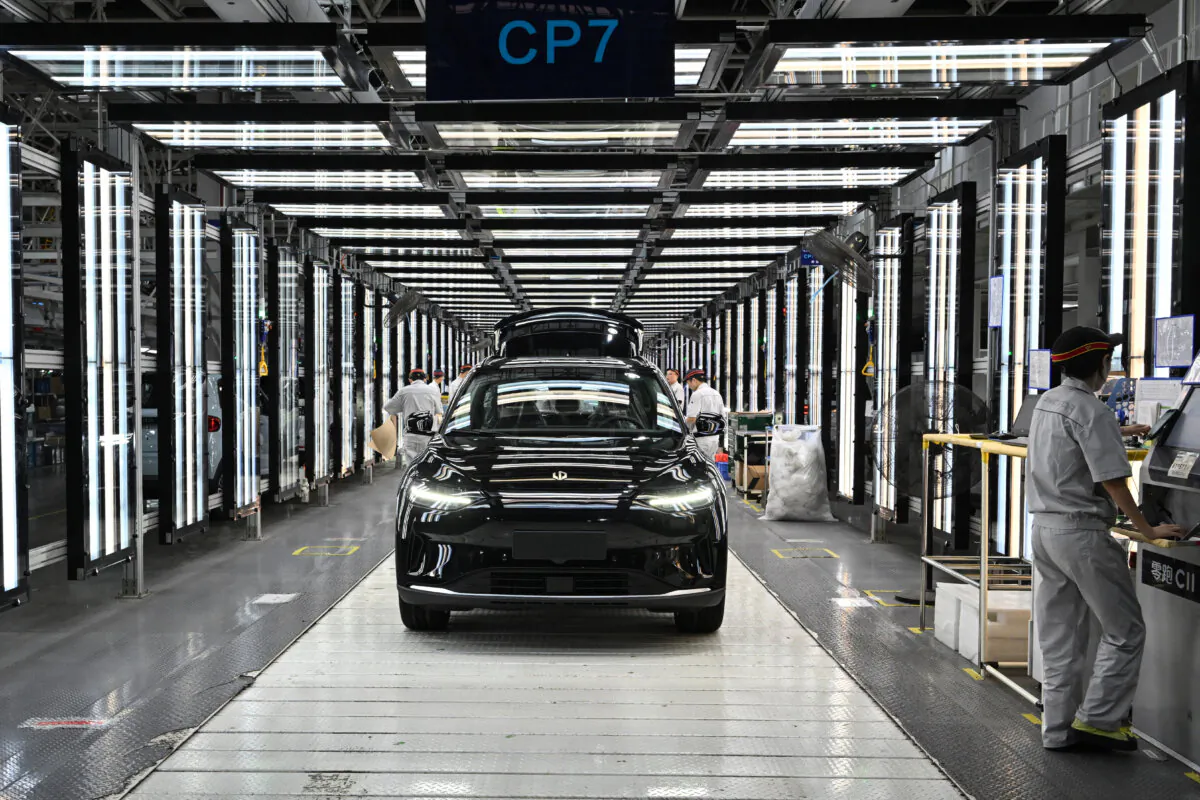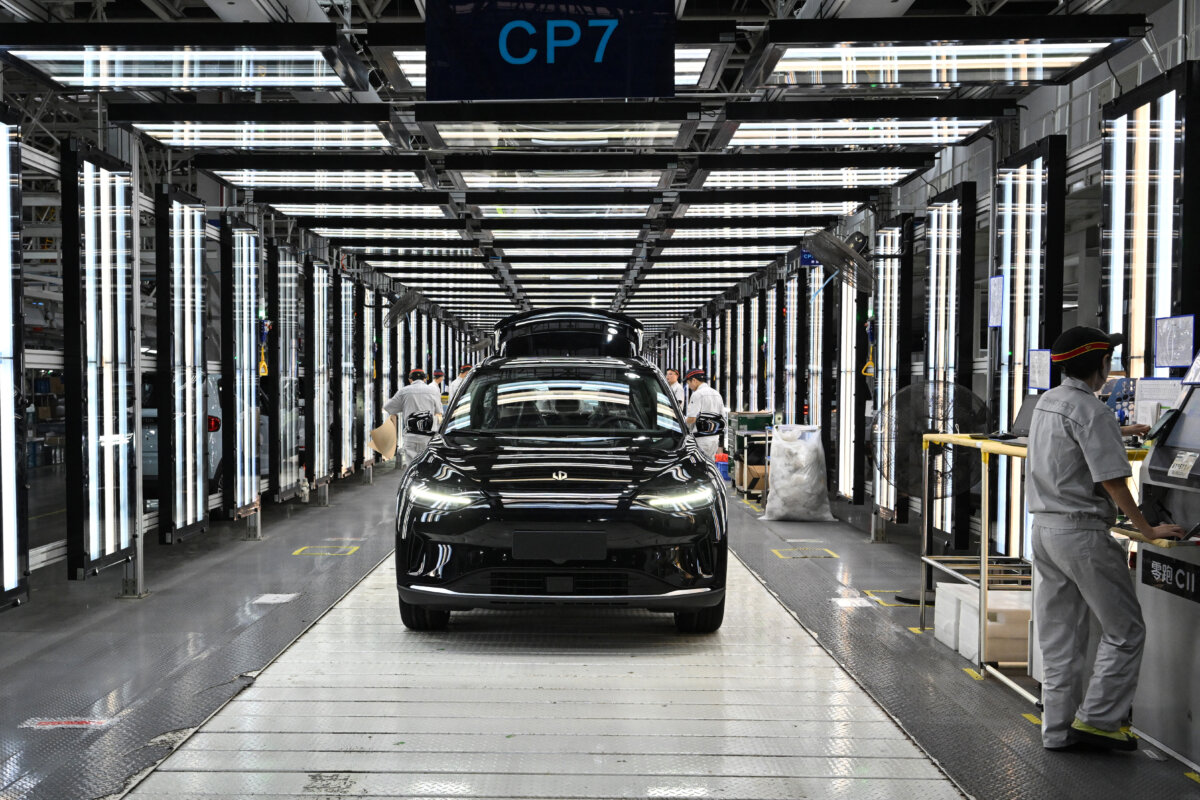

Chinese electric vehicle (EV) makers may appear locked out of the U.S. market amid tariffs, political scrutiny, software restrictions, and trade tensions, but industry analysts say many may still be pursuing a long-term strategy for eventual entry.
The strategy mirrors the gradual rise of Japanese and Korean automakers in the United States, such as Toyota and Hyundai, and comes as Chinese automakers face mounting pressure to expand overseas.
Chinese automakers are likely playing a “long game,” with major companies patient enough to pursue gradual expansion over a decade or longer, Stephanie Brinley, principal automotive analyst for S&P Global Mobility’s Auto Intelligence service, told The Epoch Times.
Toyota Motor Corporation announced its Kentucky manufacturing plant in 1985, with Camry production beginning there in 1988 as the company expanded U.S. manufacturing.
Hyundai Motor Manufacturing Alabama began production in 2005 after Hyundai entered the U.S. market in 1986 and later increased its American manufacturing presence.
While Brinley said the timeline for Chinese EV carmakers could move faster than it did for Toyota or Hyundai, meaningful scale in the U.S. market would still likely take years.
Chinese brands have a “long-term plan and long-term strategy for expanding in global markets,” she said, but they also “can build more than they can sell in their own market and need to export to other markets.”
In 2025, EVs accounted for more than half of all annual car sales in China for the first time, according to the International Energy Agency’s April 20 global energy review.
China exported seven million vehicles last year, up nearly 21 percent from the previous year, according to Jan. 22 data from the China Association of Automobile Manufacturers.
Exports of electric, plug-in hybrid, and hydrogen fuel-cell models more than doubled, reaching 2.615 million units.
Beijing has spent years encouraging vehicle exports, particularly EVs, as part of a broader industrial strategy. A 2009 policy paper from China’s Ministry of Commerce described it as a “key driver in the transformation of the country’s foreign trade model.”
In June 2023, China extended tax exemptions for new energy vehicles through 2027 in an effort to sustain EV market growth.
“China didn’t ‘organically’ drift into EV leadership—it brute-forced it with policy, scale, and control of the supply chain, and now it’s lapping the U.S.,” Lauren Fix, automotive analyst and founder of Car Coach Reports, told The Epoch Times.
American-Style Vehicles
Fix said that Chinese carmakers are rapidly moving beyond cheap small cars into SUVs and even pickups for export markets, “chasing higher margins and American-style demand.”
The 2026 Beijing Auto Show, held from April 25 to May 4, featured a wave of electric SUVs and larger models from Chinese automakers.
Geely displayed the Zeekr 8X, a luxury plug-in hybrid SUV positioned against the Porsche Cayenne.
Yijing, an EV joint venture between Dongfeng Motor Corp. and Huawei, showcased the X9 six-seat SUV. BYD’s April 24 media release highlighted the Fangchengbao Formula X and Yuan Plus SUV variants.
Brinley said the shift toward larger SUVs and more aggressive vehicle designs may reflect a combination of changing consumer preferences in China and broader global ambitions, rather than being aimed solely at the U.S. market.
She said improving battery range has reduced some of the pressure for highly aerodynamic designs, giving automakers more flexibility to develop larger vehicles that appeal to evolving customer tastes.
US Barriers Remain High
Despite global expansion ambition, Chinese automakers face major obstacles in the United States.
The United States currently imposes a 100 percent tariff on Chinese electric vehicles under Section 301 of the Trade Act.
Washington has also moved to block Chinese vehicle technology on national security grounds. In January, the U.S. Commerce Department finalized rules restricting the import and sale of certain connected vehicles and related software or hardware tied to China or Russia.
Officials said the technology could allow foreign companies to collect sensitive data or remotely access vehicles in the United States. These rules took effect on March 17, 2025.
Congress is also considering tougher measures. On April 29, Sens. Bernie Moreno and Elissa Slotkin introduced legislation aimed at strengthening restrictions on Chinese passenger vehicles entering the United States.
Slotkin said in an April 29 Facebook post that Chinese vehicles pose both economic and national security risks.
“We need to act now and get this right,” she said. “The Chinese Communist Party’s playbook of heavily subsidizing their product, underselling the competition, and then having a monopoly over that sector puts Michigan’s auto industry and our millions of workers at risk.”
Speaking at the Detroit Economic Club in January, President Donald Trump said he would be open to Chinese automakers building factories in the United States if they create American jobs.
“If they want to come in and build a plant and hire you and hire your friends and your neighbors, that’s great, I love that,” he said.
Trump is also expected to discuss trade and technology issues during a planned May 14–15 visit to Beijing, where he is scheduled to meet Chinese leader Xi Jinping.
Trade Rules
Trade rules in North America also make entry more difficult. Under the U.S.-Mexico-Canada Agreement (USMCA), vehicles must meet strict regional production requirements to qualify for tariff-free treatment.
The deal requires 75 percent of a vehicle’s content to come from North America, while a large share of production must be done by workers earning at least $16 per hour.
The USMCA is up for a review, and according to April 7 remarks by U.S. Trade Representative Jamieson Greer, negotiations to renew the deal are likely to extend beyond July 1.
Brinley said Washington is likely to pursue stricter regional content and labor requirements as part of the review, but added that software restrictions may prove to be an even bigger obstacle for Chinese automakers.
“That’s a hurdle,” she said. “I don’t know how they get around that.”
She said the restrictions force Chinese automakers to redesign major software systems for the U.S. market, increasing costs and reducing one of their biggest advantages.
“In order to sell a vehicle in the United States that’s a mainland China brand, you basically have to redo all your software. You can’t just take the autonomous system that that’s running on the BYD now and put that in the U.S. BYD,” she said. “If the appeal is that the Chinese vehicle could be lower cost and have a lower consumer price, that gap isn’t going to be what it is.”
Mexico, Canada
Even as direct U.S. access remains restricted, Chinese automakers are expanding operations elsewhere in North America.
A March 4 Benchmark Mineral Intelligence report said that Chinese EVs accounted for less than 1 percent of U.S. battery electric vehicle sales but represented 89 percent of Mexico’s BEV sales last year.
Kyle Peacock, principal at Peacock Tariff Consulting, told The Epoch Times that tariffs discourage direct imports but do not necessarily stop Chinese companies themselves.
“They keep the cars out, not the companies,” Peacock said. “The companies themselves just change tactics.”
Commenting on whether Mexico or Canada can be a back door to the U.S. market, Peacock said, “The same EV from Mexico is taxed at about 2.7 percent, and from Canada at zero percent. But to qualify for those low rates under USMCA, 75 percent, of the car’s content has to come from North America, and the batteries and parts can’t trace back to China.”
“So a Chinese automaker can use Mexico or Canada but only if they actually move most of their supply chain there,” Peacock said. “That’s expensive and slow.”
Fix said Canada could potentially serve as a staging ground for Chinese automakers, though she warned political pressure from Washington would likely intensify if Chinese-built vehicles attempted to enter the United States through Canadian assembly operations.
Under an agreement signed by Ottawa and Beijing in January, Canada lowered tariffs on a limited number of Chinese EV imports to 6.1 percent from 100 percent, allowing up to 49,000 vehicles in the first year.
Canada has indicated the quota could gradually rise to about 70,000 vehicles annually over the next five years.
Separately, Canadian officials opened a permit system on March 1 allowing up to 24,500 Chinese-made EVs to enter the country at the lower tariff rate through August.
The permits, issued by Global Affairs Canada, are valid for 60 days and require importers to be Canada-based automakers or authorized agents while complying with Canadian safety
Pressure on Detroit
Industry analysts say Chinese automakers could significantly disrupt the U.S. market if barriers eventually weaken.
“If Chinese automakers break into the U.S., pricing gets disrupted overnight,” Fix said.
She added that Chinese companies could force the Detroit Three—Ford Motor Company, General Motors, and Stellantis—to either reduce profit margins or improve efficiency and innovation.
“That kind of pressure would ignite a real technology arms race, but it also puts American manufacturing, supplier networks, and union jobs squarely in the crosshairs,” she said. “This is exactly why policymakers won’t sit on the sidelines while the industry’s profit engine gets challenged.”
Brinley cautioned against treating Chinese automakers as a single bloc.
“I don’t imagine the U.S. market would be able to absorb three or four new Chinese brands,” she said. “We’re saturated. Getting into the U.S. market is not for the faint of heart.”
Reuters and Associated Press contributed to this report.
 Friends Read Free
Copy
Facebook
Tweet
Friends Read Free
Copy
Facebook
Tweet