
Upon the opening of the 31st Summer FISU World University Games (formerly the Summer Universiade) on July 28, authorities in Chengdu, the capital of China’s Sichuan Province, upgraded the city’s alert status and heightened stability-maintenance efforts.
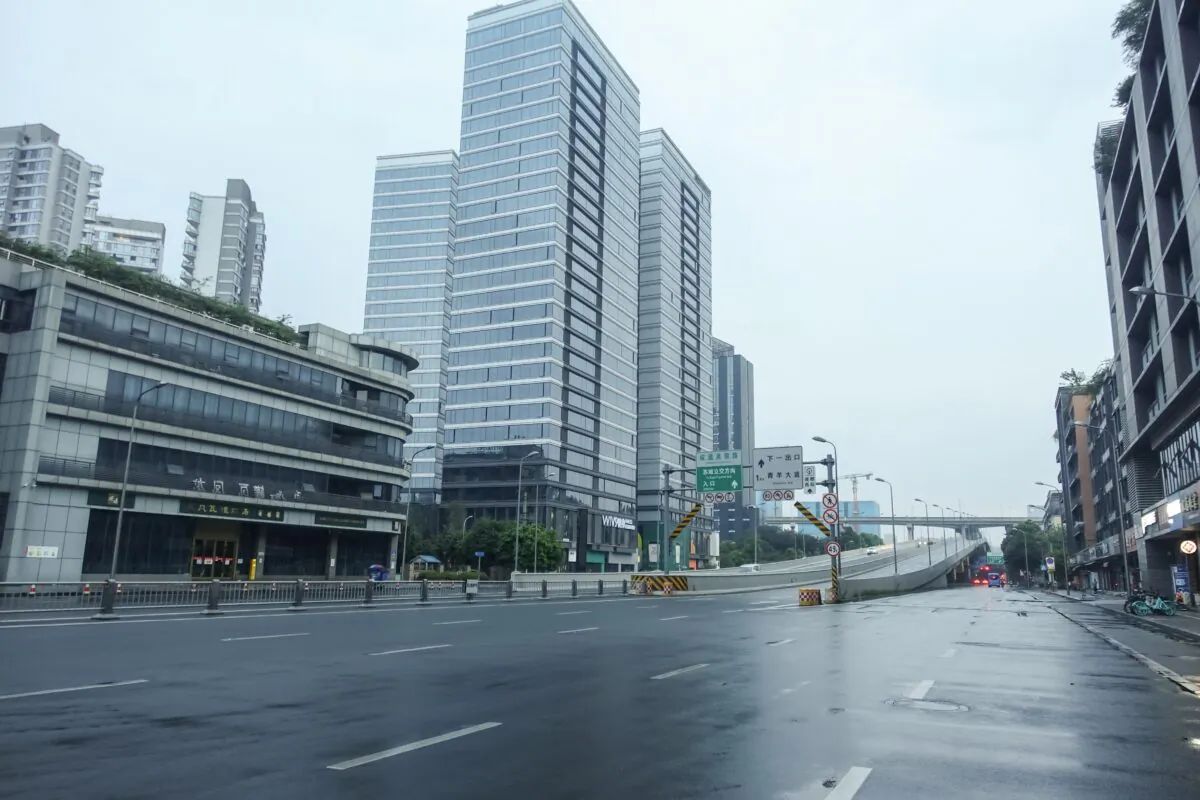
According to local residents, the authorities are suspending local factory production and restricting local traffic—despite the inconvenience caused to the public.
The Games are run off over 8 days, and include competitions in 18 sports including archery, artistic gymnastics, athletics, badminton, and basketball.
Heightened Security
Multiple videos posted online are showing how China’s communist regime has tightened local security checks.
One video showed a large number of policemen and -women arriving at Chengdu Railway Station (CRS) on July 27.
The police were shown stationed every 50 meters (around 164 feet) along a road near the CRS, as shown in another video on July 25.
The heightened security was for the arrival of Chinese leader Xi Jinping, who had already visited Guangyuan City and Deyang City in the province on the afternoon of July 25 and 26 before attending the Games’ opening ceremony.
Local authorities issued regulations and bans in the surrounding districts and venues during the event, such as no Tesla cars, no drones, and no mailing of goods containing liquids, powder, metal, gas, flammable materials, suspicious objects, chemical items, etc., according to a notice circulated online.
Mr. Yang, a resident of Wuhou District in Chengdu, said, “You can’t drive a Tesla anywhere inside the restricted area” during the Universiade, according to Radio Free Asia’s report. Some commentators have speculated that the ban on Tesla cars may have to do with the communist regime’s security concerns about cameras installed in the vehicles.
Chinese media also reported that the local authorities had restricted the use of drones during the event.
Dissidents Forced to Travel
Local residents told the Chinese-language edition of The Epoch Times that the streets were lined with police—both plainclothes and in uniform.
Chinese dissidents in the area also encountered police surveillance on a daily basis.
Mr. Cheng, who had previously been arrested for voicing his support of the 1989 Tiananmen students’ protest, said the atmosphere in the entire city was tense and uneasy. “Someone is by my door every day to watch me,” he said.
Mr. Zhao from the outskirts of Chengdu said his phone has been monitored. “The national security called me,” he said, adding that some people had been forced to travel out of town.
The Epoch Times tried to contact a number of dissidents and petitioners in Chengdu, but without success.
Power Rationing and Production Suspension
Huang Qiang, the Sichuan governor, had announced that the entire province was being set to the highest level of alert on July 16—some 12 days before the opening ceremony, according to a Chinese media report.
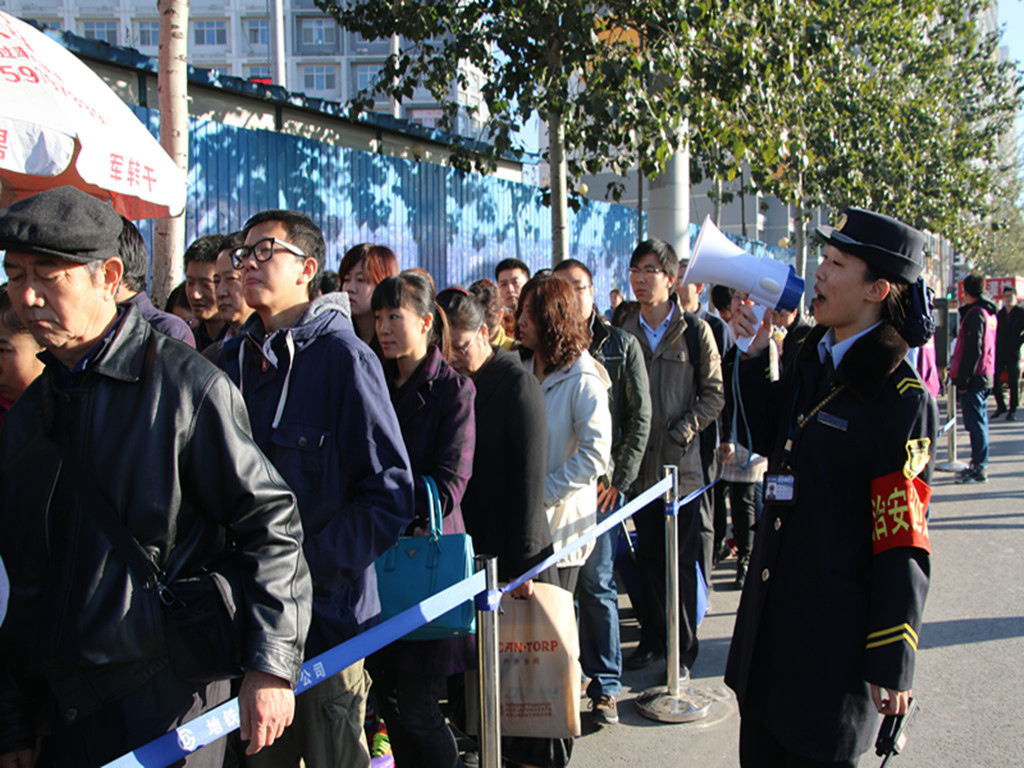
Local residents told The Epoch Times that the local authorities had implemented radio control, traffic control, suspension of work and production, power rationing, and roadblocks.
Xiaoyi (a pseudonym), a resident of Dong’an Street near the event venue, said the community has issued passes for commuting during the event, and closed nine fire evacuation routes.
Another local, Mr. Wang, said many factories had been ordered to halt production. “It’s to prevent air pollution,” he said.
The measure was mandated to some of the factories until mid-August. “I don’t care about the Universiade, but it’s affected our lives,” said Mr. Wang.
He said the measures affected him because the city implemented traffic restrictions based on even- and odd-numbered license plates during the event. “It has become very difficult for drivers,” he said.
White Paper Revolution Call
On July 11, Wang Ruiqin, founder of Washington-based IPK Media, forwarded a social media post titled “Calling for White Paper Revolutionary Action at the Chengdu University Games.”
The post said the action was to protest against Chinese Communist Party (CCP) leader Xi Jinping for his “perverse ruling” and his “dictatorship.”
Zhang Tianliang, a commentator and the host of the YouTube channel “Tianliang Time,” expressed his hope for the success of this decentralized protest.
The White Paper Revolution was sparked in China when a student from Nanjing University of Communication held a blank piece of paper in her hand to protest silently on campus, in response to an earlier fire at an apartment building in Urumqi, the capital of China’s northwest Xinjiang region. At least 10 people were killed in the fire, reportedly because they were locked inside the apartment due to China’s strict Zero-COVID policy.
Today, the girl’s whereabouts are unknown.
Her protest set the scene for a series of demonstrations by college students throughout China.
They protested the government’s strict COVID-19 measures and denounced the CCP’s authoritarian rule by holding up blank sheets of paper, and by chanting slogans such as “End Zero-COVID!” and “Down with the CCP!”
Hong Ning and Xiao Lusheng contributed to this report.
 Friends Read Free
Copy
Facebook
Tweet
Friends Read Free
Copy
Facebook
Tweet