
Commentary
There is an increasingly common experience in American life. You encounter a problem that should be relatively easy to solve. You explain it to another human being. That person understands the problem and may even agree with the obvious solution.
Yet nothing happens.
Some may remember the recurring “Little Britain” character whose answer to every request, after typing on her keyboard, was simply: “Computer says no.”
The rules will not permit it. The computer will not allow it. That belongs to another department. Nobody seems responsible for the final result, and nobody seems empowered to exercise the judgment necessary to achieve it.
Political thought has long distinguished between the rule of men and the Rule of Law. The first makes the government dependent upon arbitrary power. The second places ruler and ruled alike beneath the law.
But we may be developing something different. I have come to think of it as the Law of Rules.
The Law of Rules emerges when institutions increasingly substitute procedure for judgment. Thus, if we are faced with uncertainty, we create another rule; faced with risk, another compliance requirement; faced with questions of quality, another metric. The problem begins when following the procedure becomes more important than achieving the purpose for which it was created.
This may be connected to developments we usually discuss separately: declining courtesy, diminishing trust, extreme specialization, deteriorating pride in workmanship, the retreat of liberal education, expanding bureaucracy, and our growing willingness to allow technology to mediate human judgment.
For much of the 20th century, many employers sought college graduates because they were educated, not because they had already been trained for one narrowly specified function. An educated person could read, write, communicate, learn, think, and exercise initiative. The company could teach him the business.
The employer was hiring human capacity.
Increasingly, employers seek precise combinations of skills, software experience, certifications, credentials, and previous experience performing substantially the same task. Once hired, employees enter organizations governed by workflows, metrics, policies, and compliance systems. The employee becomes less a broadly capable person whom the organization develops and more a component already configured for the system.
Universities did not respond to this transformation with serious reconsideration of what it means to educate a human being. In this, most would receive a failing grade.
Too often, they responded by bean counting.
If employers wanted skills, universities created competencies. If parents wanted evidence of value, institutions produced outcomes. If accreditors demanded accountability, universities generated assessments, rubrics, reports, strategic plans, and documentation.
Assessment is not the problem. Professors have always assessed students. The problem arises when what can be counted begins determining what counts.
We have become increasingly sophisticated at measuring education while becoming less certain about what it means to be educated.
Students ask what is on the rubric and how many points something is worth. Faculty ask which outcome must be demonstrated and which box is checked. Everyone can satisfy the system. It is a giant beast that must constantly be fed, and that beast breeds misery.
Whether anyone has been educated is another question.
Robert Heinlein famously warned that “specialization is for insects.” He was not suggesting that expertise is unnecessary. Modern civilization depends upon specialists. His larger warning concerned reducing the human being to his specialty.
That is why the collapse of liberal education should concern us.
The humanities themselves bear some responsibility. Parts of the academic left increasingly treated education as an instrument of political transformation rather than an encounter with ideas to be understood, challenged, debated, and transmitted. Education ceases to be liberal when its conclusions are predetermined.
Yet parts of the political right answer by reducing education to economic utility: learn a trade, obtain a technical credential, study something marketable. America certainly needs tradesmen, engineers, scientists, entrepreneurs, and technicians, and not everyone needs a four-year degree. But the answer to the corruption of liberal education cannot be its abandonment.
John Adams understood something we have forgotten. Writing to Abigail in 1780, he explained that he must study politics and war so that his sons could have the liberty to study mathematics and philosophy, and they, in turn, could create the conditions that would allow their children to pursue painting, poetry, music, architecture, and the fine arts.
Adams understood that civilization accumulates. One generation secures liberty. Another builds, discovers, invents, and prospers. Eventually, civilization creates the freedom to pursue philosophy, literature, music, art, beauty, and the larger questions of human existence.
We increasingly appear to have reversed Adams’s logic. We have begun treating science, technology, commerce, and production less as instruments of civilization than as civilization’s purpose.
The artes liberales were the arts appropriate to a free person. The engineer must know how to build the bridge. Someone must still decide whether the bridge should be built. Science can tell us what can be done. It cannot by itself tell us what ought to be done.
Instead, we increasingly educate and employ people as something of organic computers: acquire specialized information, master the process, perform the function, produce measurable output, follow the rules.
And then we invented artificial intelligence.
There is considerable irony here. At almost precisely the moment institutions became extraordinarily proficient at organizing human beings to perform narrowly defined information-processing tasks, machines appeared capable of performing many of those tasks faster and more cheaply.
If the human being is merely an organic computer, then the computer will eventually win.
But that exposes a more fundamental question:
What is a human being?
If man is merely a complicated biological machine—a bundle of neurons, synapses, chemicals, and electrical impulses—the difference between human and artificial intelligence eventually becomes one of capability.
Christian civilization begins somewhere else.
Man is made in the image of God.
Human dignity does not originate in productivity, intelligence, education, wealth, or usefulness to the state or corporation. God made man, not a bundle of economic inputs.
The worker is not merely human capital. The student is not a future economic unit, and the citizen is not data. The professor is not a content-delivery mechanism. The person confronting a bureaucracy is not a case number. The human mind is not simply an inferior computer waiting to be replaced by a better one.
Human beings possess reason and moral purpose. They create, love, sacrifice, worship, err, repent, learn, and judge. Freedom matters because human beings are moral actors, and judgment matters because freedom carries responsibility. This is fundamentally the difference between legalism and justice.
The Law of Rules threatens that relationship. If exercising judgment contrary to procedure can get someone punished while following a bad procedure cannot, the rational response is obvious: follow the procedure. Institutions then complain that people lack initiative after constructing systems that discourage people from exercising it.
John Adams understood the constitutional consequences. In 1798, he warned: “Our Constitution was made only for a moral and religious People. It is wholly inadequate to the government of any other.”
Limited government requires self-limited people.
A free government depends upon people who govern much of their own conduct through conscience, virtue, faith, family, custom, professional responsibility, courtesy, and shared standards. As those internal restraints weaken, pressure for external restraints increases. When judgment is not trusted, institutions write procedures. When responsibility weakens, they construct compliance systems.
The rule attempts to perform work that character once performed.
But rules cannot create character.
This is also why statesmanship matters. A statesman cannot be an insect specialist. He must understand enough history, economics, military power, diplomacy, technology, culture, morality, and human nature to see relationships among them. Above all, he requires prudence.
There is no algorithm for prudence.
Citizenship requires those same qualities on a smaller scale. A republic assumes that people can govern themselves, and self-government means considerably more than voting.
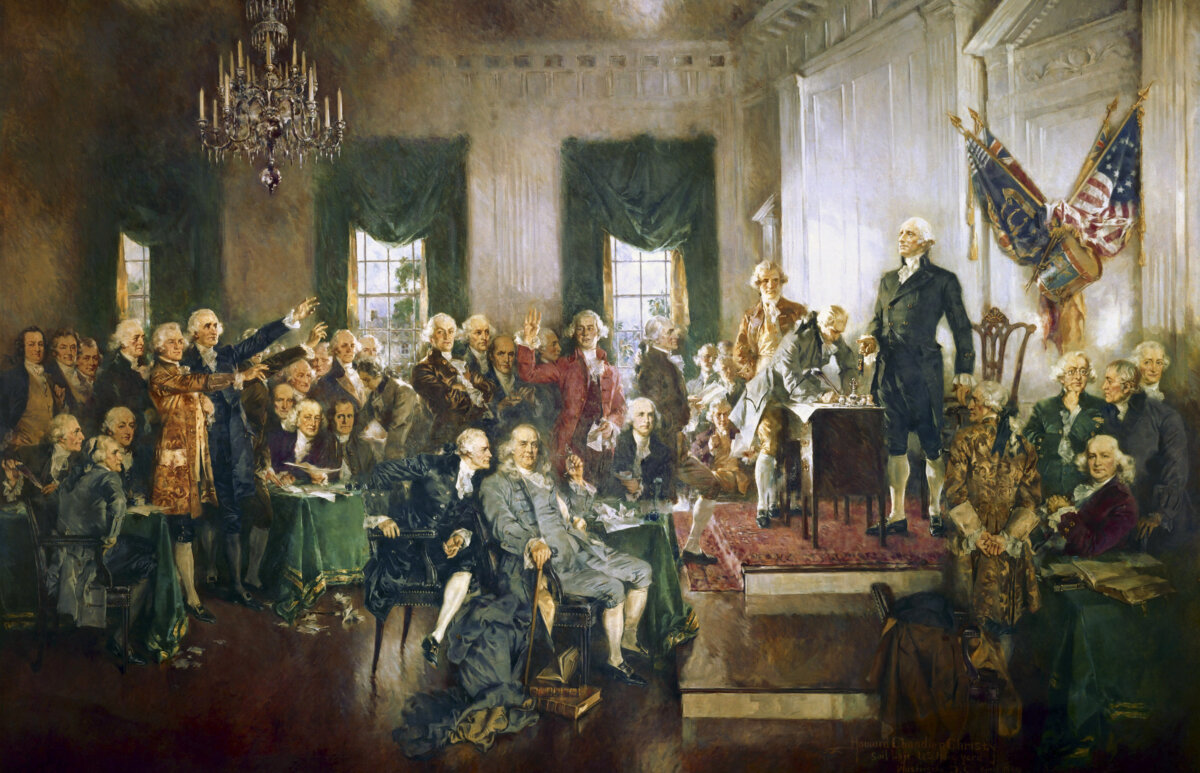
Benjamin Franklin reportedly emerged from the Constitutional Convention and was asked what form of government had been created.
“A republic, if you can keep it.”
We generally emphasize republic.
Perhaps we should think harder about keep.
The Adams of 1780 understood what civilization should make possible. The Adams of 1798 understood what constitutional liberty requires.
Those ideas belong together.
A civilization must know what freedom is for, and a republic must form people capable of using that freedom responsibly.
God did not create man as a component in someone else’s system. Human beings possess dignity, reason, freedom, responsibility, and the capacity for judgment.
A free republic depends upon precisely those qualities.
Adams understood the requirement.
Franklin understood the challenge.
The question for us is whether we are still forming people capable of keeping it.
Views expressed in this article are the opinions of the author and do not necessarily reflect the views of The Epoch Times.
 Friends Read Free
Copy
Facebook
Tweet
Friends Read Free
Copy
Facebook
Tweet