Commentary
There are several prevailing features of brilliant scholars in many fields. They can be visionary generalists with a spectacular, sweeping understanding of history, science, philosophy, art, and so on. They write big-picture books that change the world. Another type is a keen specialist in one focused area who changes everything in a particular field, with physics or economics or medicine.
The single most unusual scholar is one who possesses detailed and deep knowledge of several fields and makes a mark in each, but who, at the same time, has broad and scalable understanding of the big picture and is thus capable of elucidating the context of the particularities.
This sort of intellectual is exceedingly rare. It’s even more unusual for this person to have stability and courage in standing up alone against the errors of his time. When such a person comes along, we should recognize his uniqueness and treasure him.
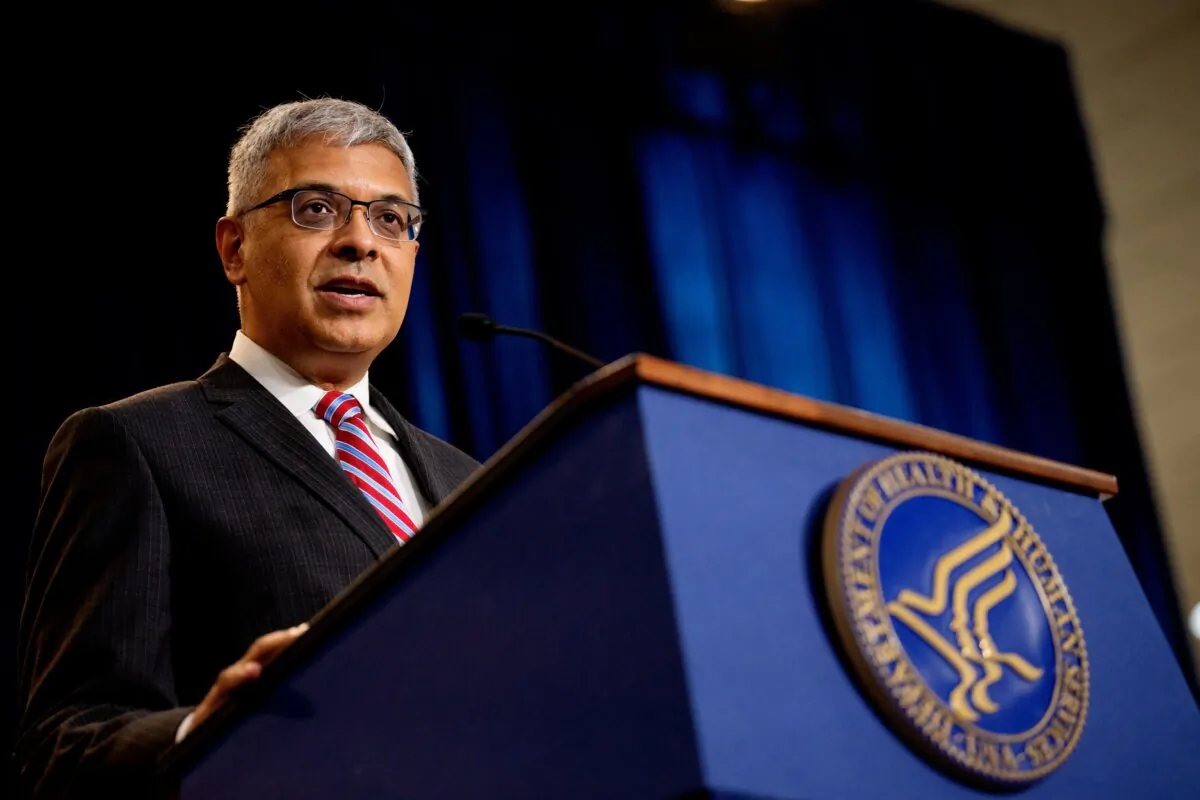
Dr. Jayanta Bhattacharya is one such person. On leave from Stanford University to head the National Institutes of Health (NIH), Bhattacharya wears his learning lightly, conveying humility and curiosity in his public interviews. But there always comes a moment in such interviews when he easily draws on a gradient of knowledge in infectious disease, pharmacology, economics, history, or even theology. He deploys this erudition in a way that is disarming because he speaks gently and cautiously and not with arrogance or pretension.
His academic background is unusual. He obtained both a doctorate in economics and an MD from Stanford within three years of each other, setting himself up for a remarkable career that landed him at the RAND Corporation and the University of California–Los Angeles before he went back to a position at Stanford in medicine. From that tenured position, he has authored 135 peer-reviewed papers that combine his interests in medicine, economics, statistics, law, and public health.
What this has enabled is a vast capacity for looking at any particular problem in public health from many different angles as well as the broadest possible understanding of the implications of policy, without neglecting mitigating factors. He has long been a quiet but impactful scholar, following a successful career path without controversy.
I often think of those days at the White House in March 2020, when Dr. Anthony Fauci is said to have told the president that it was time to shut down the economy to protect against the spread of a new virus coming from China. Several other advisers cautioned about the implications for people’s lives in commerce and otherwise, warning that a shutdown would lead to grave outcomes. Fauci clarified that he is only an infectious disease doctor and specialist in public health and would have to leave economics to others.
This is a strange way of looking at things. Public health surely includes the economic well-being and psychological health of people who are suddenly denied the right to liberty and property. Fauci pretended to be unable to assess that because it was not his area of specialization.
Bhattacharya was watching this situation unfold from his position as a Stanford professor, knowing full well the vast research on the effects of unemployment on suicide rates and sickness generally. He was not willing to build a wall between his roles as an economist and as an epidemiologist. After all, we are talking about experimenting and toying with people’s lives. He knew for certain that disaster was coming.
His brilliant thought was to do a study of population seroprevalence, that is, just how much the virus was already spreading in the community. He cobbled together enough emergency funding to make such a study possible in one community: Santa Clara, California. He published his shocking results, which indicated that the virus had already spread 10 times more than the models had assumed. Crucially, he found that infection did not lead to medically significant consequences for most, which is to say that endemicity of this strain was already being realized in a normal and natural way without lockdowns.
His study was published in May 2020. Understanding the implications, the industry that had already heavily invested in lockdowns came after him in the most cruel way possible. Silly publications such as BuzzFeed, which was a thing at the time, attacked him personally, claiming that his study was compromised because of one funding source. Bhattacharya suddenly found himself in the thick of a political battle he did not desire. As the purest scientist, seeking just facts and favoring humane treatment of people, he was stunned by the ferocity and partisanship of the time.
This did not deter him. His shock at what was happening continued through summer and intensified through fall. He looked everywhere to find a way that he could make a difference, publishing in every venue that would take his articles. He found one at The Wall Street Journal and made it clear that he was opposed both because of principle and because of the facts to everything that was unfolding. His sense that civilization was under attack by his own profession grew to the point at which he joined the effort to speak truth to power.
A result was the Great Barrington Declaration, which he proudly helped write and then signed with both a smile and with trepidation. Sure enough, within days of its release, Francis S. Collins, then head of the NIH, wrote Fauci, saying he hoped for a “quick and devastating takedown” of this document written by people he called “fringe epidemiologists.” The attacks came fast and furious from every venue over which Fauci had influence.
It was a brutal season but Bhattacharya had no regrets about his role. He was confident that he would prevail in the end, simply because he had closely investigated the facts of the case. He knew that the virus would become endemic, would be far less deadly than the models were predicting, and that the nonpharmaceutical and pharmaceutical interventions would not obtain the results their architects imagined. He had some hope for the vaccine but knew that if it was to be effective, it would only be for the medically vulnerable, a population that was aged and infirm, as was very clearly documented in all studies thus far.
Fate takes circuitous routes, but this one defies every possible prediction. It now happens that Bhattacharya heads the very agency that contracted hits on him. In his position at NIH, arguably the most important scientific agency in the world, he works 14- to 16-hour days, doing interviews and administrative work and setting policies for this huge sprawling agency.
In his time there, he has already worked with Health and Human Services Secretary Robert F. Kennedy Jr. to map out new standards for rigorous science; deleted the huge number of diversity, equity, and inclusion-focused grants; banned testing and experimentation on pets; dramatically curbed gain-of-function research; implemented new oversights to foreign grants; cooperated in tethering mandates on vaccines; withdrawn contracts that would have given the mRNA industry a new lease on life; and implemented a new focus and scientific standards for the release of new shots for new strains.
These are remarkable achievements in only two months of work. In other words, his courage in the past is being rewarded with new oversight and policy influence that is turning the ship of state around.
It’s been a long time since the best and brightest were attracted to government work. It’s hard to get used to the reality that we have one of the best living scholars in such a high position at this agency. We’ve been witness to years in which agency policy was obviously corrupted by the abuse of power and industrial capture. Bhattacharya’s goal is seemingly impossible: to restore trust in a time when it has hit rock bottom.
Honestly, it does seem like too much to take on. But if anyone can do it, it is surely Jay Bhattacharya, the humble but brilliant scholar in so many fields, with a knowledge base that is both broad and extraordinarily deep. There is poetic justice in the fact that he holds this position—but never think that it has been easy for him. He has suffered enormously, and suffers today from his vast responsibilities and in daily dealings with a media establishment that desperately wants him to fail.
The likes of Bhattacharya, a man of the hour whose life training and experience has prepared him perfectly for his role, come along very rarely in the sweep of history. Honestly, I’m in awe. We all should be. That someone like this could eventually triumph is a plot one would script in a novel, not in reality. And yet here we are.
Keep in mind that he is still a young man, and he will have plenty of time remaining, God willing, following his service in government. He will take up the vocation of pure intellectual life, perhaps in academia or perhaps in a more independent setting. Then he will produce his masterwork, a combination of theory and praxis and autobiography. That will be for the ages.
Views expressed in this article are the opinions of the author and do not necessarily reflect the views of The Epoch Times.
 Friends Read Free
Copy
Facebook
Tweet
Friends Read Free
Copy
Facebook
Tweet