
Commentary
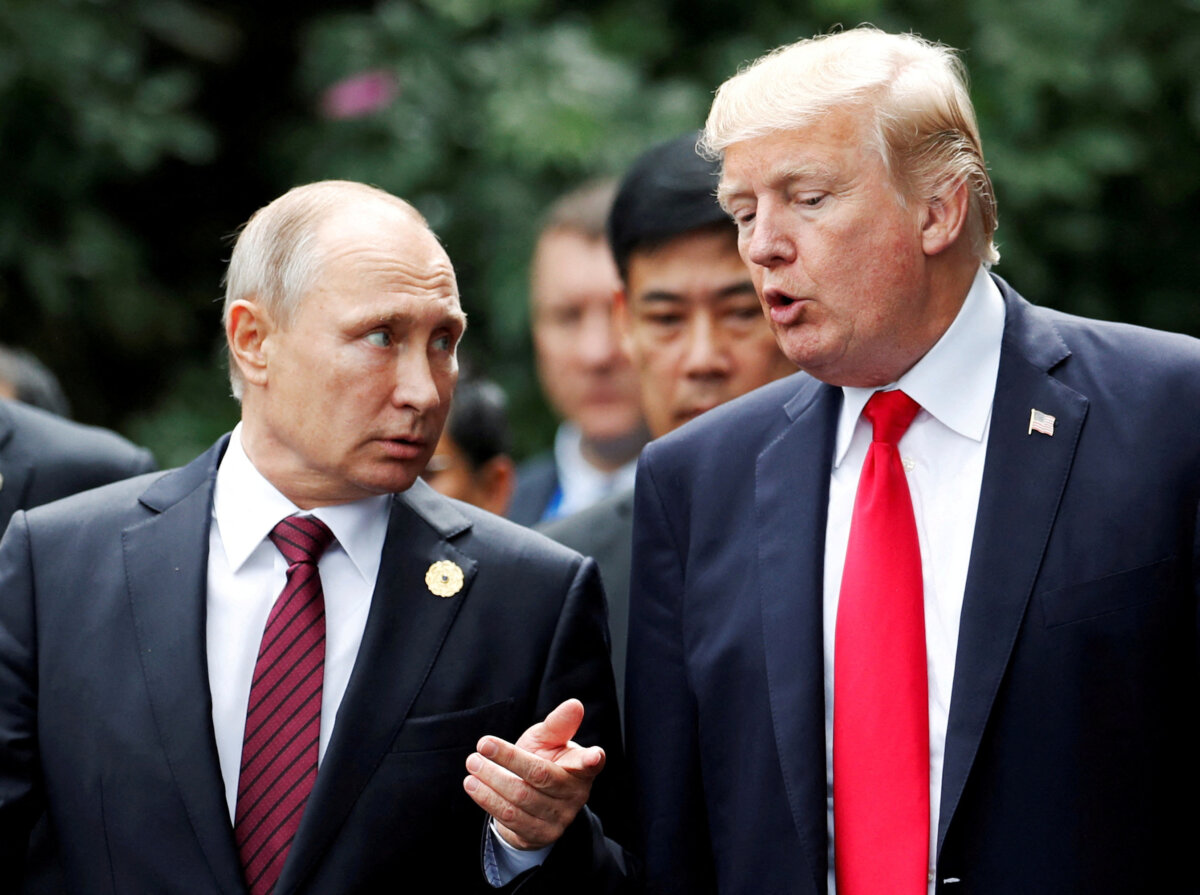
When President Donald Trump and Russian President Vladimir Putin meet in Anchorage on Aug. 15, their handshake will make headlines. But the real story runs deeper—a summer-long campaign of calibrated pressure that has pulled two major powers, and their strategic partners, into the same room.
This is not just about Ukraine. It is a stress test for America’s ability to shape the actions of two great-power rivals—Russia and China—without firing a shot.
The Energy Front: Targeting the Lifeline
In February, Moscow’s oil output took another hit. Sanctions, drone strikes, and tightening maritime insurance rules left Russia increasingly dependent on India and China to buy its crude. According to Kpler shipping data, in July 2025, nearly 1.9 million barrels per day of Russian oil were imported by India, more than by any other country.
On Aug. 6, Trump doubled tariffs on Indian goods to 50 percent, citing New Delhi’s growing purchases of discounted Russian crude. Two days later, he threatened tariffs of up to 100 percent on any country buying Russian oil—a direct shot at the revenue Moscow needs to finance its war.
For Washington, this was strategic judo: instead of attacking Russia directly, the United States targeted the arteries carrying its cash flow, using trade leverage over partners like India to choke off the Kremlin’s options. For Putin, the signal was clear—America could turn his friends into pressure points.
The Financial Chokepoint: Controlling the Arteries
Even before the tariff salvo, Moscow had been working to secure one key concession: re-entry into the SWIFT banking network. In March, Russia delivered a “wish list” to U.S. and European officials, with Rosselkhozbank—a state-linked agricultural lender—at the top.
Washington’s response was deliberately mixed. The U.S. Treasury let a Russian energy-financing license expire, keeping pressure high, but signaled conditional openness to restoring SWIFT access for Rosselkhozbank if Russia took verifiable steps toward a ceasefire. The European Union, meanwhile, asserted that any SWIFT decision required its approval.
For Russia, SWIFT relief is about more than agriculture. It’s the first crack in the wall of financial isolation. For Washington, it’s a lever—the modern equivalent of controlling access to the world’s sea lanes—that can be turned on or off to drive negotiations.
The Military Lever: Dialing the Pressure
Military aid has been another adjustable dial. In July, the Pentagon briefly paused shipments of precision munitions to Ukraine, only to resume them days later after a review. The pause was widely read in diplomatic circles as a signal to Moscow that battlefield pressure could be modulated in response to talks.
But the relief was short-lived. Within weeks, Trump ordered Patriot missile systems delivered to Ukraine—with Kyiv covering 100 percent of the cost—and the State Department notified Congress of $150 million in Bradley fighting vehicles and $172 million in HAWK missile systems. It was a reminder to the Kremlin that America could escalate again if talks faltered.
The Multipolar Gameboard: More Than Two Players
While the U.S.–Russia choreography played out, Beijing watched closely. China’s imports of Russian crude rose in Q2 2025, but the prospect of U.S. secondary tariffs gave Chinese planners a reason to keep options open.
In the Middle East, Riyadh hosted quiet ministerial talks between U.S. and Russian officials, exploring potential embassy normalization and targeted sanctions relief. These discussions ran alongside U.S. offers of Arctic cooperation—trade routes, energy exploration, and even rare-earth joint ventures—that could become post-war dividends for Russia.
In the background, BRICS expansion loomed. Moscow has leaned on the bloc as a counterweight to Western sanctions, but without relief from U.S.-controlled financial systems, its influence inside BRICS risks being more symbolic than structural.
Alaska as Stage and Signal
The choice of Anchorage is more than logistical convenience. Historically, U.S.–Russia summits have been hosted in Geneva, Helsinki, or Reykjavik—venues steeped in Cold War symbolism and European mediation. Alaska flips the script. It places the meeting on U.S. territory, but far from Washington’s political theater, and within reach of the Arctic discussions that have been on the back-channel agenda for months.
For Trump, it’s a chance to host without appearing to concede. For Putin, it’s a location that can be framed at home as neutral and pragmatic, not as a pilgrimage to the American capital.
What’s on the Table
Negotiators are expected to focus on:
- SWIFT Reconnection: Starting with Rosselkhozbank as a first confidence-building measure.
- Sanctions Rollback Schedule: Phased relief tied to verifiable ceasefire steps.
- Energy and Mineral Projects: Post-conflict cooperation in Arctic routes, LNG, and rare-earth.
- Military Freeze Terms: Gradual suspension of U.S. aid to Ukraine if Russia complies.
Both sides are keeping their strongest levers in reserve. Trump can still deploy full secondary sanctions or alter NATO’s forward posture. Putin can escalate in new theaters or accelerate BRICS currency initiatives.
The Stakes
The Alaska summit is not a peace conference. It’s a live test of the “pressure grid”—four interlocking arenas of leverage: energy flows, financial lifelines, military tempo, and diplomatic posture. Over the past six months, every move has been about narrowing the other side’s room to maneuver.
If the meeting produces even a temporary freeze in hostilities, it will show that the United States can bend rivals through economic, financial, and diplomatic force multipliers—not just military might. If it fails, it could mark the start of a sharper alignment between Moscow and Beijing, with ripple effects across Europe, the Middle East, and the Indo-Pacific.
Either way, the path to Anchorage is a reminder that in great-power politics, the visible handshake is only the final move in a much longer game.
Views expressed in this article are the opinions of the author and do not necessarily reflect the views of The Epoch Times.
 Friends Read Free
Copy
Facebook
Tweet
Friends Read Free
Copy
Facebook
Tweet