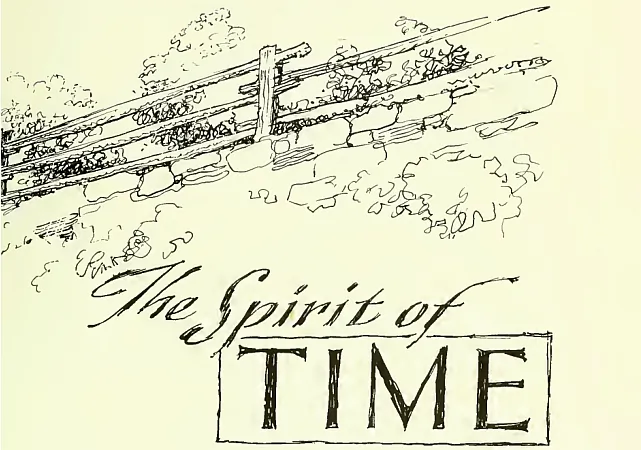

This is part eight of a 10-part series of reflections on Eric Sloane’s book on the bicentennial, “The Spirits of ’76.” Each chapter covers a different spirit of America.
American essayist and illustrator Eric Sloane began the eighth chapter of his 1973 book, “The Spirits of ’76,” with an interesting observation.
Sloane was an expert on old-style covered wooden bridges. Strange passion, but stick with me here.
He wrote that there were always signs on these bridges: “Walk your horse.” Apparently, galloping across a bridge creates a rhythmic pattern that weakens the structural foundations. To make the bridge secure for longer, people on horses would dismount and walk slowly and deliberately.
He uses this to illustrate a fascinating point about American perceptions of time in the past. It was really never about haste. The idea of a “New York minute” is new. The old way is patience, discipline, slow achievement, and unrelenting and constant work at all hours.
Sloane pointed out that if you ever visit an older farmer and see how he works, he is rather slow about it all but never stops going. He does this and does that but never seems to be in a rush. He seeks to do a thorough job, not a quick one. He doesn’t get frustrated with the wood that doesn’t fit, the nail that is rusted, or the door jamb that is off; instead, he just calmly takes it on as another thing to do.
I vaguely recall seeing this as a young man when I worked with my uncle on a roofing job. We climbed up carefully and slowly and started pulling shingles one by one, fixing or replacing them, and moving on to the next one. I quickly grew impatient as I saw the huge length we had to cover. I started to rush my portion and brag about it. He looked at me knowingly.
We worked for hours in the hot sun. Finally, at nearly noon, we said we should take a break. I was deeply grateful, and I climbed down the ladder and headed for the water hose. I drank as much and as fast as I could. He muttered a warning about that. Sure enough, I threw up. Blech. He laughed, and we went inside.
He sat down, and his wife brought him not a gigantic glass of water but a cup of coffee. I sat there gobsmacked. How in the world could he have coffee after four hours in the hot sun with nonstop work? Years later, I was still thinking about this.
Sloane has the answer. My uncle did not work fast or furiously to exhaustion. He worked slowly and deliberately, in a manner consistent with his job and his health. He knew what he was doing. I did not.
After the break and a sandwich, we climbed back up. I was intimidated by how much more there was to do. We got back at it. Another three hours went by, and we took another break. We got back up and worked more.
Sure enough, by 5 p.m. on the hour, we finished. I was thrilled, and I simply could not believe how two people working steadily and deliberately could have done all that in one day. I felt great pride and still celebrate to this day.
For my uncle, it was just another day, and he repeated these habits every day with everything on which he worked.
Sloane wrote that this is the true American spirit. Not speed. Not haste. Not a quick win. Instead, our history is marked by relentlessness, patience, deliberateness, determination, steadiness, and discipline. Routine, not dopamine. This is the foundation of the American sense of time that we have clearly lost.
Speed these days comes at the highest premium. We expect everything to happen fast. We don’t read; we watch the movie. We listen to video interviews at twice the pace of the real thing. We generate the artificial intelligence summary rather than spend an hour reading. We glom on to any technology that turns days into hours and hours into minutes and minutes into seconds.
This distorted sense of time plays into things such as business planning. We are supposed to have five-year plans and one-year plans for everything. This is supposed to inspire us to build quickly, act fast, stay driven to achieve, and keep us undiverted. I have always been suspicious of this way of thinking.
As I turn this over in my mind, I realize that I’ve always believed that the only real path to long-term success is simply to do a good day’s work. Nothing more. Make sure you get from here to there successfully in one day. Do that every day.
In six months or a year, you can look back and say, “Wow, look what we have achieved!”
But there is no point in planning it out. All you can really do is the job one day at a time, solving puzzles and problems as they come.
We’ve become so obsessed with speed that we are frustrating ourselves that we cannot do it. Instead of loving what we do and doing it completely and with excellence, our culture trains us to hate what we are doing and only love the thing we are not doing and rush to do that instead. And we treat the new thing the same as the old: as a regrettable task.
For that reason, we are always discontent and never fully engaged in the task at hand. We are fidgety and fill ourselves with resentment. Instead, we should learn to love what we must do and do it with patience and completeness so that we can always say it was a job well done.
Almost all young people today believe that they are afflicted with attention deficit hyperactivity disorder. This supposed disease is entirely made up, never discovered. It is simply a description of people who are in a wild rush and unable to be patient in their studies or work.
Even worse, we have manufactured drugs to fix this supposed affliction. They have a lot in common with street narcotics, but they are acceptable because doctors prescribe them. They cause people to be wildly focused on one thing and do seemingly impossible work, generating weeks of productivity in one all-nighter.
Magic, right? Not so much. I’ve worked with many people who take these drugs. They do amazing things, just not quite the right things. Ask them to revise what they did, and they report barely remembering having done it at all.
After much experience, I concluded that I would rather work with moderately talented people with a predictable, deliberate, and even slow pace of gradual achievement than with someone who has wild bursts of amazingness that come and go and whose work can never be tweaked because it was done in a mental haze. Such people think that they are achievers, but actually they just drive everyone else nuts.
I love work, but I’ve also come to appreciate how crucial it is to mix one’s desire to achieve with a passion for doing what one does with precision and completeness, regardless of how long it takes. Thanks to technology and our worship of progress, we have subsidized speed at the expense of quality, rationality, durability, and longevity.
Think where that has landed us. We buy things all the time now—phones, tablets, laptops, electric kitchen gizmos, choppers, and tiny machines of all sorts—that we know for sure are not going to last more than a few years at most.
They will be replaced with more spending and more stuff. We know this, and we do it anyway. Why? Because we assume that this gadgeting will help us achieve our aims faster.
It’s all rather exhausting and mostly wrong. Just look around your kitchen, for example. That juicer machine takes up lots of counter space when a hand-operated squeezer fits in a drawer. How much time do you really save? And isn’t there some joy you can find in doing things by hand?
Or how about lights and music? Must they all be operated by your phone? What exactly is the downside of standing up and changing the music or turning the light on or off? Truly, this is getting ridiculous. The goal of life is not to lounge on the sofa while pushing buttons to make things happen all around you. Maybe there is some sense of achievement that comes from actually doing something yourself.
Time in America past: slow, deliberate, thorough, and relentless. Time in America present: rushed, haphazard, panicked, sloppy, and with no longevity. It’s all just crazy. We live long lives, God willing. We can make the best of them by putting quality over speed, discipline over performance, routine over dopamine, and completeness over the cosmetics of artificial productivity.
In short, we need to get better at hopping off the horse, walking it across the bridge, and helping to ensure that the structure lasts for the next person. The sign to which Sloane pointed was correct, and it applies to much more than just old-fashioned covered bridges.
Read the other parts of the series here:
• America and the Spirit of Respect
• America and the Spirit of Work
• America and the Spirit of Frugality
• America and the Spirit of Thankfulness
• America and the Spirit of Pioneering
• America and the Spirit of Godliness
• America and the Spirit of Agronomy
• America and the Spirit of Independence
• America and the Spirit of Awareness
Views expressed in this article are the opinions of the author and do not necessarily reflect the views of The Epoch Times.
 Friends Read Free
Copy
Facebook
Tweet
Friends Read Free
Copy
Facebook
Tweet