
Commentary
Recent U.S. intelligence assessments reveal that China’s nuclear arsenal has surpassed 600 warheads and is projected to exceed 1,000 by 2030, fundamentally challenging American nuclear dominance and decades of strategic planning.
During a recent Senate hearing, Sen. Katie Britt (R-Ala.) stated that China is building at least 28 nuclear reactors—about half of all the reactors under construction worldwide. This civilian expansion parallels a major military buildup, which U.S. intelligence calls the most significant since China’s first atomic test in 1964.
The shift by the Chinese Communist Party (CCP) from a traditionally defensive nuclear posture toward one increasingly geared toward offensive capability marks a strategic turning point and poses new challenges for U.S. defense planning.
Rep. Scott DesJarlais (R-Tenn.), chairman of the House Armed Services Committee’s Strategic Forces Subcommittee, emphasized the importance of this shift, stating that the return of great power competition has ended the post-Cold War era of relative stability and shrinking arsenals. He called it “a new tripolar environment,” referring to the emerging nuclear balance among the United States, China, and Russia that is less stable and more competitive.
According to the Stockholm International Peace Research Institute, China has been expanding its nuclear arsenal by about 100 warheads annually since 2023, making it the fastest-growing nuclear program in the world. This marks a sharp departure from historical norms.
Until 2020, China maintained about 200 warheads under a so-called minimal deterrence strategy, a posture it held for half a century. The current buildup represents a fivefold increase from that baseline within a decade.
The Chinese regime is not only increasing the size of its arsenal, it is also advancing its technological sophistication. The U.S. Defense Intelligence Agency’s 2025 Worldwide Threat Assessment reports that the regime is aggressively developing systems such as hypersonic glide vehicles designed to undermine U.S. defenses. Among its most concerning advances are fractional orbital bombardment systems, which could allow missiles to orbit the globe and strike on hypersonic trajectories, potentially bypassing U.S. early-warning systems.
At the same time, Beijing announced a major military realignment, placing the People’s Liberation Army (PLA) Aerospace Force, Cyberspace Force, Information Support Force, and Joint Logistic Support Force directly under the Central Military Commission, led by Xi Jinping and other top commanders. This restructuring highlights the PLA’s growing focus on space, cyber, and electronic warfare as asymmetric tools to paralyze enemy information systems, capabilities that could degrade or nullify U.S. defenses during a nuclear exchange.
In line with this shift, the Chinese regime is also developing systems aimed at threatening U.S. nuclear command, control, and communications infrastructure, including anti-satellite weapons, advanced cyber tools, and hypersonic platforms designed to evade early-warning systems and potentially enable a decapitating first strike.
The CCP’s air and naval aviation forces continue to modernize, evolving into more advanced and capable joint-operation forces. In the past year, China unveiled the J-35A, a fifth-generation fighter jet capable of operating from aircraft carriers. While these upgrades reflect conventional power projection, the country’s nuclear delivery systems are also expanding.
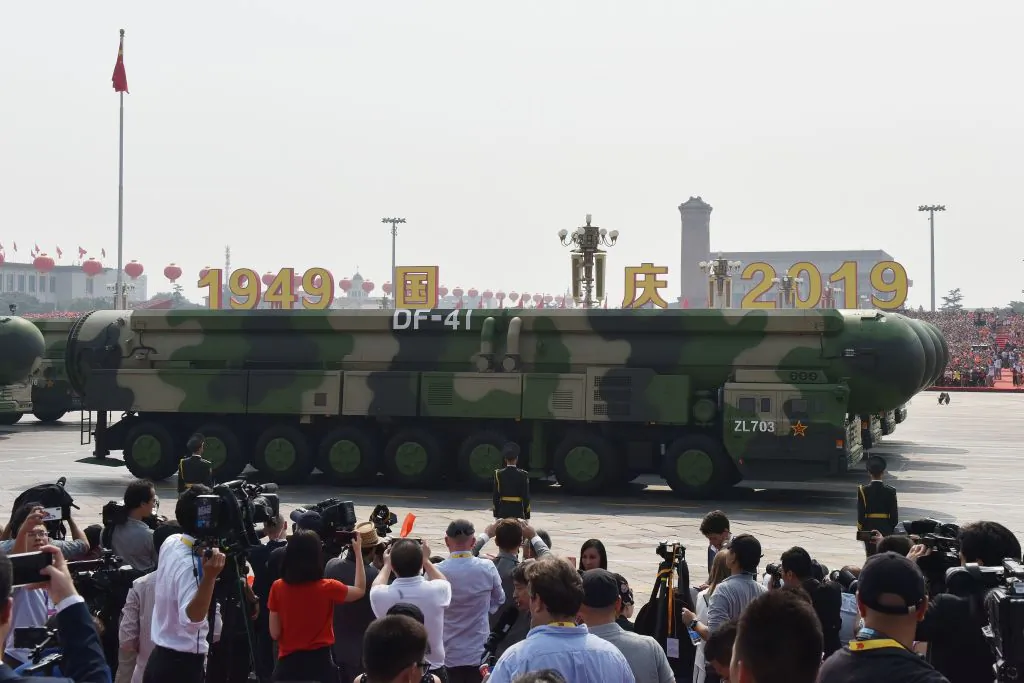
The PLA Rocket Force now fields approximately 900 short-range ballistic missiles (down from 1,000 in 2023), 1,300 medium-range ballistic missiles (up from 1,000), 500 intermediate-range ballistic missiles (unchanged), 400 intercontinental ballistic missiles (up from 350), and 400 ground-launched cruise missiles (up from 300), many of them dual-capable and able to deliver nuclear warheads.
The physical infrastructure supporting China’s nuclear expansion is also rapidly advancing. By January, China had completed or neared completion of approximately 350 new intercontinental ballistic missile (ICBM) silos across three large desert fields in the country’s north and three mountainous areas in the east, according to the Stockholm International Peace Research Institute. The Pentagon’s 2024 China Military Power Report noted that China possessed 550 ICBM launchers, more than the United States, although not all silos are yet armed.
The Federation of American Scientists emphasizes that China is not yet a nuclear “peer” of the United States. However, current trends suggest that China could match Russia or the United States in ICBM numbers by the decade’s end, depending on future force structure decisions.
The Chinese regime’s current modernization suggests a shift toward a more flexible nuclear doctrine. China’s medium- and intermediate-range nuclear-capable missiles already place U.S. forces in the Indo–Pacific, along with allies such as South Korea and Japan, within range. By contrast, the United States has not stationed nuclear weapons in the region, creating a geographic asymmetry that gives China a tactical edge in any regional conflict.
China’s nuclear buildup aligns with the CCP’s broader strategic goals: asserting dominance in East Asia, challenging U.S. global leadership, pursuing reunification with Taiwan, and achieving technological self-sufficiency, with stated transformation milestones set for 2027 and 2035.
At the same time, U.S. response capabilities face significant limitations. The Minuteman III ICBM force is decades past its intended retirement date, while its replacement, the Sentinel program, continues to suffer from budget overruns and development delays. The aging Ohio-class submarine fleet is also approaching end-of-service life between 2027 and 2040, raising the risk of future capability gaps in the U.S. nuclear triad.
These challenges are further complicated by the impending expiration of the New START Treaty in February 2026. Signed in 2010, the treaty limits the number of deployed strategic nuclear warheads and launchers for both the United States and Russia, but it does not apply to China. While New START was designed to enhance stability, it has also restricted the United States’ ability to scale its nuclear forces in response to Beijing’s rapid buildup.
The U.S. Air Force has signaled its readiness to expand nuclear deployments across Minuteman III ICBMs and strategic bombers, if authorized. Without treaty-imposed limits, the United States could increase its deployed arsenal by uploading additional warheads onto existing delivery systems. Maintaining a strategic lead remains possible, and doing so is both urgent and essential for safeguarding the United States from the growing threat posed by the CCP.
Views expressed in this article are the opinions of the author and do not necessarily reflect the views of The Epoch Times.
 Friends Read Free
Copy
Facebook
Tweet
Friends Read Free
Copy
Facebook
Tweet