Commentary
Many speeches will be delivered this year about the Declaration of Independence as we celebrate its 250th birthday.
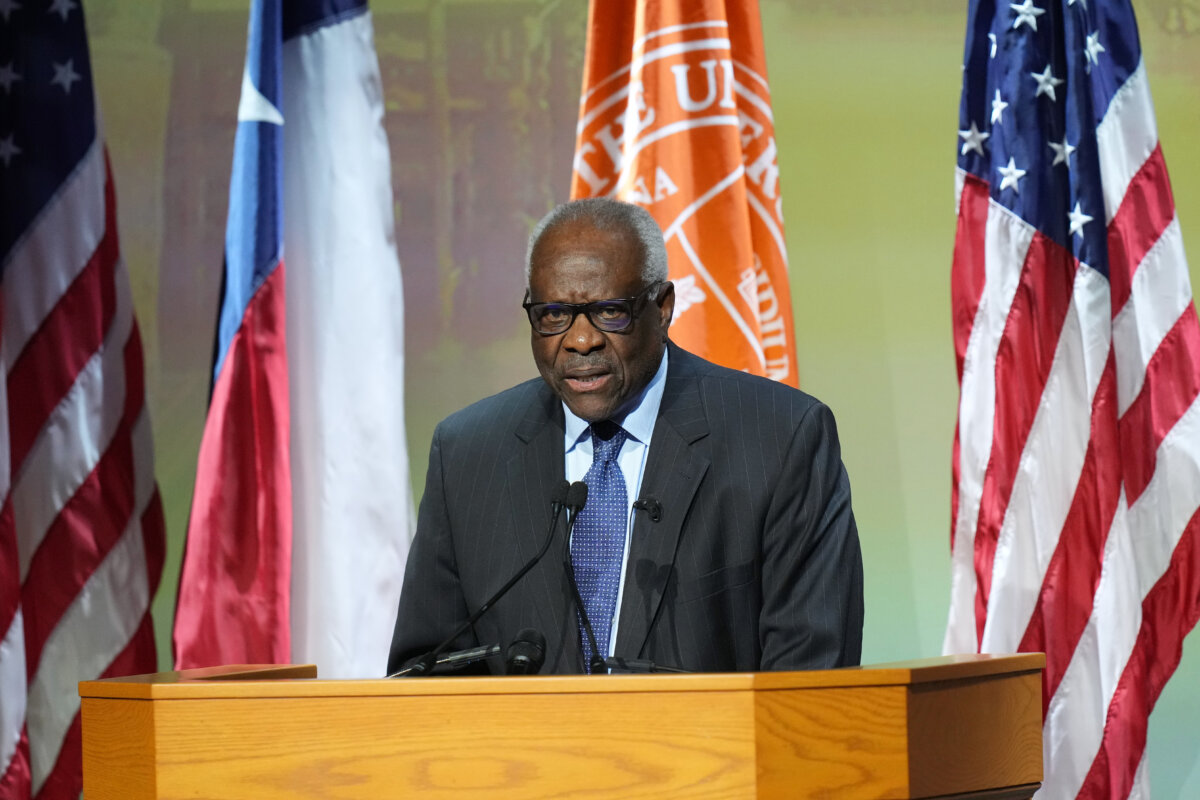
However, I think that the greatest was just delivered by Supreme Court Justice Clarence Thomas on April 15 at the Civitas Institute at the University of Texas–Austin.
The force of Thomas’s words does not just result from his deep understanding of what the United States is about and how the Declaration of Independence defines it.
The force flows from Thomas’s personal reality. He has lived what the declaration is about. His words are the product not just of thought and study, but of Thomas’s entire life experience.
Thomas grew up poor in America’s Jim Crow South.
But he said: “Despite the multiplicity of laws and customs that wreaked a bigotry, it was universally believed among those blacks with whom I lived and who had very little or no formal education, that in God’s eyes and under our Constitution, we were equal.
“When you lived in a segregated world with palpable discrimination and the governments nearest to you enforced laws and customs that promoted unequal treatment, it was obvious that your rights or your dignity did not come from those governments, but rather from God.”
An ominous beginning for a future Supreme Court justice.
Thomas’s life, career, and education was trial by fire.
By the time he became chairman of the Equal Employment Opportunity Commission, the country had already been captured by progressivism, particularly on matters of race.
His principled adherence to the eternal God-given truths of the declaration, and refusal to fold to the progressive agenda, which he calls the “then-prevailing orthodoxy on race,” was a lonely battle that left him under constant attack.
It was then that he realized that carrying out the agenda was more than knowing the principles; it was having the courage to fight, and even, if necessary, die for them.
Thomas noted that the principles stated in the opening of the declaration—“We hold these truths to be self-evident, that all men are created equal, that they are endowed by their Creator with certain unalienable rights”—could have gotten nowhere without the last paragraph of the declaration.
There the signers concluded, “We mutually pledge to each other our lives, our fortunes, and our sacred Honor.”
Thomas said, “What changed the world was not the words, but the commitment and spirit of the people willing to labor, sacrifice, and even give their lives” for what President Abraham Lincoln called at Gettysburg “the last full measure of devotion.”
Thomas asked, “Do any of us have what it took for our young soldiers to storm Normandy Beach, to fight at Guadalcanal, to later fight at Chosin Reservoir?”
He discussed the emergence of progressivism, which challenged the core principles of the declaration. As Thomas noted, its pedigree is not American but was born in the 19th-century Germany of Chancellor Otto von Bismarck.
It’s a worldview that rejects the notion that God-given truths govern our lives rather than politics and government’s so-called experts.
It’s deeply ironic and unfortunate that the Civil Rights Movement, a movement about human freedom, a movement about moving black people out from the distortions of political control and to our regime of freedom defined by our declaration’s principles, itself saw progressivism as the answer to problems of race.
We are in a great struggle today for the future of our country.
The movement toward progressivism has delivered to us a new time with massive government, deficits, debts, and bankrupt entitlement programs. The assault of progressivism on the God-given principles of the Declaration of Independence has also taken a great toll on our culture, with the traditional family and our birth rate in dangerous decline.
To restore the vitality of our nation, we for sure today need a “new birth of freedom.”
A good start for all is to listen to Thomas’s message.
Views expressed in this article are the opinions of the author and do not necessarily reflect the views of The Epoch Times.
 Friends Read Free
Copy
Facebook
Tweet
Friends Read Free
Copy
Facebook
Tweet