Commentary
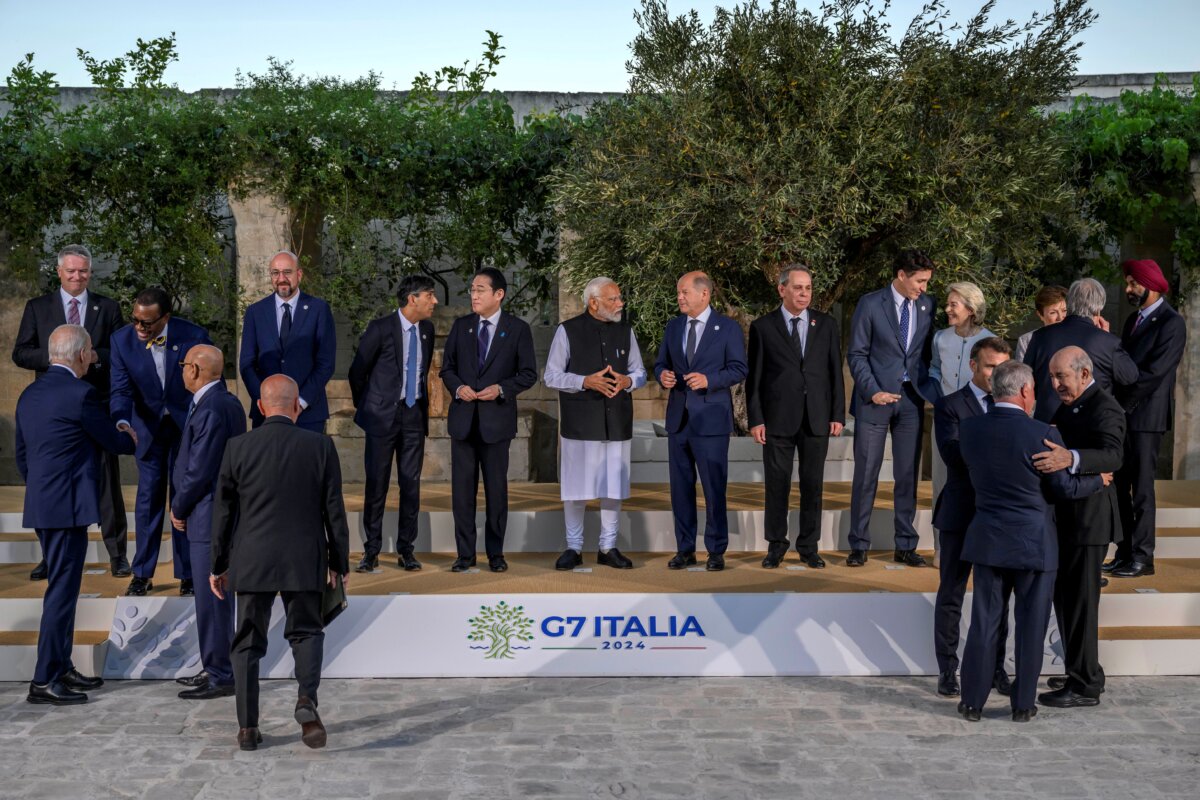
The G7 meeting next week in Kananaskis, Alberta, could be an unusually interesting discussion by the standards of that group.
The first modern leaders’ summit was the Congress of Vienna in 1814–1815 (Metternich, Talleyrand, Castlereagh/Wellington, Nesselrode, etc.), which was reasonably successful. Berlin 63 years later (Bismarck, Disraeli, Andrassy, etc.) was a qualified success. Forty years later in 1919 came Paris and Versailles (Clemenceau, Wilson, Lloyd George, Orlando), not a success, and 19 years later, Munich (Hitler, Chamberlain, Daladier, Mussolini), was a disaster.
There were only three meetings of the American, Soviet, and British leaders in World War II, at Tehran, Yalta, and Potsdam, and they were increasingly unsuccessful as Stalin reneged on all his commitments to liberate Europe. The next such meeting, also including the French leader Edgar Faure, was at Geneva in 1955. President Eisenhower opened the session with a demand that the USSR honour its Yalta commitments, and with a proposal for reciprocal toleration of aerial reconnaissance known as the “open skies” program. The Russian delegation was composed of the three factions contending for the succession to Stalin, but two of the faction heads, Nikita Khrushchev and Nikolai Bulganin, indignantly rejected the proposal. (It was finally accepted 17 years later. )
The Paris Summit in 1960 was a fiasco because Khrushchev unsuccessfully demanded an apology from Eisenhower for conducting aerial reconnaissance over the Soviet Union. The host, General de Gaulle, famously responded to the Russian leader’s threat to leave: “Don’t let me detain you.” The next summit meeting between President Kennedy and Khrushchev in Vienna in 1961, soon after the Bay of Pigs debacle in Cuba, was also a fiasco because of Khrushchev’s belligerency. Then came the meeting between President Johnson and Soviet Premier Alexei Kosygin at Glassboro, New Jersey, in 1967. It was a civilized but inconsequential exchange.
Summitry really got going with Richard Nixon. As vice president, he had his famous exchange with Khrushchev in the so-called Kitchen Debate at the American National Exhibition in Moscow in 1959. Between President Truman’s revelation to Stalin of the successful test of the first atomic bomb at Alamogordo, New Mexico, during the Potsdam conference in July 1945, until President Nixon’s dramatic visit to the People’s Republic of China in 1972, nothing very substantial happened at any of these meetings, but each one was a much-publicized event.
The China visit in 1972 began the normalization of relations between the United States and China and the long and difficult process of integrating China into civilized international relations and organizations. Shortly after Nixon’s departure, the North Vietnamese invaded the South to try to disrupt Nixon’s forthcoming visit to Moscow. The Soviets confirmed the invitation to Nixon, and Nixon, while leaving the ground war in Vietnam entirely to the South Vietnamese and South Koreans (who defeated North Vietnam and the Vietcong), ordered 1,000 airstrikes a day on North Vietnam, and to make his point he increased that to 1,200 per day each day of his trip to the Soviet Union. For the first time, the flag of the United States flew beside that of the Soviet Union over the Kremlin, and Nixon signed SALT 1, the greatest arms control agreement in the history of the world, which incidentally restored American nuclear military superiority by counting each American ICBM with 10 independently targeted warheads as a single missile.
Annual conferences between the Soviet and American leaders followed throughout the 1970s until the Soviet invasion of Afghanistan in 1979. The atmosphere in discussions between the two superpowers remained frosty until the elevation of Mikhail Gorbachev in 1983, and the Cold War ended in 1991 with the disintegration of the Soviet Union and the collapse of international communism. It was the greatest and most bloodless strategic victory in the history of the nation-state, as America’s only rival fell like a soufflé without a shot being fired.
These G7 meetings began in 1975 as largely economic discussions between the five and later seven leading economic powers among the Western allies, including Japan. After the end of the Cold War, Russia was included for a time but was disinvited after the seizure of Crimea from Ukraine in 2014. The Russians and Chinese were involved in the creation of an alternative group known as BRICS (Brazil, Russia, India, China, and South Africa), whose first official summit was held in 2009.
The G7 meetings do not normally generate particularly newsworthy results, and the routinization of the gathering of so many leaders of important countries has naturally reduced public interest in them. For a time, the summits were the occasions for sometimes violent demonstrations, both by extreme political militants and outright hooligans. In 2002, Jean Chrétien chose Kananaskis as a meeting place that would be practically inaccessible to unwanted demonstrators, who in addition to the normal heavy security, would have to breach many miles of forest wilderness and take their chances with bears and wolves and the occasional venomous snake.
As an institution, the G7 has proved resilient. This year, the other invited guests will include three of the BRICS countries: Brazil, India, and South Africa, as well as Australia, Indonesia, Mexico, South Korea, and Ukraine. (BRICS is a sham.) This is an extremely interesting variety of statesmen, from Trump to Modi (India), Lula da Silva (Brazil), Sheinbaum (Mexico), Zelenskyy (Ukraine), Meloni (Italy), and Merz (Germany). There must be some value in the leaders of a total of over 300 million people meeting like this, though it is a far cry from the gigantic historical figures—Roosevelt, Churchill, and Stalin—ironing out the future of the entire world surrounded by their military chiefs commanding 40 million battle-hardened warriors.
This year, the leaders can all advance their reciprocal tariff discussions with the United States as well as the assistance that most of them extend to Ukraine, and five or six of the leaders can concert further on the emerging containment strategy opposite China. All those attending would be grateful for any enlightenment President Trump can give about his Ukraine discussions with the Russian president, and with the Iranian government over its nuclear program and assistance to terrorists. These discussions are now coming to a head, so this meeting is very timely.
Even more than usually, the president of the United States will be by far the most important person present. Given that, and the collective influence of those attending, it could be a very useful meeting. All Canadians must wish Prime Minister Carney well on his first exposure to such an important group of world leaders.
Views expressed in this article are the opinions of the author and do not necessarily reflect the views of The Epoch Times.
 Friends Read Free
Copy
Facebook
Tweet
Friends Read Free
Copy
Facebook
Tweet