
Commentary
With the United States entering its seventh month of war with Iran, the Trump administration has declared an “Economic D-Day,” a comprehensive economic isolation package targeting not just Iran but every country, bank, and shipper that continues doing business with Tehran.
The ambition is sweeping, but will it work?
The initiative is more expansive than previous rounds of sanctions in two respects. First, it targets the operational infrastructure of the global oil trade, including shipping registries, vessel insurers, cargo inspection networks, and port operators, rather than Iran’s financial system alone.
Second, it explicitly extends sanctions to third-country buyers of Iranian crude, a category that primarily means China. On paper, this closes the gray-market channels through which Iran has survived previous sanctions regimes: China’s teapot refineries, yuan-denominated payment networks, and the shadow tanker fleets.
Perhaps this time is different. The previous 47 years of U.S. sanctions on Iran worked almost entirely through the financial system: cutting Iran off from the Society for Worldwide Interbank Financial Telecommunication, freezing dollar-denominated assets, sanctioning Iran’s central bank. Iran adapted each time, routing payments through intermediaries and building shadow banking networks through the region.
The current situation differs because the primary pressure is not financial but physical: The U.S. Navy controls the sea lanes through which Iran’s crude must travel. Financial sanctions can be rerouted, but a sustained naval blockade is harder to circumvent. Iran’s domestic inflation is running at an estimated 70 percent to 90 percent annually, its budget requires up to $124 per barrel to break even, and its oil export infrastructure has sustained significant damage.
The decisive variable, and the sanctions’ weakness, is China. Beijing imports an estimated 1.65 million to 1.8 million barrels per day of Iranian crude, at discounts estimated at 15 percent to 20 percent below market prices. This represents roughly $5 billion to $8 billion annually in energy cost savings for China’s economy.
Iran has been, along with Russia, China’s largest source of discounted crude for its industrial base. Compliance with U.S. sanctions would require China to voluntarily absorb billions of dollars in higher energy costs annually, hand Washington a strategic victory over a country it considers a geopolitical partner, and accept the precedent that the United States may dictate Beijing’s commercial relationships. All this seems highly unlikely.
The previous precedents are not encouraging. In 2018–2019, the Trump administration reimposed maximum-pressure sanctions and threatened secondary measures against Chinese buyers. China initially reduced Iranian imports but never eliminated them, and continued routing payments through alternative channels.
Within two years, China restored purchases to near pre-sanction levels through the Shandong teapot network, a constellation of independent Chinese refineries specifically structured to absorb sanctioned crude without meaningful exposure to the U.S. financial system.
That network is larger and better established today than in 2019. The yuan-for-oil payment infrastructure has matured substantially. The Chinese banks handling these transactions have been rewired to minimize the Society for Worldwide Interbank Financial Telecommunication and reliance on the dollar.
Contrast this with the 2006–2015 multilateral sanctions effort, which was coordinated by the U.N. Security Council, the European Union, and the United States, and ultimately joined by China, India, South Korea, Japan, and Turkey. This round reduced Iranian oil exports by more than 1 million barrels per day and brought Iran back to the negotiating table.
The mechanism of success was not American pressure alone but international consensus. Lloyd’s of London stopped insuring Iranian crude cargoes, EU refiners declined to process Iranian oil, and Asian buyers faced unified pressure from their most important trading partners. The cumulative effect was a constraint on Iranian economic options.
The current situation lacks key elements of that architecture. The EU has not endorsed U.S. military action. NATO is fractured over the conflict, and the UK and France explicitly refused to join the naval blockade. China and Russia are, at minimum, indirect beneficiaries of Iranian intransigence. India continues purchasing Iranian crude.
The proposed secondary sanctions against Chinese buyers, if enforced, would trigger a U.S.–China economic confrontation layered on top of the existing Iran war. Such a scenario would test the dollar’s status as a reserve currency, accelerate the development of a yuan-denominated payment network, and potentially prompt Chinese retaliation through accelerated U.S. Treasury selling, just when the United States needs more foreign buyers for its massive debt.
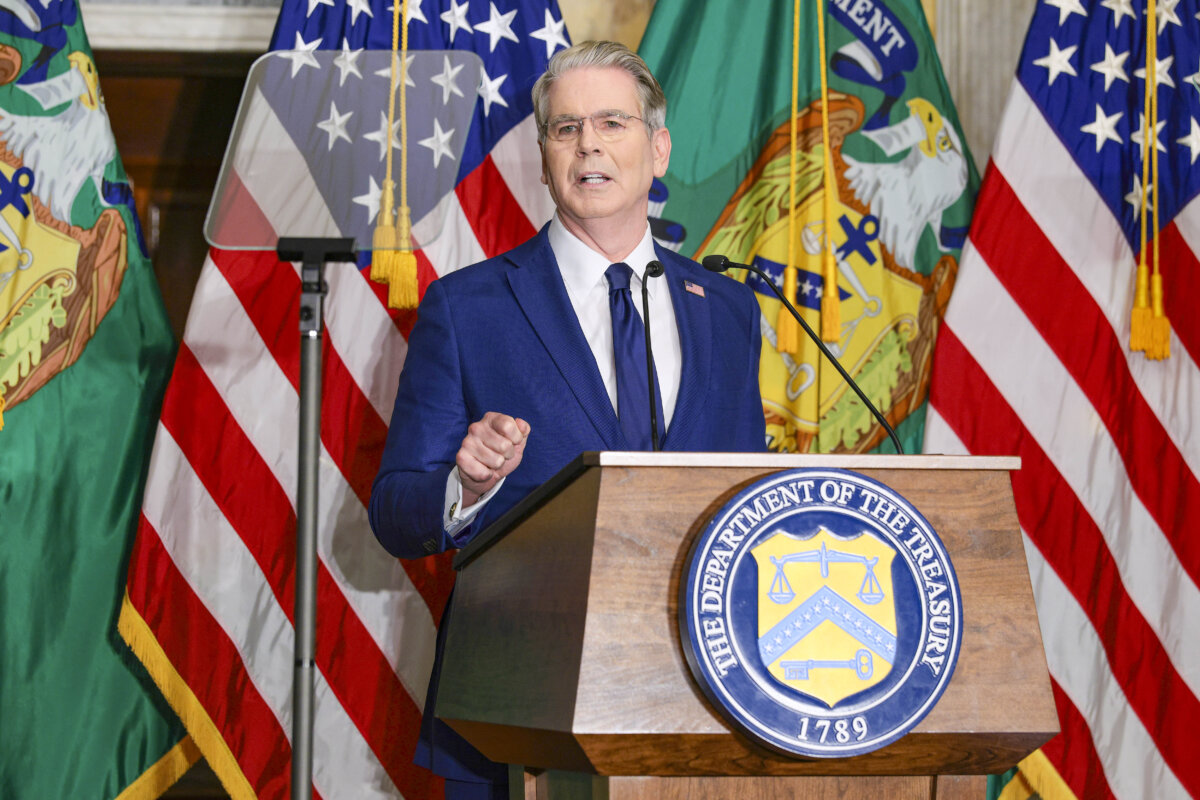
U.S. Treasury Secretary Scott Bessent has made lowering long-term Treasury yields a central policy objective, arguing that fiscal credibility, rather than Federal Reserve rate cuts, is the path to cheaper borrowing costs for the American economy.
The bond market has responded with indifference bordering on contempt: The 30-year Treasury yield is at its highest level since 2007, and the fiscal year 2026 deficit is heading toward $2.1 trillion. This is not because Bessent lacks discipline, but because the war is undermining the fiscal arithmetic in real time.
The war drives oil prices higher, which drives inflation above 4 percent, which prevents Fed rate cuts, which keeps debt service costs elevated ($1.4 trillion annualized) on $40 trillion of national debt. War and its costs widen the deficit further. The deficit-debt-inflation doom loop accelerates.
Net interest payments are already larger than defense spending and rival healthcare entitlements. If Economic D-Day sanctions ended the war, they would serve as the mechanism for Bessent’s yield-compression strategy.
The bond market’s verdict, evidenced by 30-year Treasurys hovering at about 5.25 percent, is that the sanctions will achieve neither. Yields are elevated not because investors distrust Bessent’s intentions. They are elevated because investors don’t believe that his tools are adequate for the task.
Not to say that the Economic D-Day package is entirely without effect. Secondary sanctions will raise the cost of circumvention at the margins. They make gray-market routing more expensive, complicate participation in third-country shipping registries, and reduce the number of Iran’s willing counterparties.
Combined with the naval blockade, they may reduce Iranian oil revenues sufficiently to create genuine fiscal pressure in Tehran. U.S. President Donald Trump’s assessment that Iran has “huge inflation and no money” reflects real economic conditions, not just rhetoric.
The problem is that unilateral sanctions haven’t worked. The historical record of unilateral U.S. sanctions against Iran is nearly five decades of adaptation, circumvention, and entrenchment. Iran has proven more durable under economic pressure than Washington has predicted in every previous cycle.
Without the multilateral consensus that gave the 2006–2015 sanctions their teeth, for example, without Chinese and European participation, without U.N. Security Council coordination, without allied agreement that Iran’s nuclear program constitutes a grave threat requiring shared sacrifice, the sanctions package is unlikely to achieve what seven months of military operations have not: eliminating Iran as a nuclear threat, dismantling its military and financial support of terror networks, and favorably reopening the Strait of Hormuz.
The lesson of 50 years is that sanctions work when the leading nations impose them together and that they don’t work when only one country does, even one as powerful as the United States.
In the meantime, Brent crude trades near $94, the Strait of Hormuz handles five ships per day where it once handled 130, long-bond yields sit at their highest level since the eve of the global financial crisis, and the global economy is weighed down under a supply shock that unilateral sanctions will not resolve.
Views expressed in this article are the opinions of the author and do not necessarily reflect the views of The Epoch Times.
 Friends Read Free
Copy
Facebook
Tweet
Friends Read Free
Copy
Facebook
Tweet