
Commentary
The United Nations came into existence on Oct. 24, 1945, 80 years ago this month. During the world body’s early years, pols and pundits praised it almost universally. President John F. Kennedy described it in his Jan. 20, 1961, inauguration speech as “our last best hope in an age where the instruments of war have far outpaced the instruments of peace.”
JFK continued, “We renew our pledge of support [to the U.N.]—to prevent it from becoming merely a forum for invective—to strengthen its shield of the new and the weak—and to enlarge the area in which its writ may run.”
JFK’s pledge to strengthen the United Nations was not mere rhetoric. In September 1961, the U.S. State Department released, and JFK submitted to the U.N. General Assembly, a “disarmament” plan titled “Freedom From War: The United States Program for General and Complete Disarmament in a Peaceful World.”
Under this plan, in the third of three stages, it stated, “Progressive controlled disarmament and continuously developing principles and procedures of international law would proceed to a point where no state would have the military power to challenge the progressively strengthened U.N. Peace Force.” Disarmament, in international parlance, is about who controls armed forces and their weaponry, not their elimination.
JFK’s plan for U.N. empowerment was in accord with the vision of the U.N.’s founders, who claimed that the United Nations would use its power to enforce world peace.
Ignored in this utopian dream was that this power could also be used to impose global tyranny. In fact, why should anyone expect otherwise, considering the socialist/communist dominance at the U.N.?
The threat of U.N. global governance is much more widely understood today than it was at the time of the U.N.’s founding or during the Kennedy years. But even then, Americans who did recognize the danger of strengthening the U.N. were sounding the alarm and warning fellow citizens. In January 1962, the John Birch Society (JBS) formally launched its “long-range project” to get the United States out of the United Nations. Over the ensuing decades, Birchers have had a profound effect in bringing about today’s widespread anti-U.N. sentiment.
In fact, sentiment has reached a point at which the Birch slogan to “Get US out!” no longer sounds bizarre but sensible—even mainstream.
The days when the U.N. was predominantly viewed as mankind’s last, best hope for peace have long since passed.
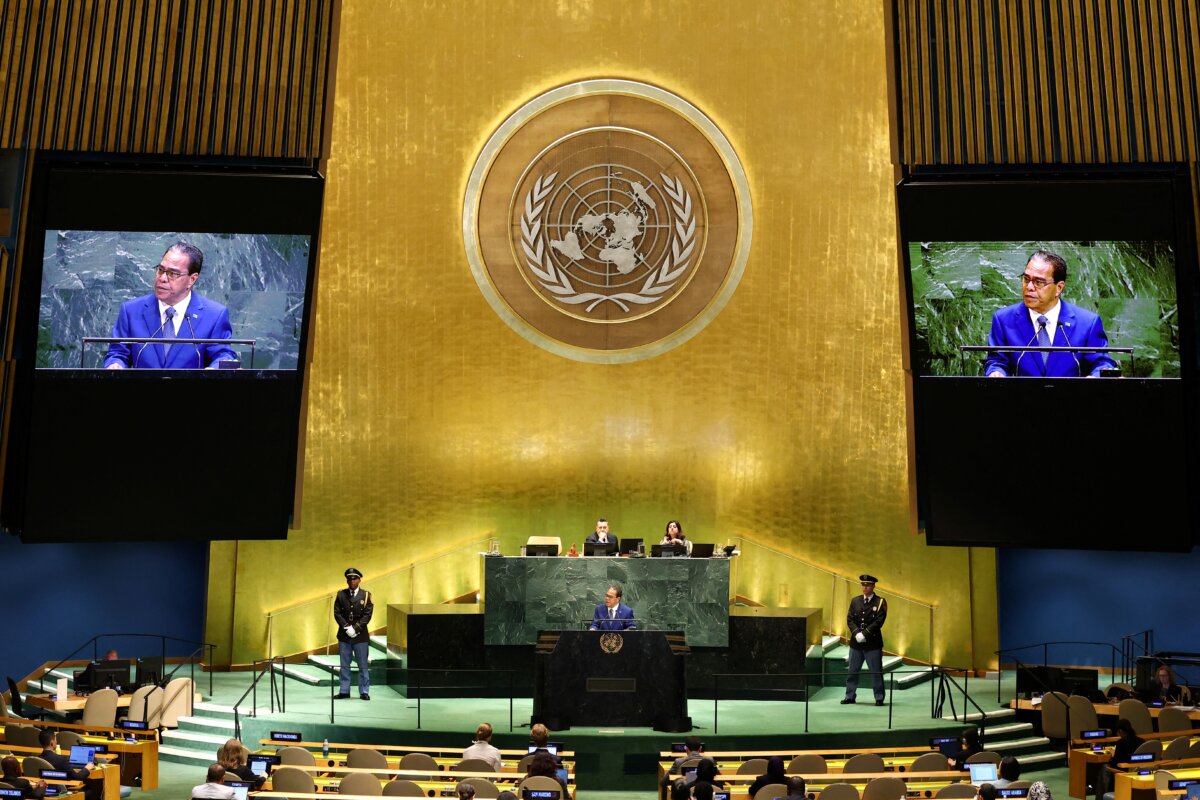
So on Sept. 23 of this year, President Donald Trump’s anti-U.N. remarks in his address to the General Assembly resonated with everyday Americans. For instance, he said the United Nations is “actually creating new problems” to solve. He cited as the “best example” of this “the number one political issue of our time, the crisis of uncontrolled migration.” He said the U.N. is “funding an assault on Western countries and their borders”—including the United States.
“Think of that: The U.N. is supporting people that are illegally coming into the United States, and then we have to get them out,” he said.
Trump also decried what’s being done “in the name of pretending to stop the global warming hoax,” adding: “The entire globalist concept of asking successful, industrialized nations to inflict pain on themselves and radically disrupt their entire societies must be rejected immediately. … That’s why in America, I withdrew from the fake [U.N.] Paris Climate Accord.”
However, in his remarks Trump fell short—far short—of calling for U.S. withdrawal from the U.N. itself. Instead, he lamented that the U.N. has “tremendous potential, but it’s not even coming close to living up to that potential.” And then, after his speech, he told U.N. Secretary-General António Guterres: “Our country is behind the United Nations 100 percent. … I may disagree with it sometimes, but I am so behind it because I think the potential for peace at this institution is so great.”
But enabling the U.N. to achieve its potential—as JFK wanted to do back in 1961—is exactly what not to do. Rather than reform or empower the United Nations, we must get out.
The U.N. threat is immense. The New American magazine, a JBS affiliate, devoted its July 2025 “Global Power Grab” issue to exposing this threat, which includes not just the U.N. itself but also its many tentacles such as the WHO, the World Bank and IMF, and NATO. (The “Global Power Grab” issue includes an eye-grabbing map on two facing pages showing various U.N. agencies throughout the world.) And in addition to U.N. agencies, there are powerful insider groups such as the World Economic Forum scheming to build world government—step by step, and piece by piece, with the U.N. at the hub of the rising monstrosity.
Those who think that Trump will tame or restrain this beast should think again. Even if Trump continues to defy U.N. encroachments in such areas as immigration and the environment, he will not be president forever. But the United Nations will remain and—if the globalists have their way—will become more threatening than ever.
Fortunately, getting the United States out of the U.N. is an idea that is catching on. Sen. Mike Lee (R-Utah) and Rep. Chip Roy (R-Texas) are sponsoring the DEFUND Act (S. 669 and H.R. 1498) in the Senate and House to do exactly this. Let’s spread the word about the DEFUND Act, contact our congressmen in support of it, and “Get the U.S. Out!” of the United Nations, as the JBS has long recommended.
Views expressed in this article are the opinions of the author and do not necessarily reflect the views of The Epoch Times.
 Friends Read Free
Copy
Facebook
Tweet
Friends Read Free
Copy
Facebook
Tweet