
Commentary
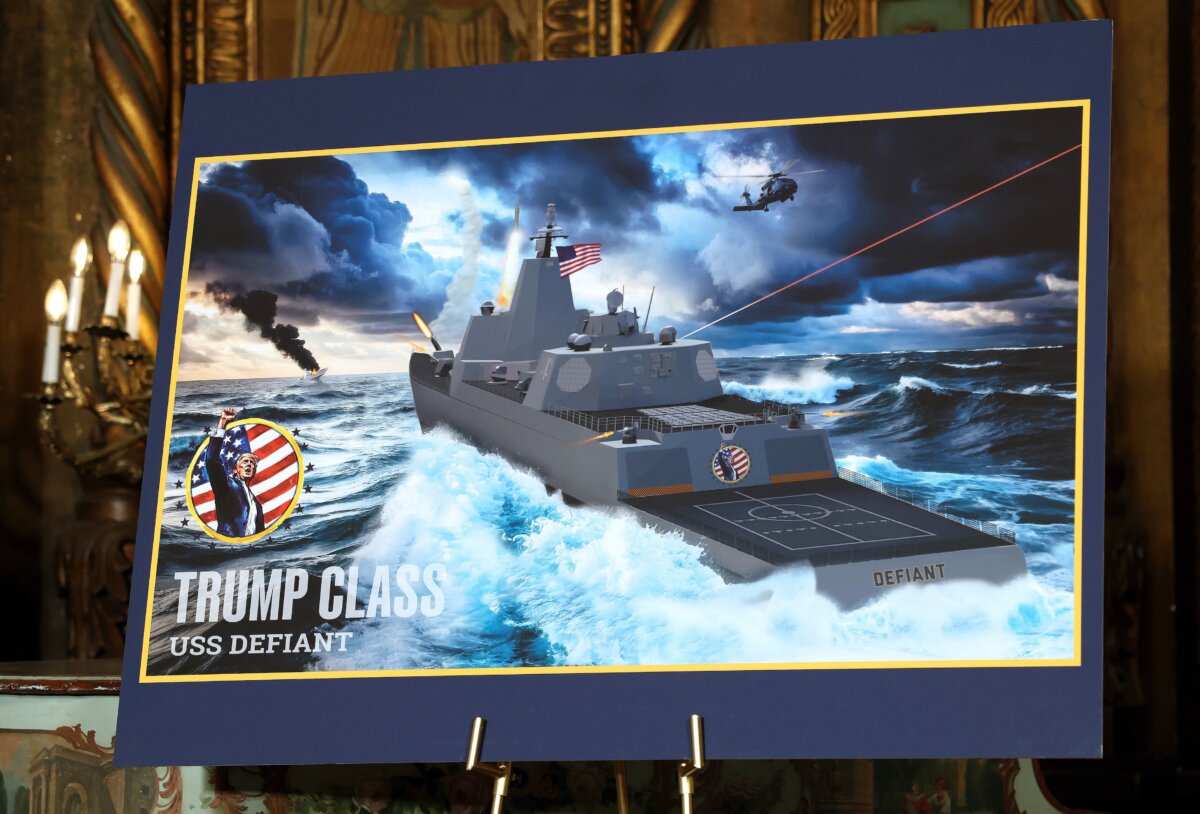
There has been a lot of discussion and speculation about what the new Trump/Defiant class battleship will be like. While some initial speculative concepts and specifications have been released, given the recent history of clean sheet ship design, it will be at least five years before the design is completed, and in that period, it is highly likely that some of the features being discussed right now, such as the railgun, will not make it into the final design and that systems/weapons not currently under discussion will be in the final design. But before discussing the best configuration for a modern battleship, it makes sense to review the reasons why battleships fell out of favor.
The U.S. Navy moved away from battleships and armored vessels in general for three main reasons. By the 1950s, many in the U.S. Navy believed that the next naval battle would be with the Soviet Union and that it would involve tactical nuclear weapons, weapons of such power that no ship could survive a direct hit.
However, even after realizing that tactical nuclear naval battles were not inevitable, naval strategists still believed that the United States could use its vast military budget to develop technology that would allow our ships to target and destroy enemy ships first and that even if the enemy ship or planes did manage to fire off a few missiles, those missiles could be destroyed before striking our own ships. Hence, armor and heavy-duty internal structure remained a waste of displacement and cost.
Regarding the battleships’ big guns, while the technology to fire gun-launched projectiles more than 100 miles was already well understood and doable post-World War II, unlike missiles, gun-launched projectiles were subject to such intense g-forces that no guidance package could be built that would survive being fired out of the barrel of a gun. And without guidance, a projectile from a gun fired 100 miles was little more than a terror weapon, as its plus or minus accuracy, circular error probable, would be more than a mile.
Battleships, although outdated, provided a volume of naval firepower that missiles couldn’t match. They remained in limited service through the late 1980s, but the Navy decommissioned the last one in 1992. The U.S. Marine Corps maintained that heavy naval surface fire support was vital for amphibious operations. In response, the Navy launched the Zumwalt-class destroyer program in 1994, aiming to deliver precision firepower with two 155 mm advanced guns capable of reaching 100 miles. While less powerful than battleship guns, the Navy planned to build 32 ships to meet the Marine Corps needs. However, the gun system failed, and the fleet was reduced to just three vessels. To date, the Navy has not come close to replacing the naval surface firepower once delivered by the Iowa-class battleships.
The reasons for moving away from battleships made sense if you bought into the idea that the U.S. Navy could, with impunity, strike our enemies and counter their attacks courtesy of overwhelming technological superiority that would, in effect, create a virtual force field around our ships. This mindset led to our most important surface warfare ship, the Arleigh Burke Destroyer, being built with hulls of less than ½ inch thick medium-strength steel. Why waste money and weight on armor and heavy-duty internal structure if you aren’t going to get hit?
Today, the mindset that our ship’s defensive systems can take out all the drones and missiles that would be thrown at them in a conflict with a peer or near-peer opponent like China or Russia is even more fantastical and arrogant than it was during the Cold War. And it is no longer the case that guns cannot fire precision-guided munitions. Not only have they been able to do so for going on 20 years, but they can also provide an invaluable complementary tier of defense against drones and missiles. Further, such guns are far more effective than the proposed lasers, which are very limited in the kind of targets they are effective against, do not function well or at all in bad or foggy weather, cannot engage targets over the horizon, and are vulnerable to easily implemented measures to make drones and missiles laser-resistant.
All this adds up to a properly designed modernized battleship with all the latest vetted defensive technology, making a whole lot of sense in today’s battlespace environment of cheap anti-ship missiles and really cheap drones. A battleship equipped with 12 76mm Ota Melara guns, each of which is capable of tackling and destroying four surface-skimming subsonic anti-ship missiles attacking at the same time, could be a lifesaver. These 120-round-per-minute guns firing a mix of unguided and guided munitions could handle a swarm of hundreds of incoming drones and provide defense against a mix of supersonic and subsonic missiles. Its large caliber guns could strike targets more than 100 miles away with precision for a fraction of the cost of a missile. And while being far from unsinkable, its ability to take missile and or torpedo hits, which would mission-kill or sink other ships, and keep on fighting is a force multiplier.
You may notice that the battleship description given above does not look much like the initial concepts for the new Trump missile battleship. That is because, as currently conceived, the proposed battleship with its futuristic guns, which actually degrade its potential firepower, is far more akin to the arsenal ships the Navy was promoting in the 1990s—an unarmored ship with a lot of missiles, with some defense. If the new “battleship” is merely going to be a big thin-skinned ship with some Kevlar for splinter protection, then it really won’t add much to the fleet. But given that the ship is far from having been designed yet, it is still possible five years down the road we could actually end up with a real modern battleship that is not only capable of continuing the fight after taking a few hits, but, with its air defense guns, is capable of defending itself and accompanying ships against the kind of swarming drone and missile attacks that our current ships will do poorly against.
Views expressed in this article are the opinions of the author and do not necessarily reflect the views of The Epoch Times.
 Friends Read Free
Copy
Facebook
Tweet
Friends Read Free
Copy
Facebook
Tweet