
Commentary
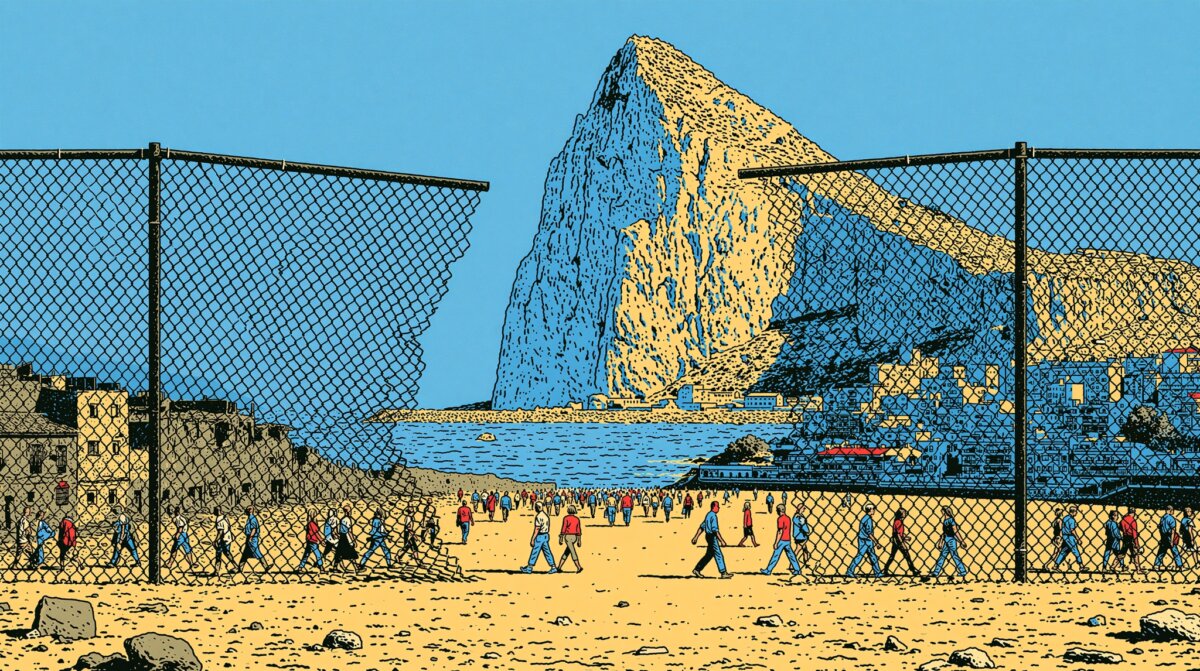
At midnight on July 15, just over a decade after the UK voted to leave the EU, the fence that has separated Spain from Gibraltar since 1908 was dismantled. The result of an agreement signed last June by Spain, the EU, Gibraltar, and the UK, its disappearance will create a fluid frontier, incorporating the Rock—as the largely self-governing British Overseas Territory is also known—into Europe’s borderless Schengen Zone. Passport controls will be conducted at the airport by both Spanish and Gibraltarian guards, after which passengers will be free to travel between Gibraltar and Spain and into the rest of Europe.
Gibraltar’s land border with Spain was located on a thin strip of land called the isthmus, where the territory’s airport and military base are also located. It was the focal point of political tension after the Brexit referendum of June 2016, in which 51 percent of Britons voted to leave the EU (the 48 percent of Remainers included 96 percent of Gibraltarians). The outcome dreaded most by Gibraltarians and their Spanish neighbors was a hard border, similar to that imposed by the Spanish dictator Francisco Franco in 1969. Franco, incensed at Gibraltar’s newly-approved constitution, thought that by closing the frontier he would ruin the Rock and benefit Spain—but his action had the opposite effect. The Andalucian frontier town of La Línea de la Concepción was devastated while Gibraltar reinvented its economy, in part by forging stronger bonds with the UK and North Africa. The border wasn’t fully reopened until 1985, ten years after Franco’s death, in preparation for Spain’s accession to the EU the following year.
Reacting to the fence removal, Fabian Picardo, Gibraltar’s chief minister, said that “the frontier that has so often divided and constrained our region will now become a place of cooperation and shared opportunity.” His words were echoed by Pedro Sánchez, Spain’s socialist prime minister, who hailed the beginning of a “new era of coexistence and shared prosperity” between the Rock and the Campo de Gibraltar, as the neighboring part of Andalucia is called. Sánchez claimed that residents of this region, one of the poorest in Spain, can now embrace their “true destiny.”
The removal of the 118-year-old fence represents a triumph of compromise and practicality over historical partisanship (although the sovereignty dispute between the UK and Spain over the Rock, now in its third century, continues on the sidelines). It will make life much easier for the 15,000 workers who cross from Spain into Gibraltar every day, 11,000 of them residents of La Línea. But it won’t be sufficient to rejuvenate the most forlorn areas of the Campo de Gibraltar, or to ensure that their residents share in the prosperity enjoyed by Gibraltarians. Greater investment (both public and private) will also be necessary, along with a continued crackdown on the region’s smuggling gangs.
Approximately 280,000 Spaniards live in the Campo de Gibraltar. In addition to La Línea, the region incorporates the port city of Algeciras. Both cities are key hubs on the drug-running routes connecting Europe with North Africa and South and Central America. In Algeciras in late 2024, Spanish authorities seized 13 tons of cocaine hidden in a banana shipment from Ecuador. Equivalent in weight to two elephants, with an estimated street value of almost €800 million ($914 million), it was Spain’s largest-ever drug haul at the time. Over recent years, neighboring La Línea has been the scene of violent confrontations between Spanish police and drug-runners, reinforcing this region’s reputation (at least within Spain) as a lawless backwater, just 40 kilometers (25 miles) from the tourist hotspots of the Costa del Sol.
The economic disparities of this region are most striking when one compares Gibraltar with La Línea. The Rock has one of the highest GDP per capita rates in the world at around $133,000, putting it in the company of tax havens such as Monaco and Luxembourg and way above the UK as a whole ($61,000). Its unemployment rate stands at 1 percent and hasn’t been above 3 percent since 2002. A 10 percent corporation tax rate enables businesses to thrive, especially in its two key industries: online gaming and financial services. Shipping is also big business, and VAT-free shopping makes the Rock an attractive tourist destination. Its marina is filled with yachts and speedboats, while its vibrant old town offers pubs, shops, hotels, and restaurants.
Just 50 meters from the border (or a half-hour walk from Gibraltar’s Main Street), La Línea exists in the shadow of the Rock, both economically and literally. Large parts of the town are shabby and depressing. Its unemployment rate rarely dips below 30 percent. Youth unemployment in the poorest neighborhoods soars to 80 percent, putting young Spaniards at risk of recruitment into the 30-odd gangs that operate the smuggling routes from Morocco. It’s estimated that around 3,000 of La Línea’s 64,000 inhabitants are involved with these cartels, lured in by huge paychecks and a lack of opportunities elsewhere. According to Francisco Mena, the leader of an anti-drug association awarded the Silver Cross of the Order of Civil Merit for a four-decade career battling narcos, even lookouts earn €1,000 ($1,142) a day. Speedboat drivers can pocket as much as €60,000 ($68,500) per trip. The return trip to Morocco, situated just 15 kilometers (nine miles) across the Strait of Gibraltar, takes under an hour, and around ten crossings are made every day.
When the border deal was announced last summer, Juan Franco, the mayor of La Línea, called for “differentiated treatment” from the rest of the Campo de Gibraltar. Though he welcomes a fluid frontier, Franco wants clarification on how it will affect environmental issues, taxation, and urban planning, and whether more investment will come from the Andalucian government. He has also stressed the importance of changing La Línea’s reputation, improving prospects for its youngsters and combating the narcos—all different aspects of the same challenge. “The solution needs to have a dual focus,” Franco told The Guardian in 2018: “First, a big police deployment …. But you also need social measures—you need training and education and you need to have jobs for people. It’s the only way to get rid of this scourge. What’s the alternative?”
Last week’s fence removal marked the conclusion of a decade of fraught negotiations between London, Madrid, Brussels, and Gibraltar. On a day-to-day basis, both Gibraltarians and Spaniards will benefit from the lack of a hard border. What’s less clear is whether the disappearance of this physical barrier will transform the Campo de Gibraltar, a part of Andalucia that up until now has lived in the shadow of the Rock.
From the Foundation for Economic Education (FEE)
Views expressed in this article are the opinions of the author and do not necessarily reflect the views of The Epoch Times.
 Friends Read Free
Copy
Facebook
Tweet
Friends Read Free
Copy
Facebook
Tweet