
Commentary
In the Trump era of tariffs, chastisement, and charged rhetoric, one could be forgiven for thinking that relations between America and Europe are currently at a low ebb.
Over the course of his two administrations, U.S. President Donald Trump has imposed tariffs on European goods, upbraided NATO allies for not paying their fair share of military costs, and, for a beat or two, refused to rule out the use of force to acquire Greenland, a territory of the Kingdom of Denmark, before later walking back what these remarks seemed to intimate.
The Trump administration has at times taken a hard policy and rhetorical line in its relations with the European Union and European governments, but its attitude toward European civilization has been consistent and hopeful.
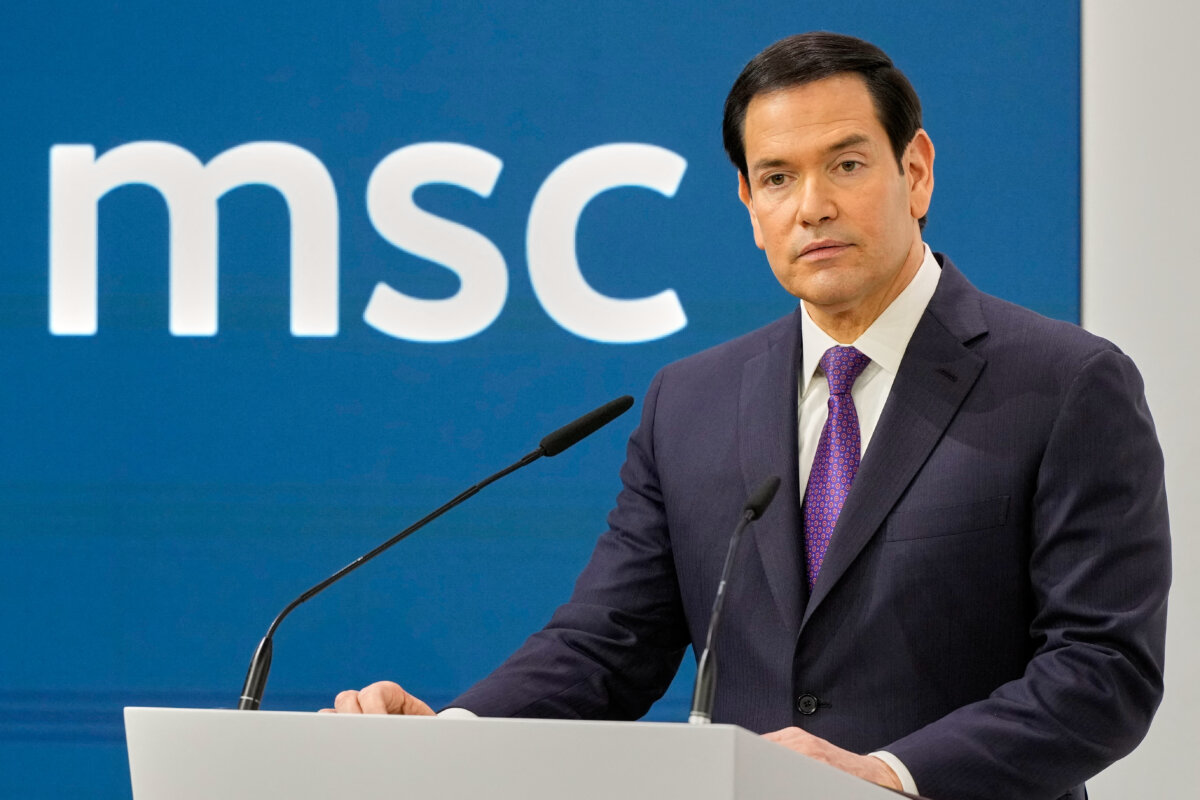
In a speech at the most important security conference in the world in Munich in February, U.S. Secretary of State Marco Rubio, America’s chief diplomat, did not wave a finger at his European hosts. Instead, he chose to stress the shared history, culture, friendship, and destiny of Europe and the United States.
As a pithy rehearsal of what counts as “Western civilization,” Rubio’s short speech was a master class. The very fact that he used the term “Western civilization” repeatedly and unapologetically was itself a breath of fresh air, especially for those of us who may remember President Barack Obama’s run of speeches in Europe, dubbed “an apology tour” by critics.
Rubio did not shy away from cheering Western cultural achievements, of which he spoke in almost religious terms. The inheritance of the West was “sacred,” he declared, rooted in a shared history, faith, culture, heritage, language, and ancestry.
What does any of this have to do with security?
Rubio’s answer was precise and used to count as so much common sense. Armies do not fight for abstract international organizations, but for their countries. They defend borders, a shared culture, and the brother next to them; they fight, not for the end of history, but for liberty and the hope of a prosperous future for their children.
The late philosopher Roger Scruton coined a term that summarizes this idea nicely: oikophilia, or love of home. Scruton also talked in terms of “the sacred” when attempting to describe what we love most about the place we call home.
A home, Scruton argues, is something loved because it is ours, a place that is open to friends, yes, but also with doors closed to the uninvited. Sacred precincts are polluted when trespassed by those not welcome, the kind of profanation that makes the familiar feel alien and no longer like the home we once knew and loved.
Flight from our shared past, culture, and faith is precisely what Rubio says America under Trump wishes to arrest, the kind of stand the West has made so many times before at moments of great crisis. Rubio stressed the shared victories of Europe and America through two hot wars and one cold war, and moments of existential import such as the Cuban missile crisis and the erection of the Berlin Wall.
It is important to remember what the West should oppose, but the secretary of state reminded us that it is far more important to remember why. Yes, the West ought to oppose communism, the “climate cult,” mass immigration, and so forth. Yes, the West has, at times, undermined its own principles and ought to hold itself to account.
But lasting civilizations are not merely reactionary, nor do they wallow.
The greatest traditions laud the achievements of their ancestors and work to hand them on to generations to come. This is literally what the word tradition means: to hand on. Civilization is the fruit of the vine and the work of many hands.
Ours is the civilization that produced William Shakespeare, Wolfgang Amadeus Mozart, Ludwig van Beethoven, and Dante Alighieri. It was quite moving to hear Rubio rattle off the names of such giants and proudly, too.
On the eve of the nation’s 250th birthday, Rubio reminded us that America will always be a child of Europe. Her stability as a nation grew out of the inestimable benefits she inherited from the English government and the rule of law; her frontiers were braved and expanded by intrepid settlers such as the Scots-Irish; her romantic spirit was inspired by the cowboy archetype first conceived in Spain. Under German settlement of the Great Plains, she became a global farming powerhouse.
Rubio is right to use language that borders on the religious to sum all of this up. The achievements of Western civilization, of which America has been the foremost champion in the modern world, ought to be regarded as sacrosanct. Our civilization is something irreplaceable and unique. Like a person we love, another will not do just as well. Leah cannot stand in for Rachel.
For believers in Western civilization, it is heartening to hear from a man who holds one of the highest offices in the land and understands that we fight hardest for what we love most. To paraphrase another great believer in the West, J.R.R. Tolkien, we love the sword not for what it does, but for what it defends: our home.
Views expressed in this article are the opinions of the author and do not necessarily reflect the views of The Epoch Times.
 Friends Read Free
Copy
Facebook
Tweet
Friends Read Free
Copy
Facebook
Tweet