
Commentary
It is deeply disappointing when a work as great and defining as Homer’s “Odyssey” finally gets the grand, blockbuster treatment it deserves, but the end result is only a vacuous modern work filled with insecurities and cynicism.
This is a sad reminder of how shallow Hollywood has become. It shouldn’t be surprising. This is the same Hollywood that has not dared to produce a single movie that might cast the Chinese government—that is, the genocidal regime of the Chinese Communist Party—in a bad light since 1997. That was the year when “Red Corner,” starring Richard Gere, and “Seven Years in Tibet,” starring Brad Pitt, came out and led to Gere and Pitt both being banned from China. To this day, no major studio wants to risk losing the Chinese market.
The new 2026 “Odyssey’s” crucial thematic point about Odysseus upsetting the laws of hospitality is a complete fabrication, presumably to make the main character feel guilty about something and give the three-hour film a more edgy feeling. As epic poet Andrew Benson Brown recently pointed out, Christopher Nolan’s Odysseus is really an anti-hero, not the real hero depicted by Homer.
And yet there is a silver lining to this cloudy review. The new movie led me to reflect on the various versions of the “Odyssey” I’ve seen: the 1954 movie starring Kirk Douglas and the 1997 TV series starring Armand Assante. Both of these American “Odysseys” also took generous liberties with the source material, not unlike the new movie, and neither of them left me particularly satisfied either.
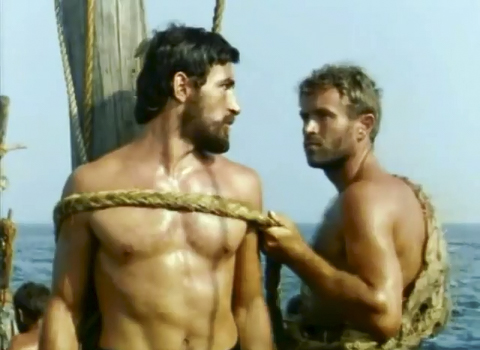
That led me to dig deeper into the history of the “Odyssey’s” screen adaptations and uncover a 1968 Italian-language miniseries directed by Franco Rossi and made in collaboration with French and West German companies. While not 100 percent faithful to the original, it comes quite close during its over-six-hour run time. The production quality, considering there is no CGI, is excellent, and the actors are spectacularly well cast, with even a Penelope (Irene Papas) who looks like she walked out of an ancient Greek vase.
What comes through in Rossi’s work most of all is a sincere reverence and humility toward the original 3,000-year-old work of Homer. The reality is that the world of Homer and the “Odyssey” is starkly different from our own today, and trying to make sense of it with our modern sensibilities will—and actually should—fall short. There are delightful resonances with our modern storytelling and world view but also strange dissonances that are profoundly compelling.
For instance, in the final act, Odysseus plots with his son and the loyal swineherd to get rid of the obnoxious suitors pillaging his pantry and shamelessly courting his wife. Our heroes lock these people in a courtyard and show almost no mercy while slaughtering them for crimes that don’t seem to match the level of the punishment. In the original poem, as in the 1968 miniseries, the suitors had never actually killed anyone.
The situation seems eerily like the plotting and carrying out of a mass shooting or other act of terrorism. I was tempted for a moment to think that this could have a bad effect on people who aren’t mentally stable.
“This is scandalous!” I felt an inner voice cry out.
But this dissonance draws out the reality of the setting in which the story takes place. There is no judicial system, no police, no army, no human authority, other than the will of the local king: Odysseus. The suitors’ actions constitute treason, and even today in the United States, treason is punishable by death. This is to say that the disturbing and violent climax is perfectly just in the context of the story.
It begs the question of us, modern viewers, if we have the nerve, the sense of justice and righteousness, to risk our lives and well-being for a cause we might just as soon not bother with.
And then there is the crucial inclusion of the ancient Greek gods, which so clearly demonstrates the perennial relationship between the human and divine. They are often left out of the modern versions but are everywhere in the original. Odysseus’s mass-execution is carrying out the will of Athena:
“Son of Laertês, descendant of Zeus, ingenious Odysseus,
Think! How will you strike at those shameless usurpers
Who’ve lorded it over your house—for three years and counting!—
Wooing your woman while offering gifts to her family.”
The 1968 version also has Athena sanctioning his wishes and helping him to disguise himself. This is crucial for putting justice and authority in the proper light. They are a manifestation of something greater than earthly aims, something more refined and elevated.
The 1968 version also gets the ending right. No other screen version I know of can resist ending on the happy moment when Odysseus and Penelope reunite. In fact, after this, Odysseus demonstrates traditional filial piety by going to his father. He also must go to fight the suitors’ families. In the very end, it is the gods again who intervene, demonstrating that they are the ones in control. They rise above the war and pettiness of humanity to bring peace.
The message reverberating through Rossi and Homer works just as well for our time. I’ll sing it for you once more: The mistreatment, selfishness, horrors, suffering, and guilt of our lives on earth are just the way of the world. There is a greater peace and higher existence beyond this, in the Divine. Should we ever choose it, it is always there and can, with its unending power and majesty, lead us home, as it did for Odysseus.
Correction: A previous version of this article misspelled Kirk Douglas’s last name and Armand Assante’s first name. The Epoch Times regrets the error.
Views expressed in this article are the opinions of the author and do not necessarily reflect the views of The Epoch Times.
 Friends Read Free
Copy
Facebook
Tweet
Friends Read Free
Copy
Facebook
Tweet