
Commentary
The rapid proliferation of artificial intelligence (AI) and supercomputing technologies has many Americans worried about the future of their careers. In a survey last month, more than half of U.S. workers expressed concern that AI could take their job or the job of a family member. Another survey in December 2025 found that almost 60 percent of young people believe that AI poses a threat to their job prospects.
Americans are not naive. They realize that fast-evolving technologies will disrupt how we do business, just like the Industrial Revolution replaced blacksmiths and the horse and buggy. Many young people, particularly, are already pivoting toward “AI-proof” career fields that promise long-term stability.
However, while concerns about AI automation have dominated headlines and sucked the oxygen out of the room, a bigger, more immediate threat to Americans’ job prospects and wages continues to go virtually ignored: That is the crowding-out effect of the rising federal debt on private investment.
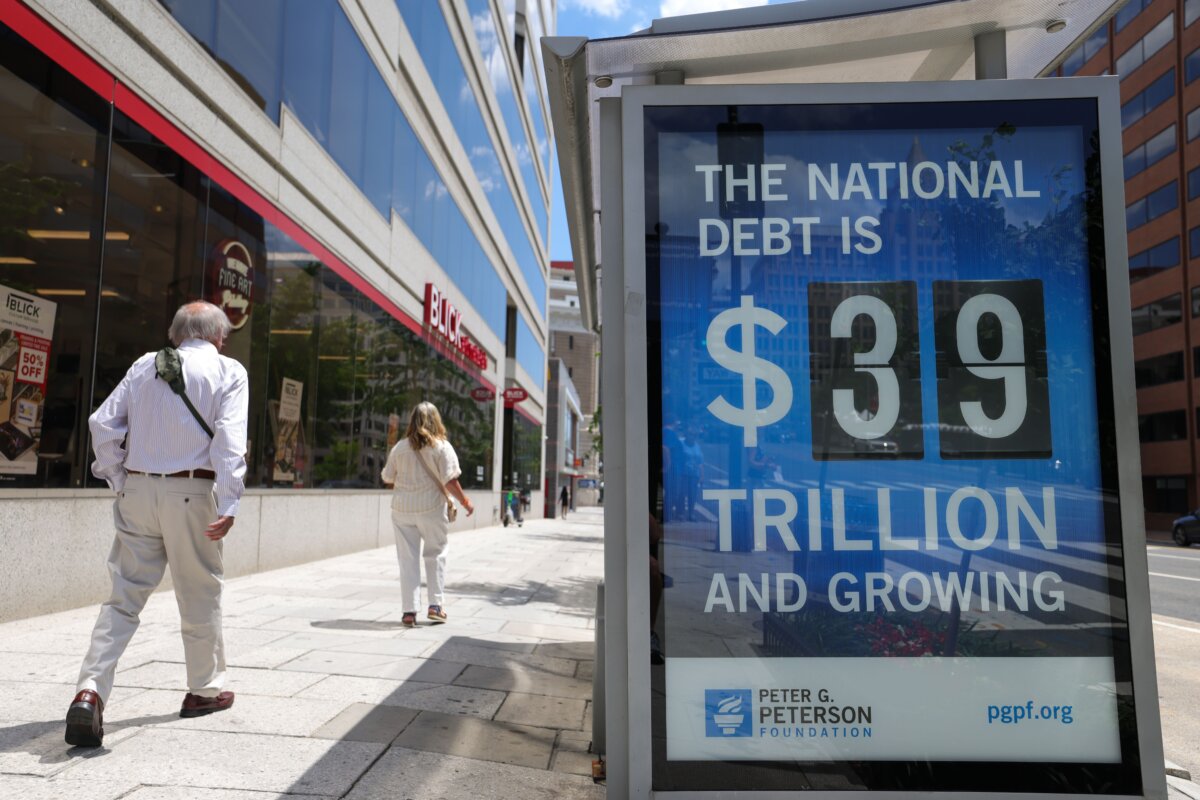
Our national debt is not a theoretical boogeyman. It’s a bona fide job-killer that is impeding economic growth and driving up costs for everyday families. And it will only get worse the longer it is ignored.
An analysis by Ernst & Young projects that on the 2025 debt path, which has accelerated in the current fiscal year, the United States will lose more than 1 million jobs by 2035, 2.7 million by 2055, and 3.6 million by 2075. These losses will disproportionately affect young people, who are more sensitive to labor market conditions.
At the same time, evidence indicates that the “crowding-out” effect of the national debt—whereby the high cost of servicing the debt pushes investment into Treasury bonds instead of private, job-creating capital—will reduce income growth by 16 percent between now and 2055.
The nonpartisan Congressional Budget Office pegs that number even higher. A 2023 report estimates that the rising debt will cut income growth by a third, or more than $14,000, over the next three decades. It notes that every dollar of federal borrowing causes a 33-cent reduction in private investment.
In other words, our national debt and the interest costs that accompany it are stifling job creation and wage growth, and the situation will only get increasingly worse as our federal debt load continues to balloon.
What’s more, the interest on our national debt—which costs about $2.8 billion per day and is projected to grow to nearly $6 billion per day by 2036—is driving up borrowing costs for consumers, exacerbating the affordability crisis. A Yale Budget Lab report found that every 1-point increase in the permanent deficit relative to gross domestic product adds between $600 and $1,240 per year in loan costs for the median U.S. home.
Sadly, young people bear the worst of these job losses, wage stagnation, and borrowing cost increases. In August 2025, unemployment among 20- to 24-year-olds peaked at more than 9 percent, more than double the general rate of 4.3 percent. Since 2023, younger Americans’ job-market optimism has fallen by 23 points, similar to the Great Recession—which caused millennials to earn about 20 percent less over their careers, with roughly half the wealth of their parents at the same age.
Coupled with Social Security’s 2032 depletion date, all these factors are squeezing young workers from every angle: disappearing jobs and lower wages today and a shrinking safety net tomorrow.
Our massive national debt and the significant costs it imposes on ordinary Americans is a problem of Washington’s own making. It will take leaders with political courage to address it—leaders who are willing to say no to reckless spending our country can’t afford, even when it may cost them their job.
Government spending builds dependence on the welfare state and obstructs private-sector growth, consolidating power: a powerful government that “provides” for all, picks winners and losers, and usurps personal liberties.
There’s only one problem: This socialist vision doesn’t work. It never has. That’s because government doesn’t create wealth; private enterprise does.
As Winston Churchill famously explained, “The inherent vice of Capitalism is the unequal sharing of blessings. The inherent virtue of Socialism is the equal sharing of miseries.”
Young people are not wrong to worry about the economic disruptions AI could bring about, but our out-of-control national debt is the bigger, more pressing elephant in the room. And we cannot afford for lawmakers to kick the can down the road.
Views expressed in this article are the opinions of the author and do not necessarily reflect the views of The Epoch Times.
 Friends Read Free
Copy
Facebook
Tweet
Friends Read Free
Copy
Facebook
Tweet