Commentary
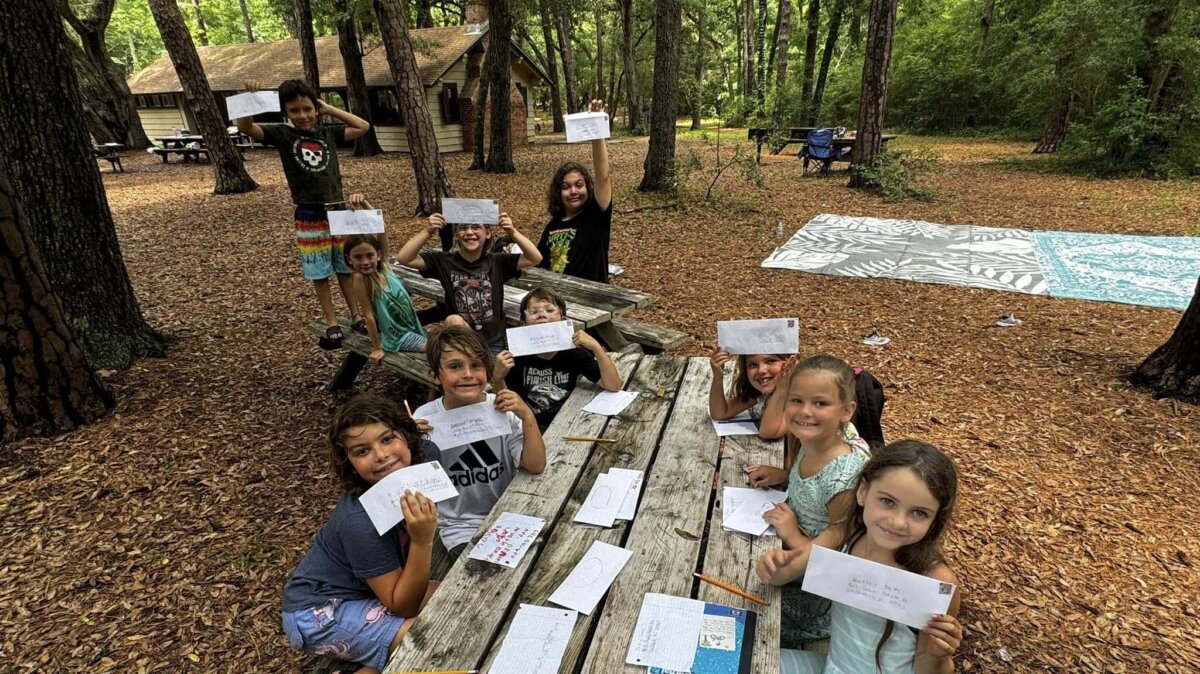
At Carolina Kids Co-Op, school is out—outside, that is.
At its flagship location in Myrtle Beach, South Carolina, more than 150 students in preschool through high school gather daily for school in a local public park, taught by experienced educators while immersed in the natural world. Separated by ability level, the students spread out across the green space, a ringing bell signaling the shift from one class period to another. This location is one of 17 across four states—South Carolina, North Carolina, Florida, and Kentucky—that together serve nearly 1,000 students.
“It looks very much like you took a private school and took the roof and the walls off,” said Jess Alfreds, who founded Carolina Kids Co-Op (CKC) in 2022. Alfreds began homeschooling her daughter in 2020 when schools shut down and she and her husband began working remotely from their home in Connecticut. The family soon decided to move to Myrtle Beach and continue homeschooling, but when they arrived, Alfreds was surprised that there weren’t any secular, academic-focused homeschool programs in her area. Like so many of today’s education entrepreneurs, Alfreds built what she couldn’t find.
What began with 12 kids, including Alfreds’s then-first grader, grew quickly to dozens of students doing school on the beach.
“We hired 14 teachers in two weeks,” Alfreds said. “We put a program together and for the next two years, we really perfected this program in Myrtle Beach. Our kids were doing better than they had ever done before.” All of CKC’s Myrtle Beach students are homeschoolers, with about half of them attending the full-day, drop-off program five days per week. The remaining students come part-time, typically at least three days per week.
CKC is part of a diverse ecosystem of emerging K–12 schools built by entrepreneurial parents and teachers and driven by families looking for entirely different learning models that prioritize both academic success and social-emotional well-being. This educational ecosystem was developing before 2020, but it has gained significant traction in the years since the COVID-19 pandemic. Frustrated by Chromebook-centric classrooms, cookie-cutter curricula and testing, and rising youth mental health concerns, some parents are seeking—and building—alternatives to conventional schooling.
“Life-saving” is how Stephanie Webster described the impact of enrolling her daughter Brynleigh in CKC’s Myrtle Beach program three years ago. Webster explained that remote learning during the COVID-19 pandemic was difficult for her daughter. Then, when Brynleigh’s public school eventually reopened for in-person learning, there seemed to be heavy reliance on a technology-centered curriculum.
“It was like a different strategy of learning at that point, where they continued the remote learning in the classroom,” Webster said. “She didn’t learn that way. That was a struggle for her.”
“It just got worse and worse for Brynleigh in traditional public school,” she said, noting that her daughter’s anxiety spiked, bullying became an issue, and concerns rose about self-harm.
Webster knew that she needed to act. She withdrew Brynleigh from public school in the middle of sixth grade and enrolled her full-time at CKC.
“Almost immediately, I saw a shift in my child and just could not believe the difference,” Webster said. She insisted that it was the individualized, outdoor learning environment that prompted such a positive change in Brynleigh. CKC is entirely screen-free, and the curriculum is tailored to each student’s academic needs, determined by intake assessments.
“Honestly, I think she felt loved,” Webster said. “In public school, she felt like a burden. When she started CKC, she really felt like part of the family. They took her under their wings and made sure she was succeeding.”
Although Myrtle Beach is CKC’s original location, the network’s momentum is increasingly coming from entrepreneurial educators who are bringing this distinctive model to their own communities. In Gainesville, Florida, Trish Way, a former public school teacher and reading specialist, launched a CKC program after realizing that her neurodiverse son—who has attention-deficit/hypersensitivity disorder (ADHD) and sensory processing disorder—was unlikely to thrive in a conventional classroom.
“It was obvious he wasn’t going to fit,” she said. “The kindergarten teachers were honest that he was most likely going to get sent home.” As a single mom at the time, she began homeschooling while searching for an in-between option that blended structure, flexibility, and community.
When she heard about the CKC network in a local homeschooling Facebook group, it instantly resonated. Way launched a pilot program in a public park in spring 2025 with 12 families. Today, CKC Gainesville has 53 students, most of whom attend tuition-free using Florida’s school choice programs that enable education funding to follow students to their preferred learning environment, including programs such as CKC.
All CKC locations are independently owned and operated, with site directors gaining access to CKC’s full curriculum, coaching, marketing tools, and support in identifying ideal outside spaces in which to run their programs. Although there is no up-front fee to join the network, there is a 20 percent annual revenue-share agreement.
What distinguishes CKC Gainesville, Way said, is that it has become an inclusive haven for families whose children have struggled in a conventional classroom.
“More than half of our population is neurodiverse or has ADHD or a learning disability,” she said. Parents often approach cautiously, worried that they’ll be told that their child can’t be accommodated.
“And we’re like, ‘Come on in,'” Way said. “‘Please join us!’”
What’s making this kind of inclusive, innovative schooling more attainable for more families is not just entrepreneurial ambition but also policy change. In states such as Florida that have robust school choice programs, funding is beginning to follow students to a much wider assortment of learning environments.
South Carolina is following Florida’s lead. It is among the more than a dozen states that have enacted sweeping school choice policies since 2020. In January, most of CKC’s Myrtle Beach families applied for the Education Scholarship Trust Fund (ESTF), a new school choice program that includes students schooling at home and in programs such as CKC. Webster is one of them.
“I am a single mom on one household income,” she said.
“It will definitely help if we get it.”
She said that right now the $5,000 annual full-time tuition for CKC Myrtle Beach is a huge financial stretch.
Wendy Damron, president and CEO of South Carolina’s Palmetto Promise Institute, said the ESTF program gives more parents the opportunity to find or curate the right educational fit for their children.
“Through ESTF, families can choose the option that best meets their child’s unique needs, whether that’s a private school, charter school, out of district public school, a microschool, schooling at home or a hybrid approach,” Damron said.
Greater interest in, and access to, unconventional education options helps explain why programs such as CKC are growing rapidly—and making a big impact. Webster is in awe of her daughter’s academic progress and emotional resilience, as Brynleigh, now 15, continues to thrive at CKC. She urged other families to consider new and different schooling options.
“Just give it a try and see how your child responds,” Webster said. “I think you’ll see a difference in your student immediately.”
Originally published on Forbes.com, reposted from the Foundation for Economic Education
Views expressed in this article are the opinions of the author and do not necessarily reflect the views of The Epoch Times.
 Friends Read Free
Copy
Facebook
Tweet
Friends Read Free
Copy
Facebook
Tweet