
Commentary
This column is long overdue. It is a confession of my own unjustified credulity and an apology for my naivete at how public life is managed behind the scenes. It pertains to the most conspicuous display of extremist activism of the past decade, one that caused revulsion among vast numbers of people.
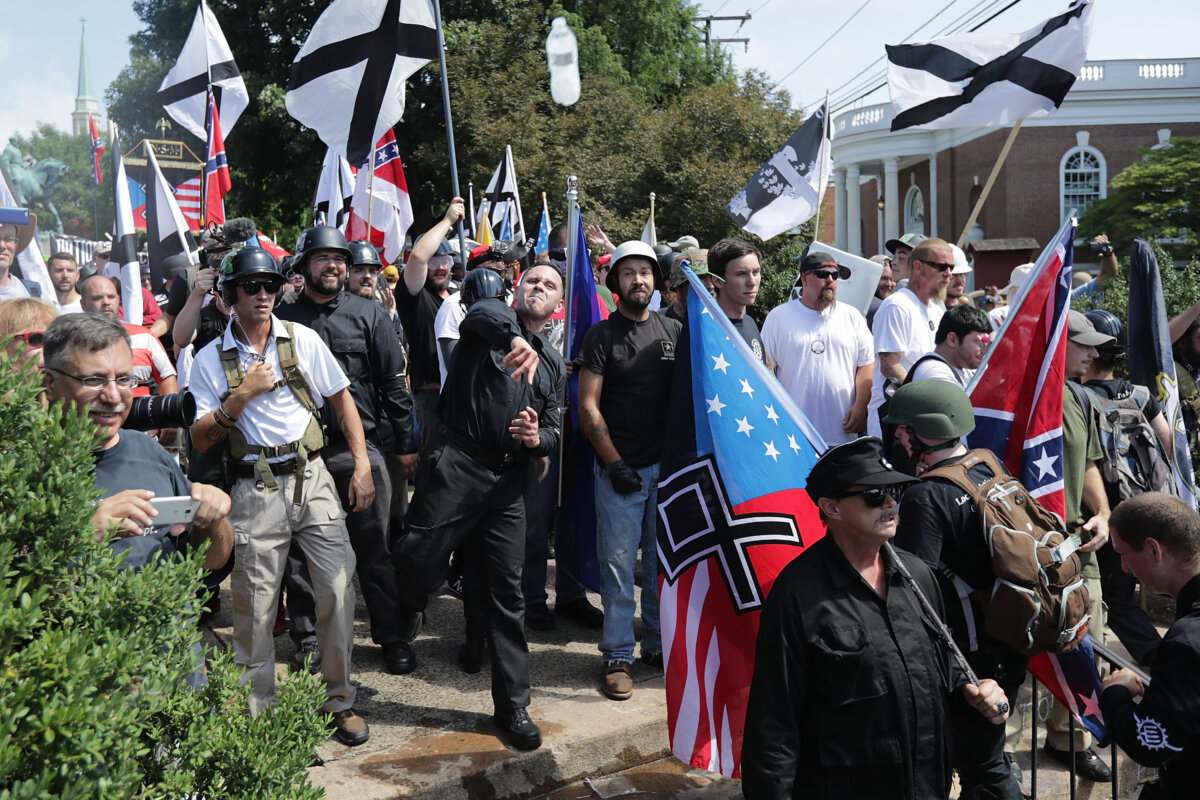
The incident was the “Unite the Right” rally in Charlottesville, Virginia, from Aug. 11 to Aug. 12, 2017. It came complete with angry young white dudes carrying tiki torches and Confederate flags, shouting slogans such as “Jews will not replace us.”
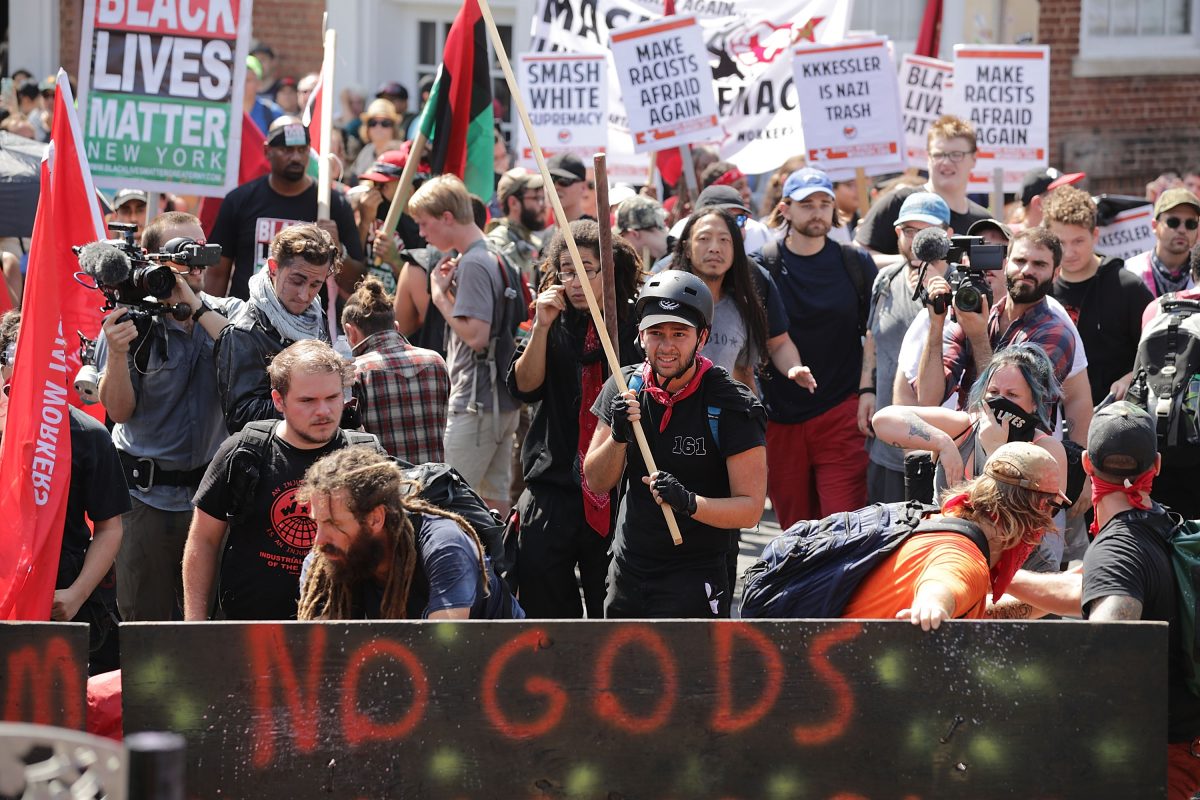
It was a ghastly scene but one that fit a narrative being constructed for public consumption, one I mostly accepted. I had spent two years working on a book on the history of collectivist thinking on the right. I began my historical reconstruction with the early writings of G.W.F. Hegel after Germany’s losses in the Napoleonic wars. The legendary philosopher cobbled together a meta-history that posited the inevitable restoration of the Prussian kingdom with church, state, and civic life united and on the march. His influence persisted, and his followers broke into left and right camps.
The left is well-examined but the right less so, and hence my book that marched through the main thinkers and ideas up to World War II. It covered the history of mercantilism, industrial policy, racial science, eugenics and segregation, anti-immigrant sentiment, authoritarian traditionalism, and the interwar strongman politics of executive power. I thought that I had it all figured out and tied up my theorizing in a pretty bow, thus providing a kind of interpretative lens through which to understand contemporary politics.
The result of my efforts was “Right-Wing Collectivism: The Other Threat to Liberty.” I was proud of this work and still believe that it contains valuable information. Just before going to print, this rally in Charlottesville took place, seeming to provide an illustration of my main points. So I led with it in the introduction. I was nowhere near cynical or incredulous enough to have imagined that this rally was not what it seemed. Some people at the time had their doubts simply because the entire episode appeared to be made for mainstream media, as much of a caricature as one can imagine.
For my part, I was inclined to believe because I wanted to do so. It provided a convenient hook for my book, so I repeated all the talking points. Later, the events of Charlottesville were recounted endlessly by Joe Biden in his campaign for president in 2020. It was also the source of the bogus claim that President Donald Trump had said there were “good people” on both sides that day without pointing out that he specifically condemned the neo-Nazis. He was instead referring to protesters who opposed the removal of a statue of Robert E. Lee.
That much I knew for sure. The incident, even if real, was being exploited in ways that were not justified by the facts. Of that I was certain. But I had not gone far enough in my thinking to imagine that the event itself was constructed theater, a bought and paid for act. As it turns out, much of it likely was nothing more than that.
The Department of Justice (DOJ) has fleshed out some important details about that rally. In a grand jury indictment (in Alabama) of the Southern Poverty Law Center, which supposedly opposes hate and raises money on that basis, the DOJ says that the organization actually paid a key organizer of the rally. It also provided transportation for people to get to the rally. This might be just the most conspicuous feature of their involvement. It was part of their business model to fund both the problem and the solution.
I had allowed myself to become the ideal target of this propaganda campaign. It was designed to make it look as if this country were facing a genuine threat from the rise of neo-Nazi and racist youth who were targeting blacks and Jews in revanchist rallies, a fable I had echoed in my book. To be sure, there were real people at that rally, sincere dudes fed up with leftist hegemony and deluded into believing that this was the way to deal with their frustrations. But how much was authentic and how much was a put-on is now wholly up for debate to be settled by empirical evidence.
For me, this illustrates the dangers of interpreting public life through a preset ideological lens. Lacking objectivity can lead even intelligent people into a situation of being trolled by elites with designs. I had ruled out the idea that this rally could have been a masquerade designed to elicit a predictable response and was therefore inclined to use it to confirm my biases. Now I see exactly what was going on and feel rather foolish for having fallen for it.
Now it is a genuine question: How much of the right-wing extremism problem is widely exaggerated for political purposes? Clearly, the demand for such groups has long exceeded the supply. Here we have a left-wing nonprofit actually shelling out millions of dollars to create the thing against which they are raising money. They claim that they are fighting the right but use donor money to subsidize and manufacture an enemy.
As Scott Adams explained, if you are paid to be a hate hunter, you are certainly going to find it. If you cannot find it, you can take the next step and fund it into existence. That might sound like conspiracy theory to people who imagine that everything you see in public life is exactly what it says it is. But if you turn up your cynicism just a notch, many things make sense that otherwise would have eluded your purview.
The DOJ has reported that the grand jury found millions of dollars in improper payments to fake hate groups, funded through shadow organizations and businesses so that the recipient could disguise the origin of the money. The funds went to the Ku Klux Klan, United Klans of America, Unite the Right, National Alliance, National Socialist Movement, Aryan Nations, National Socialist Party of America (American Nazi Party), and American Front. That’s pretty much a list of the bulk of the supposed hate movement in the United States, all allegedly funded by a nonprofit that needed an enemy.
According to the indictment, the funds came from shell organizations such as Center Investigative Agency, Fox Photography, North West Technologies, Tech Writers Group, Imagery Ink, J&J Electronics, Kelly’s Marine, and Turner Personnel. Opening up bank accounts under false names to move money under false pretense amounts to wire fraud, of course, so this will be a pillar of the prosecution. We are talking about criminal activity here.
We cannot get back the past 10 years during which time we were constantly told that the real threat in this country came from right-wing hate. And although my treatment of the topic was more scholarly and historical, I do admit that I, too, was fooled. It’s quite the bitter irony to discover that the threat you identified was in part, perhaps in large part, a fiction created by activists who needed an enemy so badly that they funded one into existence.
It’s hard to exaggerate the implications of these revelations. It forces us all to revisit our imaginings concerning the real threats to this country. As I think about it in retrospect, I really should have known better.
From my personal experience over my lifetime, living in many cities and moving in many different social environments, I’ve mostly only encountered Americans of sincere belief and peaceful intentions, never a cell of violence-prone quasi-Nazi thugs. They surely do exist, but when left-wing groups use donor money to invent and platform them, something else is going on. This is the point at which activism becomes an outright scam.
Here is to hoping that we all learn from these revelations. That includes me. I hope at some point to prepare a second edition of my book, minus the introduction and with a more careful and nuanced account of the topic I intended to cover. It’s an important one in history, but one does wonder these days just how much is real and how much is constructed political theater. The difference between the two is stark and extremely relevant.
Views expressed in this article are the opinions of the author and do not necessarily reflect the views of The Epoch Times.
 Friends Read Free
Copy
Facebook
Tweet
Friends Read Free
Copy
Facebook
Tweet