
Commentary
The Trump administration’s strike on a Venezuelan drug-running boat on Sept. 2 in Venezuelan waters didn’t happen in a vacuum. It was a calculated blow that brings huge implications for Washington’s Latin American policy, Venezuela, and China. In one act, the U.S. government’s drug war has become part of a much larger one, and the ripple effect will be massive.
In fact, the United States has deployed a group of battle vessels in the vicinity of Venezuelan waters, in case the message wasn’t clear. The status quo ante of a relatively passive United States doing little about the drug-running Venezuelan regime is over.
China’s Huge Investments in Venezuela
Venezuela is no longer just another failed socialist state that was once the richest nation in Latin America—it has become a geopolitical battleground. Under the second Trump administration, Washington has shifted from a passive to an active posture, punishing Caracas for its drug smuggling that specifically targets the U.S. population.
But that’s just the beginning.
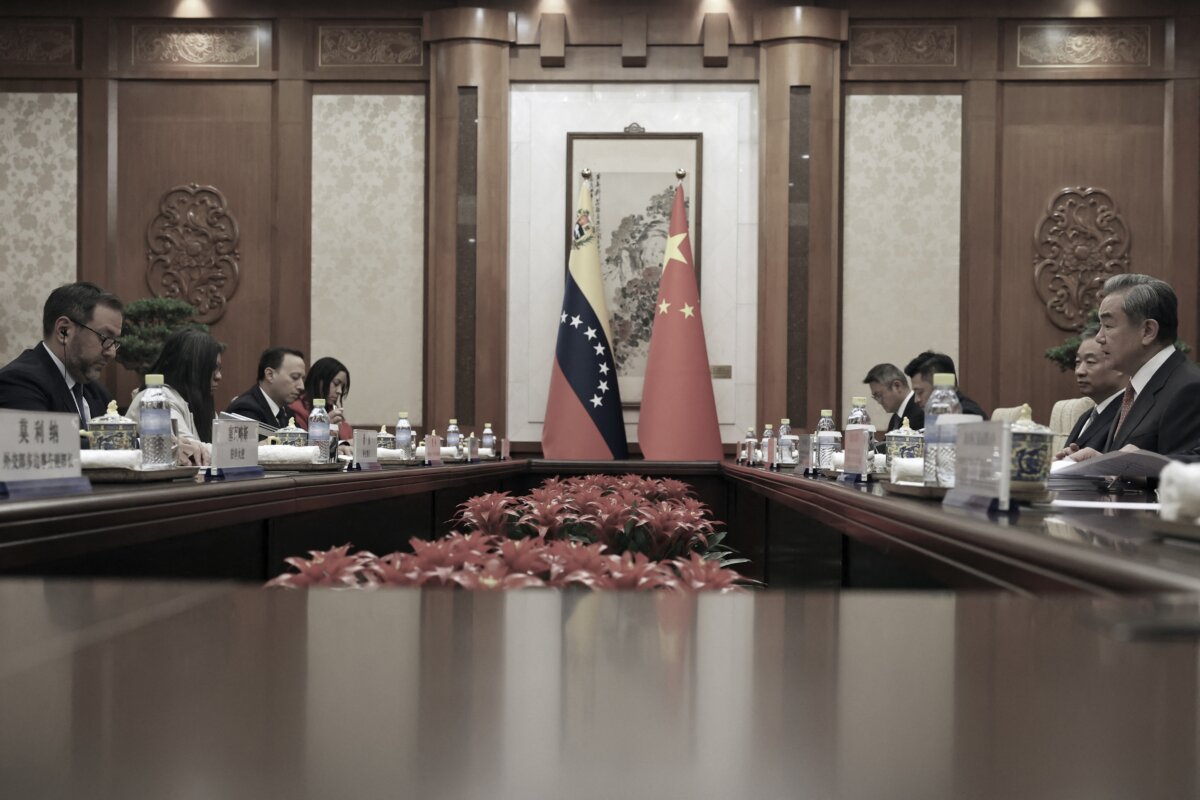
For Beijing, Venezuela is a valuable geopolitical asset. Over the past decade, China has poured billions into Venezuela’s collapsing oil sector, swapping cash and infrastructure for future crude shipments. With Venezuela holding the world’s largest proven oil reserves, the Chinese Communist Party (CCP) sees an opportunity not just for energy security, but for political influence in Latin America and a platform from which to wage various kinds of attacks against the United States.
Maduro Is China’s Proxy, Echoing Cuba’s Cold War Role
If this scenario seems familiar, it’s because Venezuelan leader Nicolás Maduro has taken a page from Fidel Castro’s Cold War playbook. Just as Cuba became Moscow’s forward base in the 1960s, Venezuela is the CCP’s proxy in the Western Hemisphere.
By aligning with China, Maduro gains economic support and international protection, while Beijing gains a foothold just south of the U.S. border. This evolving partnership mirrors the Soviet strategy of projecting influence close to America’s backyard.
CCP’s Key Role in Venezuela’s Drug Trade
As one might expect, Beijing is taking full advantage of Venezuela’s corrupt government and proximity to the United States. Reports from U.S. officials point to Chinese companies supplying precursor chemicals used to manufacture fentanyl and other synthetic drugs. That’s a direct result of the CCP’s approval.
Many of these drug precursor ingredients are funneled through Venezuela, where local cartels process and re-export narcotics northward. This shadow trade has become a growing flashpoint between the United States and China, with Washington accusing Beijing of enabling the flow of lethal drugs into American communities via Venezuela’s porous ports. Of course, Beijing denies any such involvement.
US Strike on Narco-Boat Linked to Tren de Agua Gang
In the wake of destroying a Venezuelan drug-smuggling vessel operated by the Tren de Agua gang, U.S. forces seized large shipments of narcotics destined for the American market. The operation was described as a direct warning to Maduro’s regime, signaling that Washington would not tolerate Venezuela’s deepening role in the hemispheric drug war.
The dramatic attack on the drug boat that made world news underscores the rising stakes of Venezuela’s transformation into a narco-terrorist state aligned with the Chinese regime.
CCP Backing Venezuelan Gangs
With the criminal regime in Caracas and Chinese financial support, Venezuelan gangs now have smuggling and other criminal operations into Colombia, Central America, and even across the U.S. southern border.
U.S. law enforcement agencies have determined that these groups are fueling spikes in violent crime, human trafficking, and migrant smuggling in cities across the United States. Put another way, the CCP is waging war against the United States by threatening domestic stability and American lives through its Venezuelan proxy.
Venezuela’s Hopes to Join BRICS Supported by China
What’s more, under China’s sponsorship, Venezuela is seeking to join the BRICS, although Brazil recently blocked its membership bid. Nonetheless, Venezuela’s alliance with China further positions it to continue posing a regional challenge to the United States. This makes Caracas more than a nation of gangs, drugs, and human trafficking.
Should Venezuela formally join BRICS, it would become an added adversary of the U.S.-run global financial system, placing it in the geopolitical threat category with regard to U.S. power and influence, both regionally and globally.
By drawing Caracas into the BRICS camp, Beijing (along with Russia, Turkey, and others) not only props up Maduro’s regime but also strengthens a counterweight to U.S. influence in the hemisphere. Analysts argue this is part of a broader CCP strategy to distract Washington from Asia by igniting instability in its backyard. This potent Latin American proxy front allows China to pressure the United States on two continents at once.
A New Cold War in the Americas
Venezuela is no longer simply an economic and humanitarian tragedy—it’s a frontline in the U.S.–China geopolitical rivalry. By bankrolling Maduro’s regime, supplying precursor chemicals, and possibly adding Caracas to BRICS, Beijing could establish a multi-faceted proxy presence in the Western Hemisphere. The U.S. response—ranging from maritime drug busts to renewed sanctions—signals just how serious Washington views the threat.
Just as Cuba once served as Moscow’s Caribbean pawn, Venezuela is Beijing’s beachhead in the United States’ backyard, ensuring that a potential U.S.–China conflict may be fought not in the South China Sea, but just south of Miami as well.
Correction: A previous version of this article gave an incorrect time frame for the first U.S. strike on a Venezuelan drug-trafficking boat. The Epoch Times regrets the error.
Views expressed in this article are the opinions of the author and do not necessarily reflect the views of The Epoch Times.
 Friends Read Free
Copy
Facebook
Tweet
Friends Read Free
Copy
Facebook
Tweet