Commentary
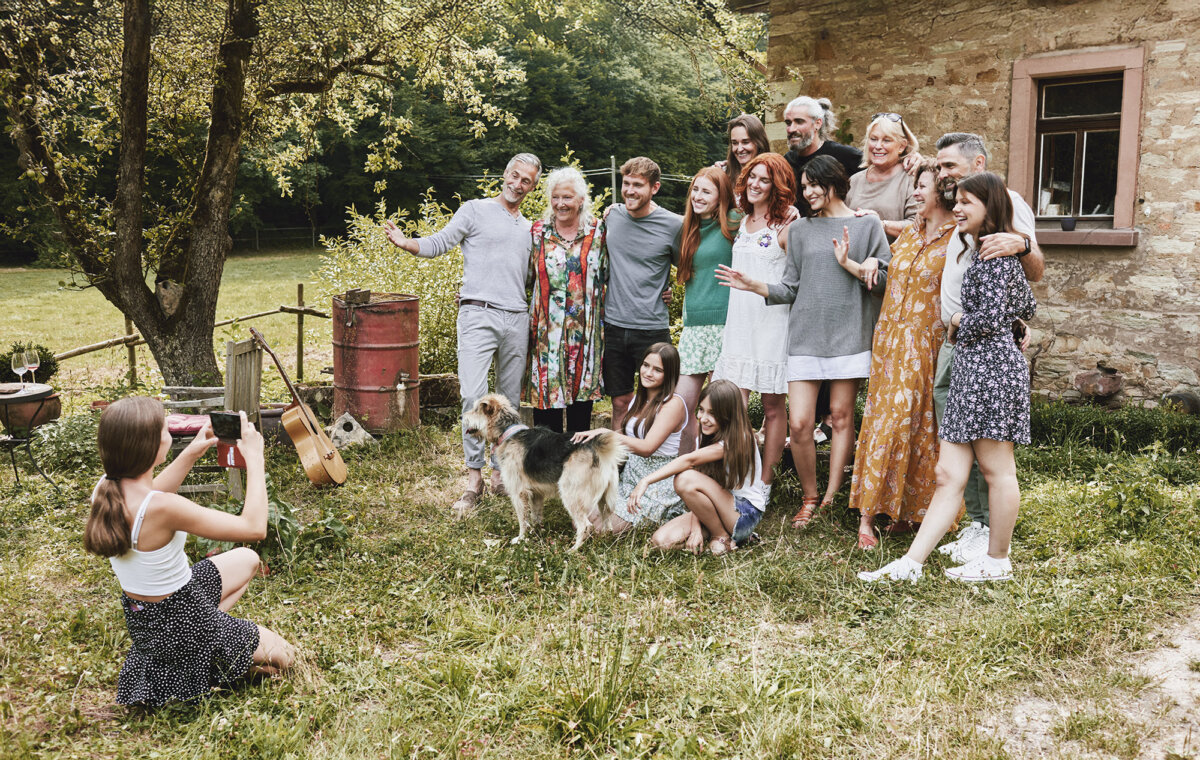
I live on land with my husband, my brother, and his wife and their children, alongside my brother-in-law, my husband’s cousin, and my uncle—my father’s brother. We are all building something together, with a steady rhythm of people coming and going through this place we’re creating. The kids run wild together, like a feral pack, free in a way that feels increasingly rare, and the days carry a sense of shared purpose that is hard to replicate in a more fragmented life.
It’s a good life, but lately I’ve felt what’s missing: the older generation.
My mother is here right now, visiting from Hawaii for three weeks leading up to our two biggest events of the year, Confluence and American Regeneration. My hand is broken, and I’ve been limited in what I can do—caring for my children, keeping up with the daily rhythms of the ranch, or preparing for what’s ahead. Her presence has changed everything. She steps in without being asked, notices what I don’t, and brings a steadiness that comes only with time. She organizes, feeds, plays, and holds space in a way that reshapes the entire environment. She becomes another layer of care for my children, another set of hands when one of mine is out of commission, and another person deeply invested in what we are building here.
Her being here has made me wonder why more families don’t live this way. I’ve tried to convince both of my parents to move to Texas, explaining that most people never get the chance to live on land with all six of their grandchildren. But my mother loves Hawaii, and my father loves Idaho. This version of multigenerational living may not be mine to fully realize, at least not in this season.
That doesn’t mean that it’s lost. It may simply not be for this generation.
We often choose to do life alone without questioning the structure. Children leave home, and instead of expanding what already exists, we duplicate everything—mortgages, rent, utilities, child care, and time. From a purely economic standpoint, it makes little sense. Consider what happens when a family lives separately. Three households mean three mortgages or rents, three internet bills, three sets of utilities, three refrigerators to fill, and often three separate child care arrangements. Now compare that to one piece of land, one larger home or a cluster of homes, shared utilities, shared food, and built-in child care. The difference is not marginal. It is the difference between surviving month to month and building something that lasts.
Even living with multiple families from the same generation begins to restore some of what we’ve lost. On our land, having my husband, my brother, and my brother-in-law means that there are always hands when something needs to be built, fixed, or carried. The kids move freely between my home and my sister-in-law’s, forming bonds that feel more like those of siblings than cousins. My brother is detail-oriented and strong in relationships, while I tend to think in broad strokes and long arcs. Together, we balance each other in a way that makes both the family and the work stronger.
We are not without an older generation entirely. My uncle lives on the land with us, and I have lived alongside him for most of my life, as he was married to my mother’s identical twin. When your mother is a twin and they marry brothers, you grow up feeling like you have four parents. I often think about the benefit of having my uncle here, as well as the benefit to him at this stage of life. He couldn’t farm alone anymore, but he wouldn’t want a sedentary life. He needs purpose. He needs to get on the tractor. He handles the pigs, and that is his domain.
At his age, he is not as flexible, and we give him the space to do things his way. He can be set in his routines, but there is a rhythm to it that works. He has his own small house where he can retreat, and he steps into the larger family when he wants connection, conversation, or simply to be part of something. It is a balance between independence and belonging, and it is one that many people quietly long for.
For most of human history, multigenerational living was the norm. In the United States, that began to shift after World War II, as prosperity and cultural ideals around independence reshaped how families lived. By the late 20th century, only a small percentage of Americans lived in multigenerational households. Today, that number is rising again, with roughly one in five Americans living in some form of a multigenerational home. Although the reasons are often economic—housing costs, child care, and elder care—the benefits extend far beyond necessity.
There are also cultural patterns that have remained intact. Multigenerational living is far more common among Hispanic, Asian, and immigrant families, where it is often viewed not as a fallback, but as a foundational value. In those households, family is not something you move away from; it is something you organize your life around.
When a family shares not just a home, but a business or a purpose, something more powerful begins to form. The older generation brings wisdom, experience, and often financial stability. They have lived long enough to recognize patterns, to see cycles, and to guide decisions with perspective rather than urgency. The younger generation brings energy, labor, and innovation. They are willing to take risks, build, and push forward. Together, they create something far more resilient than either could alone.
They also create something less tangible but just as important: a sense of belonging.
I saw this firsthand once. I dated a man in his 30s who ran a construction company with his father, and their entire family lived together across three generations. Their lives were deeply intertwined, not just at home but in their work. His mother handled billing and invoices. His sisters coordinated with subcontractors and cleaned job sites after the work was done. If there was a problem on a project, the whole family showed up to solve it.
That same instinct extended beyond their own business. When I was dating their son, I had a pipe break in my restaurant. Without hesitation, their entire family came to help. Eight people showed up to clean, fix, and restore, regardless of what else they had going on that day. I remember standing there, overwhelmed not just by the help itself, but by what it represented. I felt taken care of, supported, and part of something larger than myself.
There is something powerful about three generations living together and building something side by side. It changes how problems are solved, how work is distributed, and how people experience both hardship and success.
That kind of life reshapes what wealth looks like. It is not just money in an account or a house passed down at the end of a life. It is wisdom transferred in real time, children raised with multiple adults guiding them, and work that is shared rather than carried alone. It creates continuity, not just inheritance.
I would rather give my children something to step into than something to spend.
Yesterday, my mother organized the kitchen, juiced lemons for the upcoming event, played with the kids, and kept them up later than I would have. She noticed details I missed and brought a presence that steadied the entire household. My father and stepmother will be here next week for the festival, and I am grateful for that as well. Even in short windows of time, the presence of the older generation changes the texture of daily life.
I am grateful for the relationship I have with my parents, even if it does not look the way I once imagined. I may not be building the full picture right now, but I am laying the foundation.
A piece of land, a shared life, and a way of being that pushes against the idea that we are meant to do everything alone.
Maybe my children will be the ones who choose it fully. Maybe they will be the generation that comes back together, not out of necessity, but out of wisdom. If that is true, then this is not something I have missed. It is something I have started.
Views expressed in this article are the opinions of the author and do not necessarily reflect the views of The Epoch Times.
 Friends Read Free
Copy
Facebook
Tweet
Friends Read Free
Copy
Facebook
Tweet