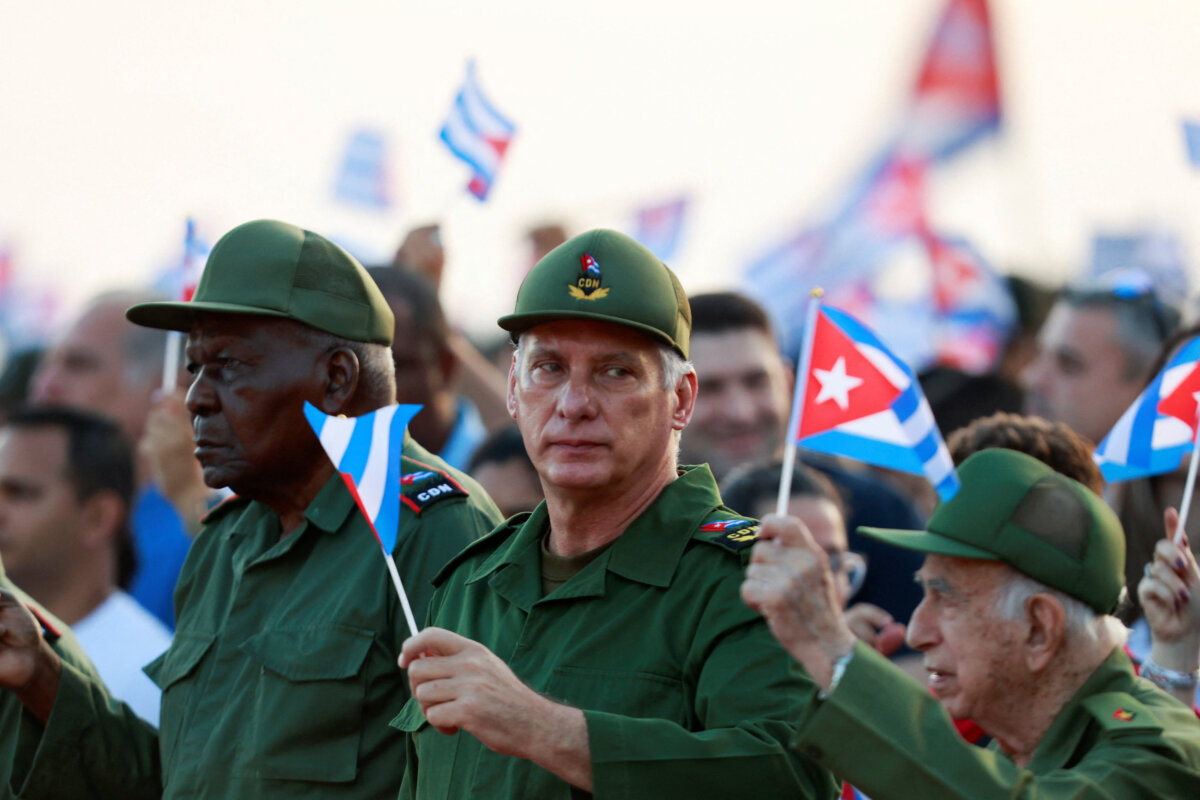

The State Department released a report on July 20 accusing Cuba of supporting left-wing groups in the United States and infiltrating the highest levels of the government.
The report states that the Cuban regime has conducted a “sustained campaign of subversion” against the United States for almost 70 years. The State Department released the report just days after U.S. Secretary of State Marco Rubio called for world leaders to take the threat of violent far-left groups seriously.
The State Department linked left-wing organizations such as Antifa, Code Pink, Communist Party USA, Democratic Socialists of America, the National Network on Cuba, and the National Lawyers Guild to the Cuban regime and detailed a plan certain left-wing organizations had for mobilizing in the event of U.S. military action against Cuba.
Antifa is a far-left extremist group that originated under the Soviet Union and functioned as the violent wing of Germany’s Communist Party to target political rivals.
Addressing Cuba’s efforts to engage in espionage and influence ideological movements in the United States, the State Department said, “It is a campaign that has infiltrated the highest reaches of the U.S. government, recruited and cultivated generations of American activists, backed an unprecedented wave of left-wing terrorism on American soil, and carried out one of the most durable and damaging foreign intelligence penetrations in American history.”
Infiltration and Espionage
The report describes Cuba’s strategy against the United States as unique due to the “irregular and covert” operations of the regime. The State Department accused Cuba of perfecting an approach involving a war of attrition based on infiltration, espionage, sabotage, proxy networks, and a revolutionary infrastructure intended to “turn America against itself.”
The State Department said Cuban agents infiltrated the top levels of the Pentagon, the State Department, and the National Security Council and operated undercover without being detected for decades. However, the State Department said that the most successful sphere of Cuba’s campaign against the United States has been ideological.
The report describes Cuba’s main foreign intelligence agency, the Dirección de Inteligencia, as one of the most effective human intelligence operations in the world and states that the agency shares sensitive information about the United States with China, Russia, North Korea, and Iran. It warns that Cuba’s spies previously gained access to the government’s most sensitive top secret materials.
Global Network
The report states that Cuba recruited, cultivated, and mobilized a global coalition of political groups, activists, and intellectuals. The coalition developed into a widespread revolutionary network that helped shape several extremist movements, including the Black Panthers, the Weather Underground, and Antifa, the State Department said.
The State Department’s report accuses Cuba of actively facilitating the rise of “far-left terror” in the United States in the second half of the 20th century. It also states that Cuba’s revolutionary network continues to have ties to socialist groups, anti-Immigration and Customs Enforcement groups, left-wing nonprofit groups, and Marxist militant groups in the United States.
The report alleges that Cuba has played a central role in “shaping America’s radical left” since the 1960s by infiltrating American universities, inspiring American activists, and using its espionage and influence networks.
Ideological Movements
Cuba was also linked to the development of left-wing ideologies, such as black power, in the report. The State Department said the Cuban regime attempted to frame Cubans and African Americans as groups oppressed by “white America,” leading to a “racial revolution,” which it said has expanded since the 1960s.
“What began in the mid-1960s as the language of a militant vanguard has since migrated into the nation’s premier activist organizations, university departments, nonprofit networks, government agencies, public-health bureaucracies, and mainstream political culture,” the State Department said.
It said the Cuban regime used its resources to sustain and expand various ideological and intelligence front groups that target the United States. It warned that the groups have played a key role in developing, training, and supporting left-wing activists, assets, and domestic terrorists in the United States.
The report also links recent ideological movements, including the rise of Antifa, the George Floyd riots, and the increase of left-wing activism at college campuses to Cuban influence.
The National Network on Cuba, a coalition of more than 60 American groups, including Code Pink, Communist Party USA, Democratic Socialists of America, and National Lawyers Guild, was identified by the State Department as a key connection between left-wing activists in the United States and the Cuban regime.
The State Department said the National Network on Cuba repeatedly coordinated U.S. delegations to Cuba and hosted conferences that featured strategies for the expansion of Cuba’s influence networks in the United States.
The State Department also referenced the National Network on Cuba’s National Rapid Response Plan that was released in June. The plan outlines a strategy to launch “coordinated nationwide actions” against U.S. military bases, Immigration and Customs Enforcement detention centers and field offices, and federal institutions within 24 hours of U.S. military action or the threat of military action against Cuba.
Previous Developments
On July 16, the State Department hosted a conference that addressed terrorism threats. Rubio told attendees from more than 60 nations that threats from violent left-wing organizations pose an international threat and urged governments to work together to address the threat.
“We will either cooperate across our borders, or the terrorists will continue to exploit the gaps between them,” Rubio said.
Rubio also tied the rise of violent left-wing organizations in the United States to Cuba.
“The Cuban regime’s sprawling intelligence and ideological network helped to build the far left in our country and in our hemisphere and it remains inextricably linked to the far-left groups and movements across and beyond the West,” he said.
In March, U.S. President Donald Trump floated the possibility of a U.S. takeover of Cuba. At the time, Trump said Rubio was handling the issue and said there could be a friendly or unfriendly takeover.
On July 13, the State Department announced new sanctions against 10 entities tied to the Cuban regime’s funding sources and its actions in targeting its own people.
The Cuban Embassy in Washington, Code Pink, Communist Party USA, Democratic Socialists of America, the National Network on Cuba, and the National Lawyers Guild did not respond to requests for comment.
 Friends Read Free
Copy
Facebook
Tweet
Friends Read Free
Copy
Facebook
Tweet