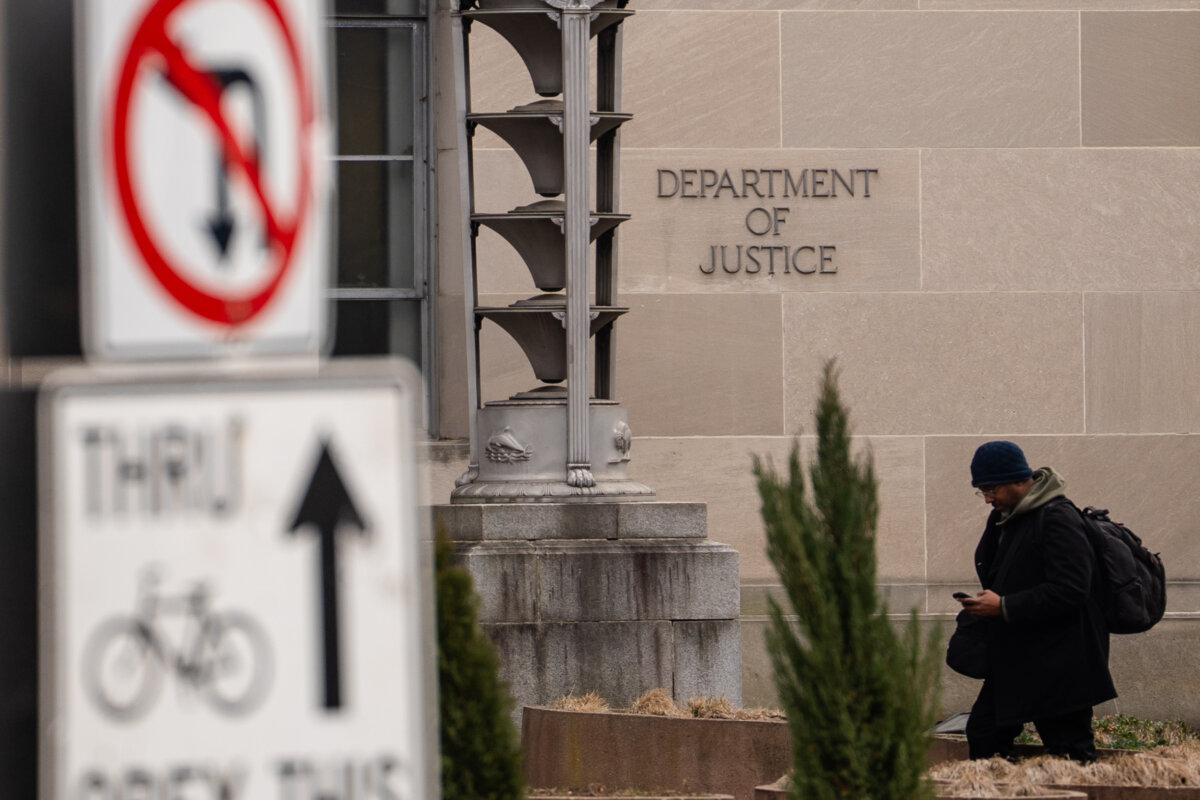

A federal judge barred three lawyers chosen by the Trump administration to run the U.S. Attorney’s Office for the District of New Jersey, determining that their selection is in violation of federal law and the Constitution by assigning a stand-in prosecutor without Senate approval.
In a 130-page opinion issued Monday, U.S. District Judge Matthew W. Brann ruled that the “triumvirate” arrangement, which splits leadership between Philip Lamparello, Jordan Fox, and Ari Fontecchio, goes beyond the attorney general’s authority and sidesteps the Federal Vacancies Reform Act.
“One year into this administration, it is plain that President [Donald] Trump and his top aides have chafed at the limits on their power set forth by law and the Constitution,” Brann wrote. “To avoid these roadblocks, this administration frequently purports to have discovered enormous grants of executive power hidden in the vagaries and silences of the code.”
Brann determined that the arrangement empowers the executive branch to single-handedly fill an important role requiring presidential nomination and Senate confirmation.
“I conclude that the current leadership structure for the Office of the United States Attorney for the District of New Jersey exceeds the Attorney General’s statutory authority to appoint inferior officers and delegate them powers and therefore constitutes a unilateral appointment in violation of the Appointments Clause,” he stated.
Brann stated that a persistence in unlawful leadership could result in dismissed cases, leading to the release of “scores of dangerous criminals,” while underscoring that the administration has legal routes it has so far ignored.
Attorney General Pamela Bondi appointed the three lawyers on Dec. 8, 2025, after Alina Habba resigned as acting U.S. attorney. A federal appeals court had already disqualified Habba, ruling she was serving in the position in an unlawful capacity. The Third Circuit Court of Appeals supported that decision and later chose not to reconsider it.
The Justice Department had requested the appeals court to reconsider Habba’s disqualification, submitting that it disrupted federal cases.
Brann noted similar disqualifications in other districts, such as Nevada, where a judge disqualified a U.S. attorney from several cases for similar reasons.
Habba, presently a senior advisor to Bondi, criticized Brann’s ruling on social media.
“Another ridiculous ruling from Judge Brann disqualifying three individuals serving New Jersey’s DOJ front office of the U.S. Attorney,” she wrote on X. “Judges may continue to try and stop President Trump from carrying out what the American people voted for, but we will not be deterred. The unconstitutionality of this complete overreach into the Executive Branch, time and time again, will not succeed. They would rather have no U.S. Attorney than safety for the people of NJ. Judges do not fire DOJ officials, AG Pam Bondi and POTUS do—get in line.”
Brann dismissed government arguments that the delegation assigns the attorney general’s own powers, saying it was nothing more than a rhetorical smokescreen.
The office has been vacant without a Senate-confirmed nominee since the administration took office in January 2025.
Brann stated that the separation of powers ensures adherence to statutory limits, citing prior Supreme Court rulings to underscore that “friction between the branches is an inevitable consequence of our Constitutional structure.”
A number of the Justice Department choices have been rejected by the courts, including a Virginia judge questioning another appointee’s use of the U.S. attorney title. In New York, a judge precluded a DOJ attorney investigating the state attorney general, Letitia James.
In Los Angeles, defense lawyers have also sought to remove a senior federal prosecutor for comparable reasons.
 Friends Read Free
Copy
Facebook
Tweet
Friends Read Free
Copy
Facebook
Tweet