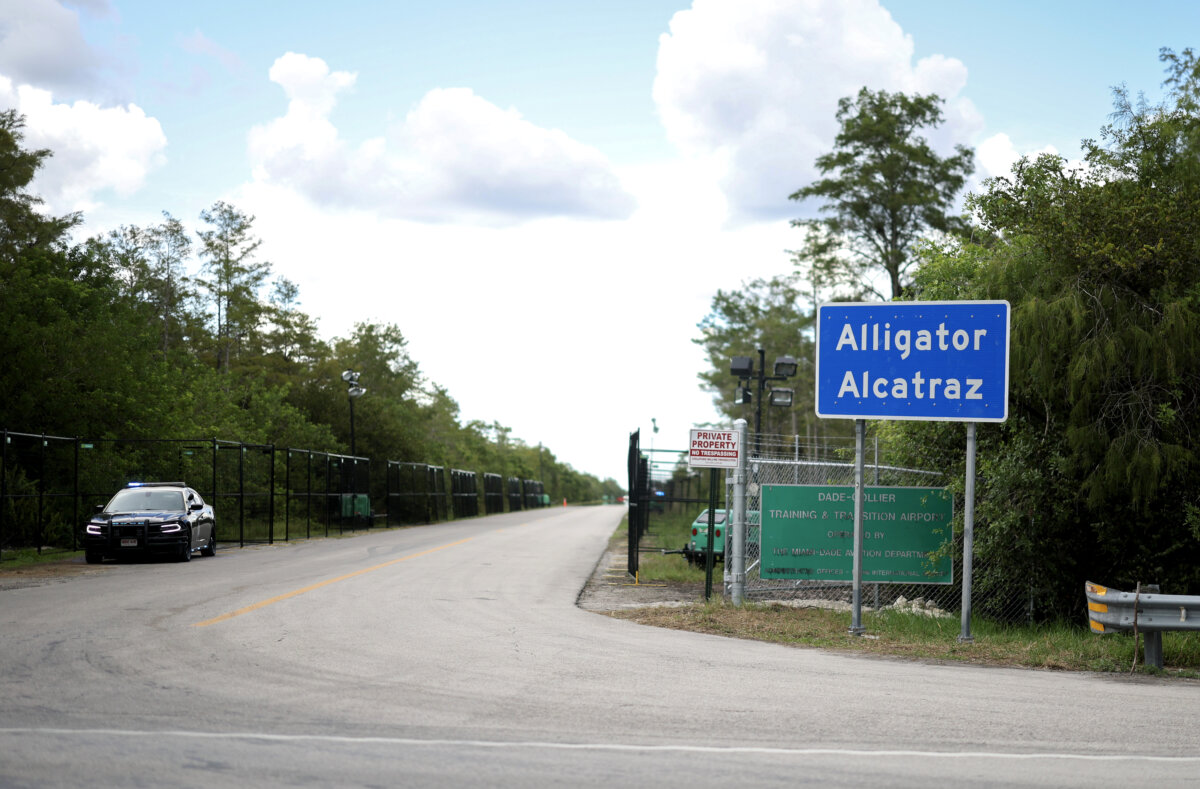

District Judge Rodolfo Ruiz of the U.S. District Court for the Southern District of Florida heard arguments on Aug. 18 in a suit brought on behalf of detainees at the Florida detention center known as Alligator Alcatraz.
The suit, filed by the American Civil Liberties Union, accused the government of violating the detainees’ First Amendment rights by denying them access to attorneys and by not giving them privacy to discuss their cases.
They also said officers were going from cell to cell, pressuring detainees to sign voluntary deportation orders.
The government challenged those claims and said the facilities, which are still being built on an airfield surrounded by the Everglades, have been updated to allow lawyers to meet with detainees in conference rooms. It stated that the attorneys’ documents are examined for contraband but not read.
An attorney for the government also said the First Amendment claims are just a ruse because the plaintiffs want Alligator Alcatraz shut down. He said the plaintiffs are trying to “fragment, to prolong, [and] to block” the administration’s work deporting illegal immigrants.
This is the second lawsuit brought against Alligator Alcatraz, which began operations in July.
The previous suit, brought in June before the facility officially opened, alleges that it was erected without proper environmental impact studies. The judge in that case ordered a 14-day pause in the facility’s construction.
Although Ruiz did not immediately issue a ruling, the court was able to resolve one aspect of the case on Aug. 18.
The plaintiffs previously said the government had not designated an immigration court to hear cases for the detainees, a violation of their Fifth Amendment due process rights.
Attorneys for the government told the court that over the weekend that the Miami Krome North Service Processing Center had been assigned jurisdiction to hear these cases.
The judge suggested that this made the Fifth Amendment claims irrelevant for the time being, although he asked the government for assurances that it would not create confusion by switching courts.
Ruiz said his main concern is that the case might have been brought in the wrong district. The charges against the federal government were appropriate in Florida’s Southern District, where he presides, but he said the charges against the state might be heard in Florida’s Middle District, where Alligator Alcatraz is located.
Ruiz said he would deliberate and that, if he decided that his district was not the right one, he would transfer both the state and federal suits to the Middle District.
Attorneys for the plaintiffs had previously asked Ruiz to issue broad directives about the governance of Alligator Alcatraz to ensure their clients’ rights, but the judge said he was unwilling to do that.
 Friends Read Free
Copy
Facebook
Tweet
Friends Read Free
Copy
Facebook
Tweet